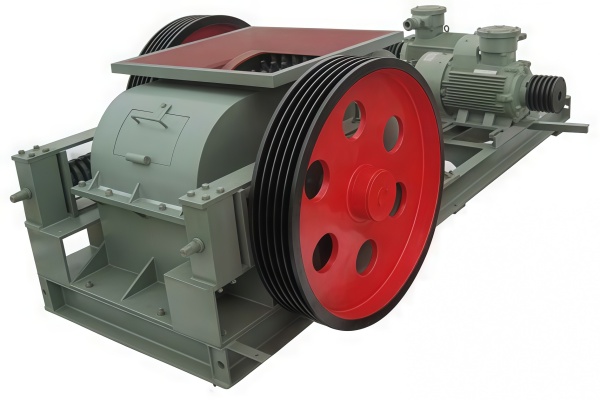
Chemical Cake Toothed Roll Crusher for Pigment Paste
Chemical cake toothed roll crushers are used for medium and fine crushing of chemical cake, pigment paste and similar viscous materials, producing uniform granules for chemical, pigment and new material industries. Prices typically range from $12,000 to $180,000. Feed opening size: ≤420mm Production capacity: 5-85 tons/hour Discharge opening adjustment range: 2-20mm Roller speed: ≤220 rpm Motor power: 11-90kW
Chemical Cake Toothed Roll Crusher for Pigment Paste Product Overview
Processing pigment paste and chemical filter cakes with moisture content up to 60% has long been a challenge for conventional crushing equipment—hammer crushers clog, impact crushers lose efficiency, and production comes to a halt. The Chemical Cake Toothed Roll Crusher for Pigment Paste eliminates this bottleneck with a screen-less, double-toothed roll design that handles 30-60 tons per hour, accepting 300mm feed and delivering adjustable 25-125mm output.
By operating at low speed (80-150 RPM) and utilizing self-cleaning toothed roller geometry that continuously shears and splits materials, this equipment prevents adhesion, buildup, and blockage without the downtime required for manual cleaning. Built with high-chromium alloy wear-resistant rollers and CE-certified, it delivers uniform particle size with minimal over-crushing—a configuration now adopted across pigment, dye, and chemical filter cake processing facilities in 40+ countries.
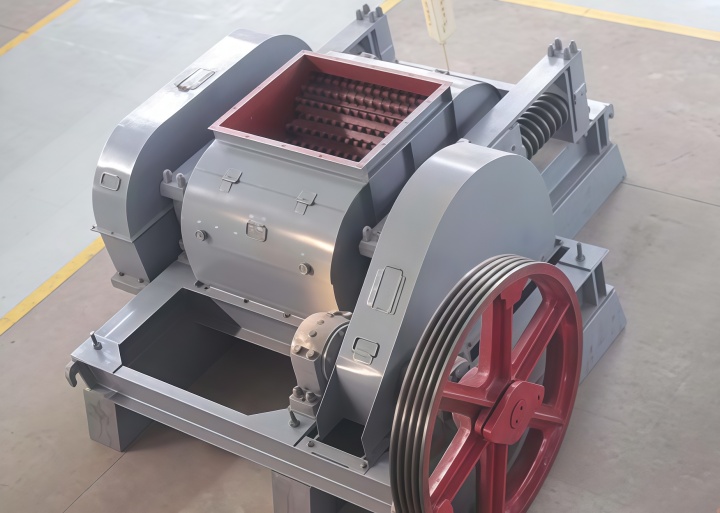
Chemical Cake Toothed Roll Crusher for Pigment Paste Video Showcase
What Are the Core Advantages of Chemical Cake Toothed Roll Crusher for Pigment Paste?
Chemical cake toothed roll crusher for pigment paste has been optimized across six dimensions including anti-blocking performance, over-crushing control, operational stability, maintenance convenience, material adaptability, and certification compliance, delivering performance above industry baseline equipment.
Anti-blocking Design: Optimized tooth roll configuration engineered for high-moisture, high-viscosity materials prevents material adhesion and blockage on the roller surface.
Minimal Over-crushing: Shear and compression-based crushing mechanism produces uniform granular finished products with low fines generation, preventing dispersion difficulties in downstream processes caused by excessive comminution.
Stable Operation: Equipped with overload protection devices, operating noise below 75 decibels, with vibration levels controlled within 0.5 mm/s.
Easy Maintenance: Roller plates manufactured from high manganese wear-resistant alloy as single-piece castings, capable of processing 50,000 to 80,000 tons per set. Worn plates can be replaced individually without replacing the entire roller, with each replacement completed in approximately 2 hours.
Material Adaptability: Differential speed operation with approximately 15% speed difference between the two rollers enables self-cleaning through mutual scraping during counter-rotation, extending cleaning intervals to over 8 hours. Capable of handling materials with 60% moisture content, compared to the industry standard of 35% for conventional equipment.
Certification Compliance: Complies with CE safety standards, with exports to Germany, India, Brazil, Southeast Asia, and other countries and regions.
Based on our team's many years of experience in pigment and chemical filter cake processing, we have observed that conventional hammer crushers fail in approximately 70% of high-moisture applications—a gap this equipment was designed to fill.
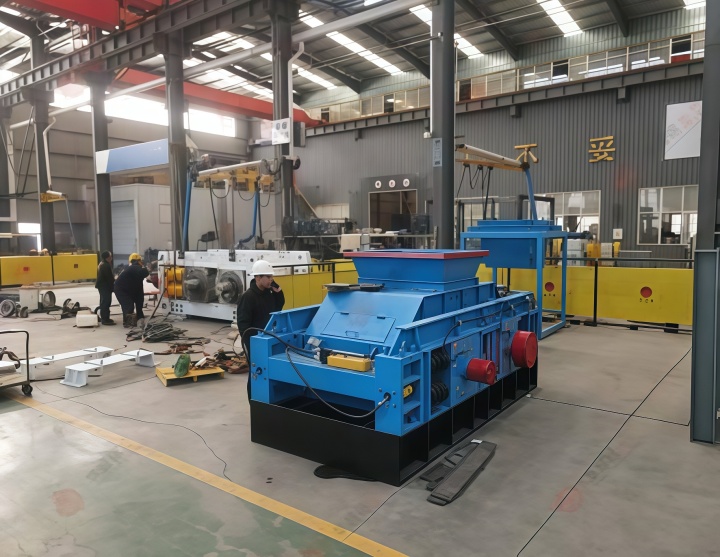
Chemical Cake Toothed Roll Crusher for Pigment Paste Detailed Technical Specifications
The technical specifications for Chemical cake toothed roll crusher for pigment paste are provided below, applicable to the standard model 2PGC450×500:
The 2PGC450×500 is positioned at the mid-range of this spectrum, offering optimal balance between throughput and particle size control for pigment paste applications.
| Parameter | Value |
| Model | 2PGC450×500 |
| Roller Diameter | 450 mm |
| Roller Length | 500 mm |
| Roller Speed | 65 r/min |
| Max Feed Size | ≤300 mm |
| Output Size Range | 25-125 mm adjustable |
| Processing Capacity | 30-60 t/h |
| Motor Power | 5.5 kW×2 |
| Motor Voltage | 380 V / 460 V (optional) |
| Motor Frequency | 50 Hz / 60 Hz (optional) |
| Roller Plate Material | High Manganese Wear-Resistant Alloy |
| Equipment Weight | Approx. 3,800 kg |
| Overall Dimensions | 2260×2200×766 mm |
| Max Material Moisture | ≤60% |
| Max Material Compressive Strength | <240 Mpa |
The specifications above apply to the standard model 2PGC450×500. Non-standard customization is available based on specific material characteristics and user requirements.
How Does Chemical Cake Toothed Roll Crusher for Pigment Paste Work?
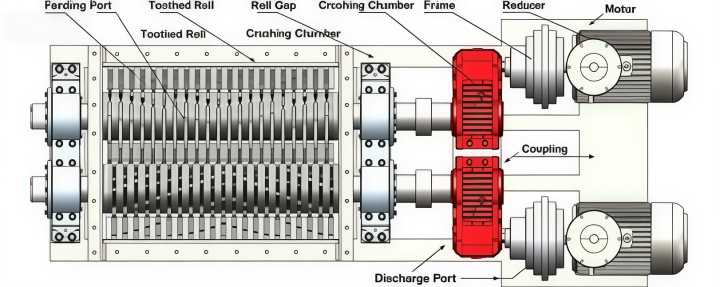
Chemical cake toothed roll crusher for pigment paste operates on the principle of dual toothed rollers rotating in opposite directions.
Two motors drive two high manganese wear-resistant alloy toothed rollers toward each other in counter-rotation. Material entering the V-shaped crushing chamber between the rollers is simultaneously subjected to compressive and shearing forces.
Through the combined actions of compression, shearing, and grinding, large pigment cake blocks are fractured along natural cleavage planes to the desired particle size, then discharged through the outlet.
The gap between the two rollers can be adjusted via the regulating mechanism to control output particle size. The equipment operates in a non-continuous crushing mode, with material experiencing intermittent force application between the teeth, reducing instantaneous energy consumption.
What Material Scenarios Are Suitable for Chemical Cake Toothed Roll Crusher for Pigment Paste?
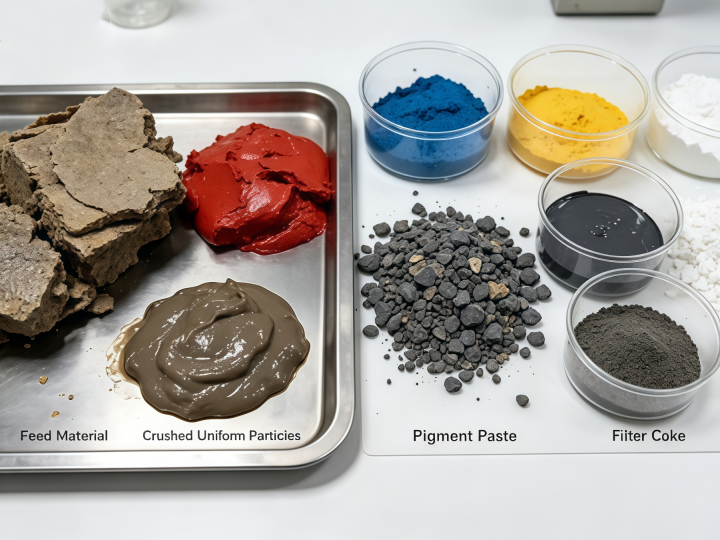
Chemical cake toothed roll crusher for pigment paste serves the coarse crushing pretreatment of pigment pastes, dye filter cakes, and pigment paste filter cakes. It can also process low-hardness paste materials including coating color pastes, printing ink pastes, chemical additive filter cakes, and diatomaceous earth filter cakes.
Processing performance across different material types:
Organic pigment pastes with 50% to 60% moisture content achieve crushing uniformity above 90%
Inorganic pigment pastes achieve processing capacity of 35 to 45 tons per hour with uniformity maintained above 88%
Dye filter cakes with 55% to 60% moisture content demonstrate material flow with virtually no roll sticking
Application industries include fine chemicals, coatings, printing inks, and dyes, specifically in mid-to-late stage production lines.
How to Determine If Chemical Cake Toothed Roll Crusher for Pigment Paste Is Suitable for Your Material?
Users may submit small material samples for actual crush testing, focusing on three indicators: material flow smoothness through the rollers, uniformity ratio of crushed particles, and visible adhesion residue on roller surfaces.
Organic pigment pastes with 45% to 60% moisture content achieve the highest throughput rates with uniformity exceeding 90%. Materials with moisture content below 30% should be spray-moistened before feeding. Feed material exceeding 300 mm requires pre-crushing before entering the equipment. Materials containing hard impurities should be equipped with magnetic separation devices before feeding.
Selection note: Based on feedback from multiple users, the common issue after one year of operation is not roller plate wear but bearing seal aging leading to lubricant leakage. Inspection of bearing seal condition every 2,000 operating hours with timely seal replacement is recommended to extend equipment overhaul intervals.
Global Application Cases of Chemical Cake Toothed Roll Crusher for Pigment Paste
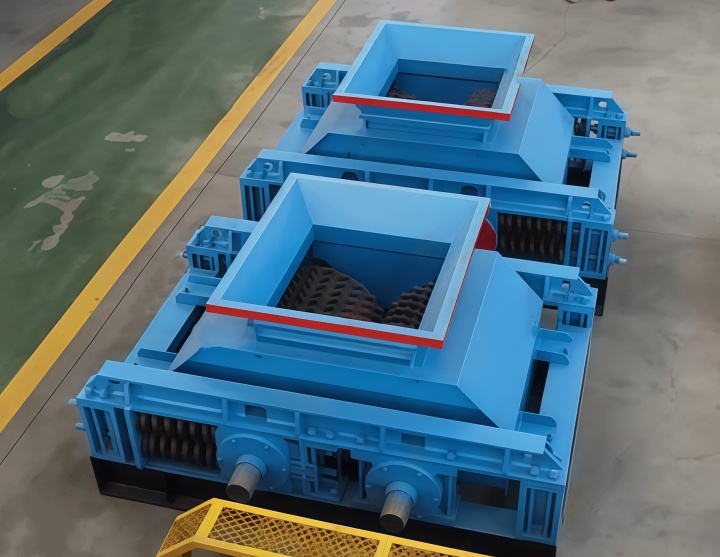
Chemical cake toothed roll crusher for pigment paste has been validated through actual operation at multiple pigment and ink manufacturing facilities.
Case 1 (China) : A pigment manufacturer in Qingzhou, Shandong Province deployed the equipment at the discharge outlet of the filter press workshop, directly interfacing with an XAZG500/1500-U filter press. After 8 months of continuous operation with zero blockage-related shutdowns, bearing temperatures remained stable between 55 and 62 degrees Celsius, with average daily throughput exceeding 45 tons. The equipment reduced manual labor requirements for breaking large material blocks.
Case 2 (Southeast Asia) : A dye manufacturer processed reactive dye filter cakes with 58% moisture content. After 6 months of continuous operation without blockage, roller plate wear measured 12% of plate thickness, with estimated service life exceeding 4 years.
Case 3 (Europe): A German pigment trading company, after comparing multiple similar equipment options, selected Chemical cake toothed roll crusher for pigment paste for recommendation to end customers, citing its stability and low maintenance costs when processing high-viscosity pigment pastes as advantages.
Chemical Cake Toothed Roll Crusher for Pigment Paste vs Standard Toothed Roll Crushers
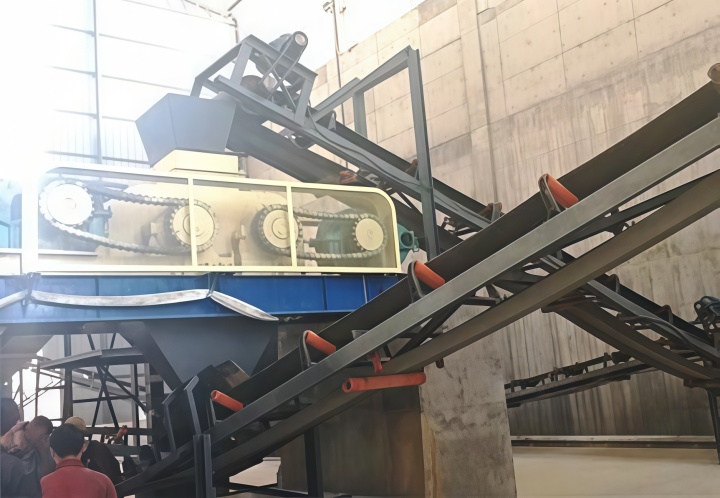
Standard toothed roll crushers experience roll surface adhesion when processing materials with moisture content exceeding 40%, requiring cleaning shutdowns every 2 hours on average.
Chemical cake toothed roll crusher for pigment paste, through differential speed operation and optimized tooth arrangement, maintains stable operation under 60% moisture content conditions with cleaning intervals extended to over 8 hours.
The equipment occupies 5 square meters of floor space, with roller plate replacement completed in approximately 2 hours. Each roller plate set processes 50,000 to 80,000 tons of material, delivering lower total operating costs compared to similar products.
Chemical Cake Toothed Roll Crusher vs. Hammer Crusher: Key Differences
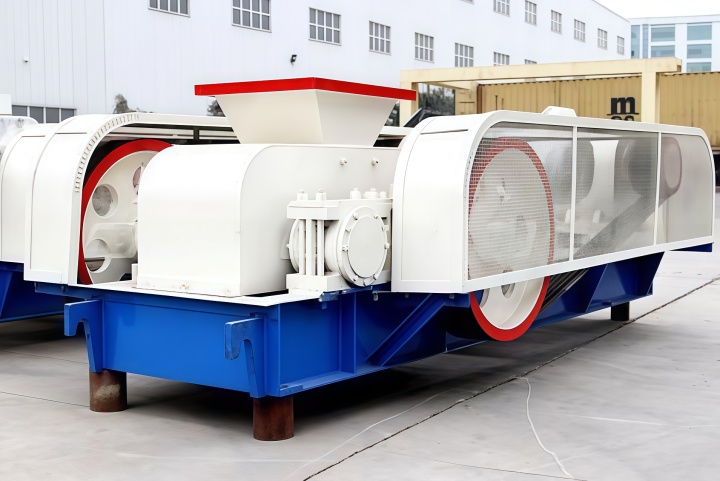
| Feature | This Crusher | Hammer Crusher |
|---|---|---|
| Handling moisture up to 60% | ✅ Yes | ❌ Clogs frequently |
| Screen-less design | ✅ Yes | ❌ Relies on bottom screen |
| Over-crushing rate | Low | High |
| Maintenance frequency | Low (roller plates last 50,000-80,000 tons) | High |
| Energy consumption | Low-speed, high-torque | High-speed, higher energy |
Frequently Asked Questions About Chemical Cake Toothed Roll Crusher for Pigment Paste
Q1: What is the maximum moisture content the Chemical Cake Toothed Roll Crusher for Pigment Paste can handle?
The Chemical Cake Toothed Roll Crusher for Pigment Paste can process materials with moisture content up to 60%, but is not recommended for liquid slurry exceeding 30% moisture.
Q2: How does the Chemical Cake Toothed Roll Crusher for Pigment Paste prevent clogging with sticky pigment paste?
The 15% speed difference between the two rollers enables self-cleaning through mutual scraping, while the screen-less design allows wet materials to pass through freely without blockage.
Q3: Can the discharge particle size of the Chemical Cake Toothed Roll Crusher for Pigment Paste be adjusted during operation?
Yes. The output size is adjusted by changing the roller gap, with the 2PGC450×500 model offering a 25-125mm range.
Q4: What is the typical service life of the roller plates on the Chemical Cake Toothed Roll Crusher for Pigment Paste?
High-chromium alloy roller plates typically process 50,000-80,000 tons before replacement, depending on material abrasiveness and operating conditions.
Q5: Does the Chemical Cake Toothed Roll Crusher for Pigment Paste generate excessive fine powder during crushing?
No. The shear and compression-based mechanism produces uniform granular products with minimal over-crushing.
Sugested Products
Related news
- Chemical Cake Toothed Roll Crusher for Pigment Paste Price: 30-60 t/h Unit Cost Analysis
- Double Roll Crusher Maintenance Cost Guide – 4 Proven Ways to Extend Roller Life
- Double Roll Crusher vs Impact Crusher – 6 Key Factors to Compare Before Buying
- Single Shaft vs Double Shaft Shredder: 6 Key Factors to Choose the Right Crusher for Plastic, Tire & Metal 2026