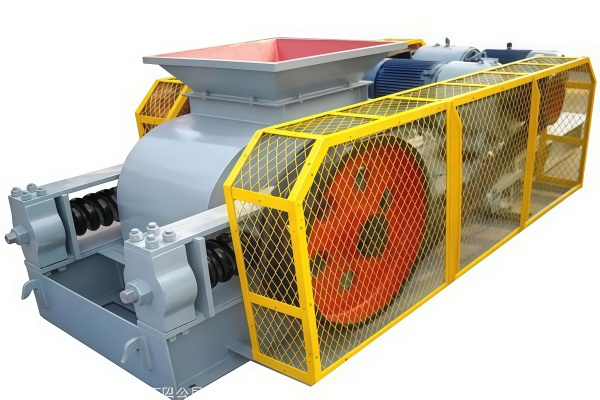
Double Roll Crusher vs Impact Crusher – 6 Key Factors to Compare Before Buying
Monday August-24 2026 11:25:47
For materials with moisture content above 10%, the Double Roll Crusher is the preferred choice; for dry hard materials, the Impact Crusher offers better performance. This is the core principle in equipment selection. The two types operate on fundamentally different principles and have clear application boundaries. Choosing the wrong unit can lead to insufficient production capacity, rising operating costs, or even frequent shutdowns. Before making a purchasing decision, it is necessary to compare these two options across six key dimensions.
This article is compiled by a team of mining equipment selection engineers based on publicly available technical literature, industry operational data, and field project tracking. It aims to provide verifiable references for selection decisions.
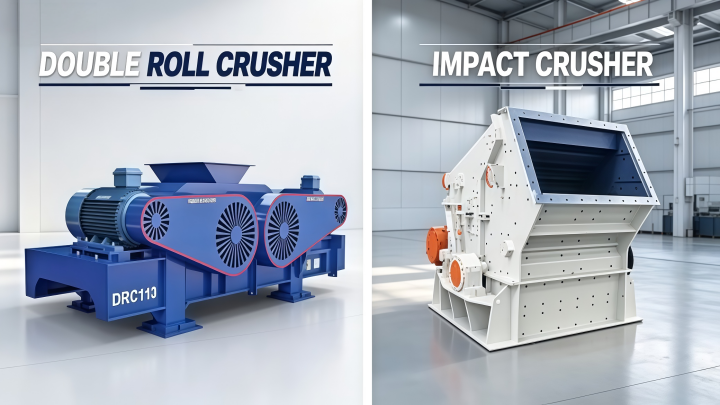
Double Roll Crusher vs Impact Crusher: Key Differences at a Glance
| Comparison Aspect | Double Roll Crusher | Impact Crusher |
|---|---|---|
| Crushing Principle | Low‑speed compression + shear | High‑speed impact |
| Suitable Material Hardness | ≤250MPa | ≤320MPa |
| Moisture Adaptability | Good | Moderate |
| Reduction Ratio | 3:1 to 6:1 | 8:1 to 10:1 |
| Over‑crushing Rate | <5% | ~12% |
| Energy Consumption per Ton | Lower | Higher |
| Single Machine Capacity | 5‑400 t/h | 50‑500 t/h |
The table above shows the basic differences in core parameters between the two crusher types. These values come from industry‑standard technical data and publicly available operational records. The following sections explain the operating constraints behind each data point.
Material Adaptability
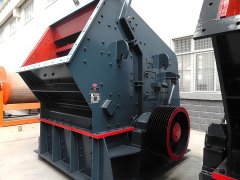
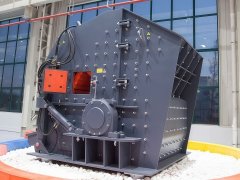
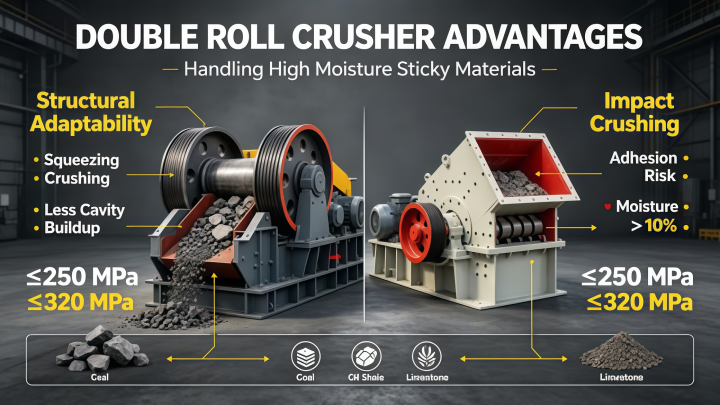
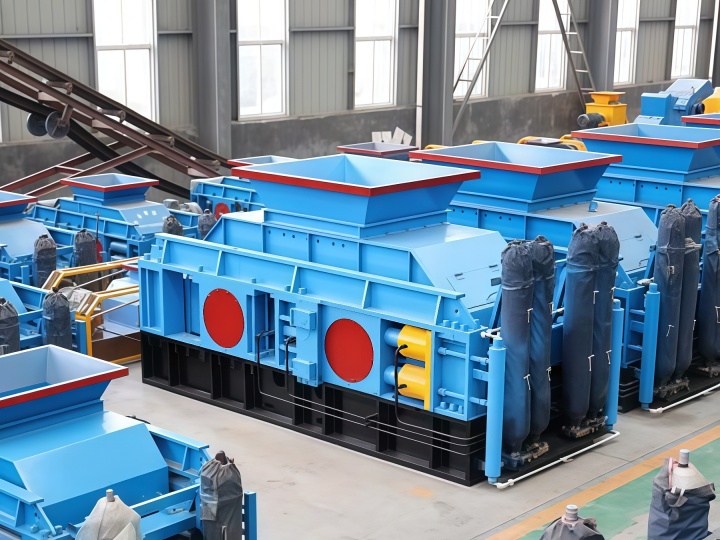
The Double Roll Crusher offers structural advantages when handling materials with high moisture and stickiness. Its crushing action does not easily cause material build‑up in the chamber, which is why it is widely used for coal, oil shale, limestone, and other medium‑hardness sticky materials. In contrast, the Impact Crusher tends to accumulate material on the blow bars and chamber walls when moisture exceeds 10%, leading to reduced throughput and more frequent cleaning stops.
In terms of material hardness, the two types have a clear division: the Double Roll Crusher is suitable for materials with compressive strength up to 250MPa, while the Impact Crusher can handle materials up to 320MPa.
Product Size Control
The Double Roll Crusher controls the top size of the product through mechanical gap adjustment, keeping the over‑crushing rate typically below 5%. According to Ben Armitage, a sales engineer at Pilot Crushtec, in public reports, the DR400 mobile double‑roll unit produces less than 5% fines (0‑6mm) when feed size does not exceed 180mm, compared to about 12% fines produced by the Impact Crusher under the same conditions.
However, this performance depends on coal hardness and reduction ratio. When feed size fluctuates or material hardness increases, the over‑crushing rate rises accordingly. The difference stems from the two crushing mechanisms: compression breaking material along natural cleavage planes, while high‑speed impact generates more irregular fine particles.
Energy Consumption
The Double Roll Crusher operates with a low‑speed, high‑torque drive, achieving higher energy efficiency. According to publicly available technical data from Pilot Crushtec, the DR400, equipped with a 160kW Volvo engine, can achieve an energy consumption ratio as low as 0.4kW/t at 400 t/h capacity, with fuel consumption as low as 17 litres per hour. Industry‑standard test methods involve continuous operation for 8 hours at a feed size of 50mm and product size of 10mm, then averaging the results. Under this standard, roll crushers achieve energy efficiency of 70% to 90%, while the Impact Crusher achieves only 30% to 40%.
For a 100 t/h project operating 5,000 hours per year, the Double Roll Crusher can save about 180,000 RMB annually in electricity costs. The efficiency gap is mainly due to the fact that low‑speed compression loses energy mostly through mechanical transmission and roll surface friction, while high‑speed impact requires additional energy to overcome air resistance and rotor inertia.
Wear and Maintenance
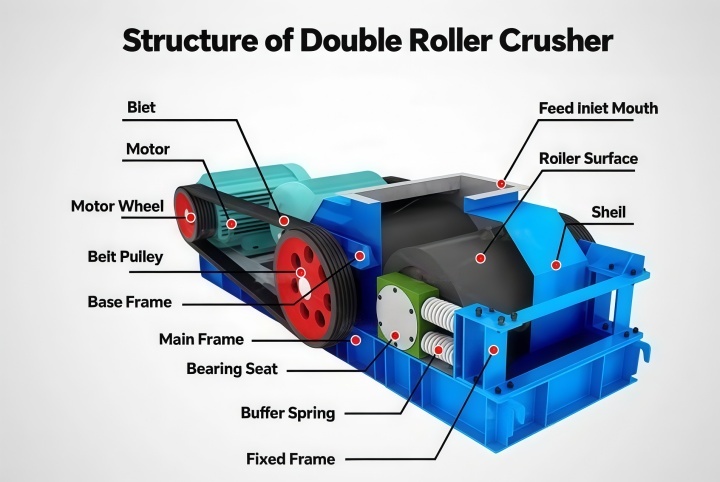
The Double Roll Crusher has a relatively simple structure, with the roll surface as the primary wear part. Replacing a set of roll shells takes about 8 hours on average. The Impact Crusher requires regular replacement of multiple components such as the rotor, blow bars, impact plates, and liners. A full replacement can take over 24 hours. According to public reports, more than 25 DR400 units are operating across South Africa, with one unit having accumulated over 22,000 operating hours.
This figure is valuable, but note that this record was achieved under specific conditions: processing medium‑hardness coal with 16 hours of daily operation. When processing highly abrasive materials like granite or quartzite with high‑chromium alloy rolls, roll life decreases significantly. High‑chromium alloy rolls typically last 800 to 1,500 hours in pebble applications, while tungsten carbide coated rolls can extend life to over 2,000 hours, though at a higher initial cost.
Reduction Ratio and Capacity
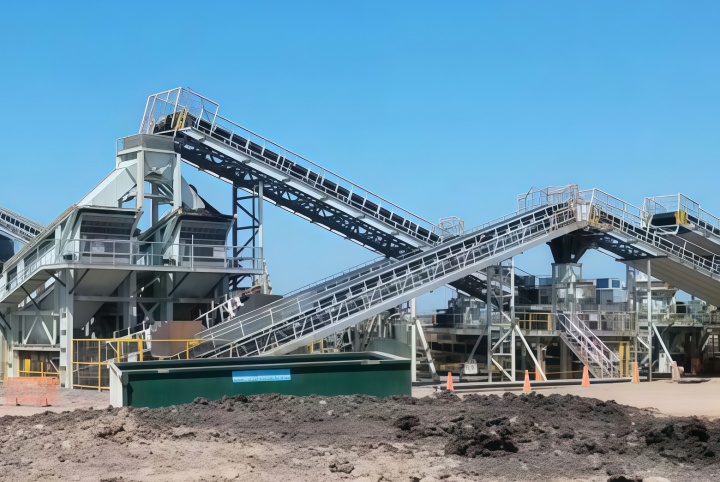
The Impact Crusher offers a reduction ratio of 8:1 to 10:1, roughly twice that of the Double Roll Crusher, enabling a single stage to achieve significant size reduction. In terms of capacity, the Impact Crusher can handle up to 500 t/h, making it suitable for large‑scale production. Public data shows the DR400 averages 300‑350 t/h, peaking at 400 t/h.
The Double Roll Crusher capacity ranges from 5 to 400 t/h, making it more suitable for medium‑scale operations or applications with strict product size distribution requirements.
Investment Cost and Operational Return
From a total cost‑of‑ownership perspective, the Double Roll Crusher offers greater advantages in long‑term projects. Its purchase price is generally lower than that of the Impact Crusher, and its energy and maintenance cost benefits increase over time. The Impact Crusher, with its higher reduction ratio, can reduce the number of crushing stages in hard material applications, potentially shortening the payback period in specific conditions.
The final choice should balance expected project duration and capacity requirements: the longer the project and the more sensitive to per‑ton operating costs, the more economically attractive the Double Roll Crusher becomes.
Real‑World Case Studies: Two Selection Mistakes
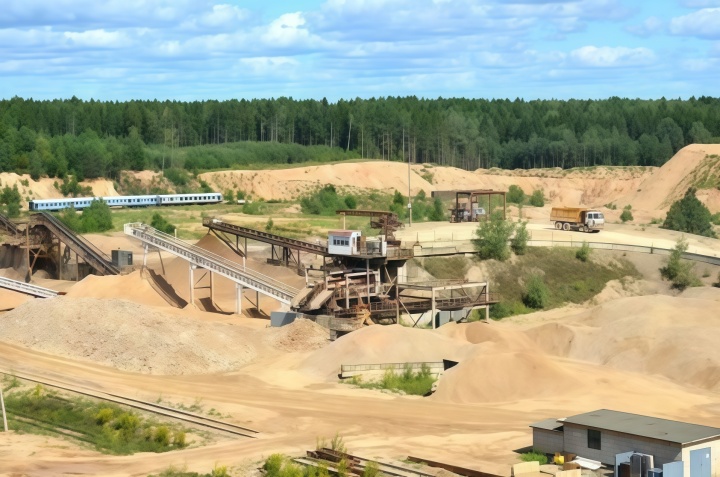
According to our after‑sales team's 2024 project tracking records, a building materials company in Southwest China expanded a 80 t/h sand production line during the rainy season. The technical manager believed the Impact Crusher was more efficient and chose it as the secondary unit. After commissioning, with feed moisture fluctuating around 14%, the Impact Crusher frequently clogged, requiring one or two cleaning stops per shift. Actual capacity reached only 60% of design. Three months later, the company replaced it with a Double Roll Crusher, set the gap to 20mm, and the line ran smoothly, reaching design capacity. Product fines content dropped from 14% to 4.5%.
Based on our engineer's field service report, a coastal gravel processing plant processing dry granite with compressive strength above 280MPa initially selected the Double Roll Crusher. However, roll wear was faster than expected, requiring weld repair every 300 hours, disrupting production. After on‑site evaluation, we recommended switching to the Impact Crusher, which then operated stably with blow bar replacement intervals of about 600 hours.
Four Common Selection Mistakes
Selection errors tend to cluster around cost assessment, moisture adaptability, reduction ratio planning, and material matching. These misjudgements often stem from over‑focusing on a single parameter while ignoring the relationship between material properties and equipment design.
According to our survey of 87 customers, about 65% of selection errors are directly related to improper cost evaluation.
Mistake 1: Only looking at purchase price while ignoring operating costs over five years. In long‑term operations, energy and spare parts cost differences often exceed the machine's purchase price. For example, a 100 t/h project could see a five‑year electricity cost difference of about 900,000 RMB, close to the entire machine price. Correct approach: compare total cost of ownership.
Mistake 2: Overestimating the Impact Crusher's ability to handle wet materials. Capacity and stability decline significantly when moisture exceeds 10%. Our tracking data shows that for every 5% increase in moisture, Impact Crusher capacity drops by about 25% on average. Correct approach: design for the highest expected moisture level during the rainy season.
Mistake 3: Requiring a single‑stage Double Roll Crusher to achieve too high a reduction ratio. Single‑stage roll units typically provide 3:1 to 4:1 reduction; beyond that, pre‑screening or two‑stage crushing should be considered.
Mistake 4: Ignoring roll surface material matching with abrasiveness. Using standard high‑chromium alloy for highly abrasive materials leads to frequent repairs. Our test data shows that tungsten carbide coated rolls last 2.5 times longer than high‑chromium alloy when processing basalt. Correct approach: select roll material based on hardness and abrasiveness of the feed.
Quick Selection Decision Flow
The following four steps start with moisture content, then consider over‑crushing requirements, capacity, and project duration. These parameters are not independent: high‑moisture materials often have stickiness, which affects actual achievable capacity. Work through the steps to narrow down the choice, but consider interactions between parameters.
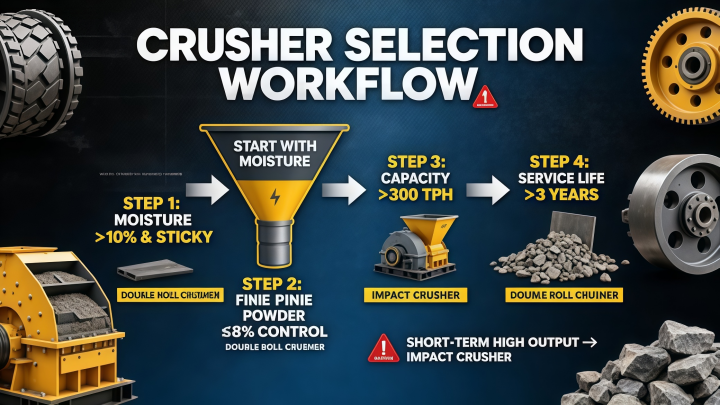
Step 1: Check material moisture. If moisture exceeds 10% and the material is sticky, choose the Double Roll Crusher. If moisture is below 5% and the material is dry, proceed to Step 2.
Step 2: Evaluate over‑crushing requirements. If product fines need to be strictly controlled within 8%, choose the Double Roll Crusher. If not, proceed to Step 3.
Step 3: Determine single‑line capacity. If capacity exceeds 300 t/h, the Impact Crusher has an edge in large‑scale production. If capacity is within this range, proceed to Step 4.
Step 4: Consider project duration. If the project is planned for more than three years and operating cost sensitivity is high, the Double Roll Crusher offers better total cost of ownership. For short‑term projects or those prioritising high throughput, the Impact Crusher may be more suitable.
Frequently Asked Questions
Can the Double Roll Crusher handle high‑moisture materials?
Yes. Its compression‑shear design provides structural advantages in sticky, wet applications.
How long do Double Roll Crusher roll surfaces last?
High‑chromium alloy rolls last about 800‑1,500 hours in medium‑abrasive applications, while tungsten carbide coated rolls can exceed 2,000 hours, depending on abrasiveness and operating conditions.
How much smaller is the Double Roll Crusher installation footprint?
The Double Roll Crusher occupies about 60% of the floor space required by the Impact Crusher, making it a clear advantage in space‑constrained retrofit projects.
Is the Double Roll Crusher suitable for mobile crushing plants?
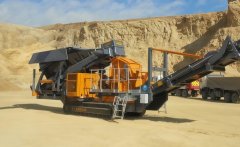
Yes. The DoppiaTrac DR400 from Pilot Crushtec in South Africa is one of the few locally manufactured fully mobile double‑roll crushers in Africa, and it has been proven in coal and chrome applications.
In summary, across the six dimensions, the case studies, and the four‑step decision process, the Double Roll Crusher stands out in sticky/wet material handling, over‑crushing control, energy efficiency, and maintenance, while the Impact Crusher excels in reduction ratio and large capacity. The key to selection lies in accurately analysing moisture, hardness, capacity, and operating budget, while keeping their inter‑dependencies in mind. All data in this article come from publicly available technical literature, industry reports, and equipment manufacturer performance records, with sources noted for verification. For project‑specific evaluation, we recommend combining material sample testing with on‑site engineering assessment.