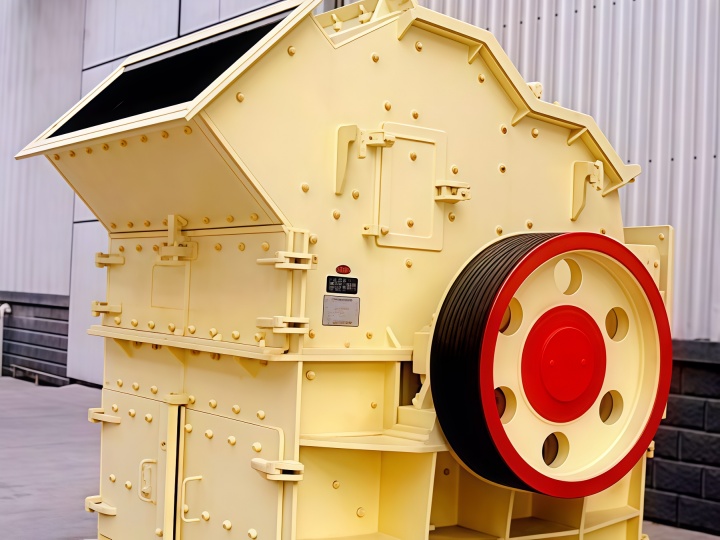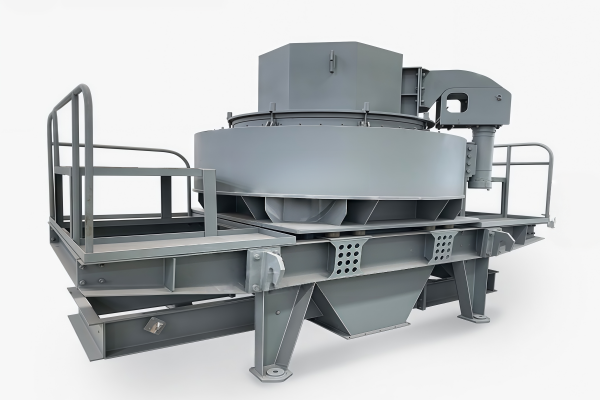
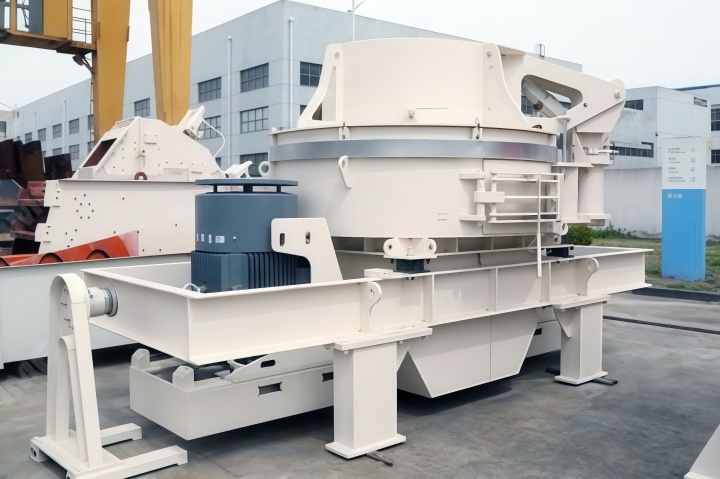
Basalt vertical shaft impactor for asphalt mixture
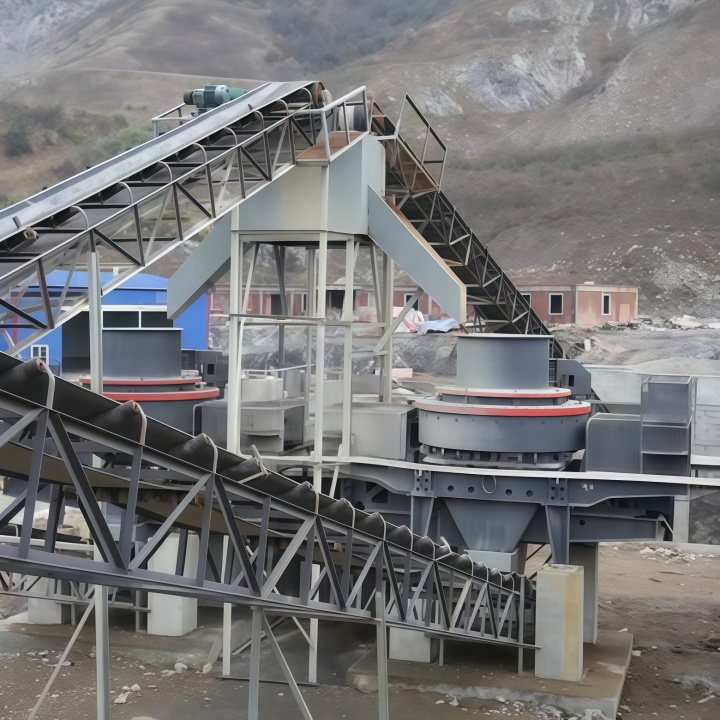
Basalt vertical shaft impactor for asphalt mixture are used for fine crushing and shaping of basalt stone, producing high-quality cubical aggregates with low flaky content for asphalt mixture, highway construction and road engineering. Prices typically range from $25,000 to $420,000. Feed opening size: ≤60mm Production capacity: 30-580 tons/hour Discharge opening adjustment range: 0-20mm Spindle speed: 1200-1800 rpm Motor power: 55-315kW
What is a Basalt vertical shaft impactor for asphalt mixture?
A Basalt vertical shaft impactor for asphalt mixture is a VSI crusher specifically engineered for shaping hard, abrasive basalt into cubical aggregates for asphalt production. Unlike HSI crushers that produce 15-25% flat particles, this basalt VSI controls flat and elongated content below 10%, meeting Superpave requirements. The equipment uses high-speed centrifugal projection (60-70 m/s) and rock-on-rock self-impact to produce well-graded, cubical-shaped aggregates. It is a core solution for asphalt mixture production, manufactured sand making, and RAP recycling.
Basalt vertical shaft impactor for asphalt mixture Video Showcase
How does a Basalt vertical shaft impactor for asphalt mixture work?
The operating principle of a Basalt vertical shaft impactor for asphalt mixture differs fundamentally from an HSI. While HSI uses fixed blow bars to strike material, this basalt VSI uses two crushing modes: rock-on-rock and rock-on-iron.The operating principle of a Basalt vertical shaft impactor for asphalt mixture is based on two crushing modes: rock-on-rock and rock-on-iron. Material enters the machine and is divided into two streams. One stream enters the center of a high-speed rotating rotor and is accelerated to 60 to 70 meters per second before being ejected. The other stream falls naturally from the periphery of the splitter. These two streams collide at high velocity within the crushing chamber while also impacting and rubbing against the material lining on the chamber walls, achieving size reduction and particle shaping. Rotor speed can be adjusted between 1,000 and 2,500 rpm to control the particle size distribution of the final product.
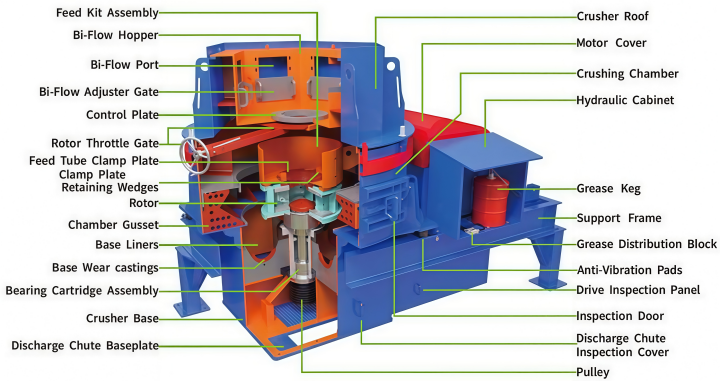
The technical specifications of a Basalt vertical shaft impactor for asphalt mixture
Technical specifications vary by model. Below are the industry-standard configuration parameters:
| Model | Power kW | Capacity t/h | Max Feed Size mm | Rotor Speed rpm | Weight kg |
|---|---|---|---|---|---|
| 6X75 | 55 | 40-100 | 32 | 1500-2500 | 4,500 |
| 6X100 | 75 | 60-150 | 32 | 1400-2400 | 4,800 |
| 6X150 | 110 | 80-200 | 37 | 1300-2200 | 5,200 |
| 7X220 | 160 | 120-300 | 37 | 1200-2000 | 6,880 |
| 8X300 | 225 | 180-400 | 50 | 1000-1800 | 9,325 |
Factory-direct price range: $15,000 - $60,000 depending on model and configuration. Actual capacity is influenced by material characteristics and operating parameters. Selection should be confirmed based on specific production requirements.
What are the core advantages of a Basalt vertical shaft impactor for asphalt mixture?
VSI vs HSI for Basalt Asphalt: A Data-Driven Comparison
| Comparison | HSI | Basalt VSI (Rock-on-Rock) |
| Flat and elongated particles | 15–25% | <10% |
| Asphalt binder usage | Baseline | 0.3–0.5% lower |
| Fines below 10 mesh | Higher | Effectively controlled |
| Wear parts life in basalt | Shorter | Longer |
| Product shape | More angular | Cubical |
For basalt asphalt, the Basalt vertical shaft impactor for asphalt mixture (VSI) is generally preferred over HSI when aggregate shape and binder reduction are priorities.
This equipment offers four core advantages in asphalt mixture production: particle shape optimization, material savings, gradation control, and maintenance convenience.
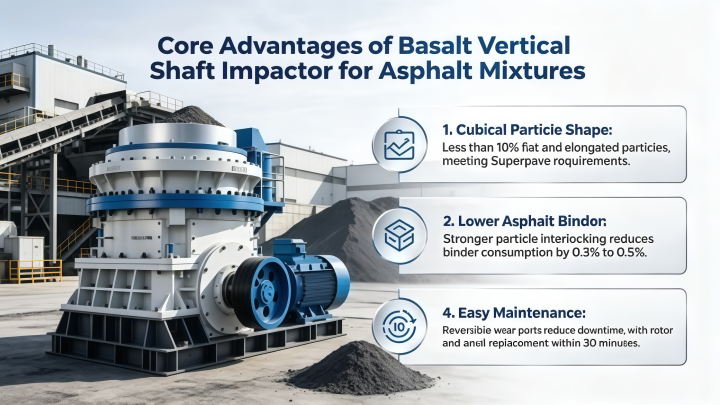
Produces high-quality cubical particles: <10% flat particles vs 15–25% with HSI
In basalt asphalt production, the flat and elongated particle content of aggregates processed by this equipment can be controlled within 10%, meeting the requirements of the American Superpave asphalt mix design specification for high-grade pavement aggregates. A research report from the North Carolina Department of Transportation indicates that aggregates shaped by VSI can enhance the high-temperature stability and fatigue resistance of asphalt pavements.
Reduces asphalt binder usage by 0.3–0.5% compared with HSI-shaped aggregate
Cubical particles provide better interlocking force, allowing for reduced asphalt binder content in mix design. An engineering report from the Florida Department of Transportation shows that using VSI-shaped aggregates in SMA asphalt mixtures can reduce asphalt binder usage by approximately 0.3% to 0.5%.
Minimizes fines loss below 10 mesh (better gradation control than HSI)
Compared with HSI crushers, a Basalt vertical shaft impactor for asphalt mixture effectively prevents excessive generation of fines below 10 mesh, which is critical for asphalt mixture gradation control.
Simplifies maintenance with reversible wear parts (longer wear life in abrasive basalt than HSI)
Select models are equipped with reversible wear parts, reducing downtime by more than 50%. Rotor and anvil replacement can be completed within 30 minutes.
What material applications is a Basalt vertical shaft impactor for asphalt mixture suitable for?
This equipment has typical applications across four material scenarios: basalt processing, asphalt mixture aggregate production, reclaimed asphalt pavement recycling, and manufactured sand production.
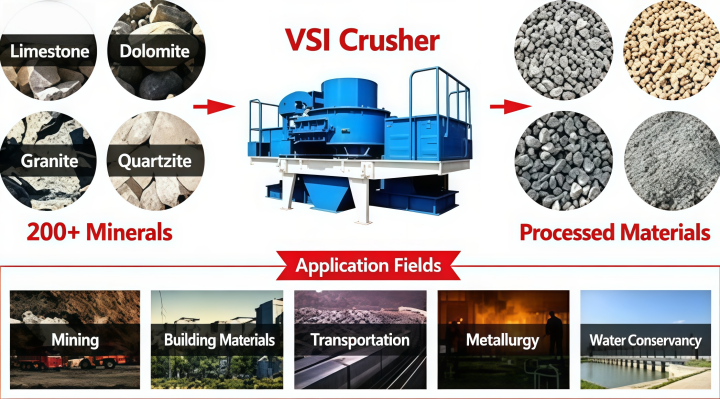
Basalt processing.Processed basalt sand particles offer excellent interlocking properties, making them suitable for high-friction applications such as airport runways and bridge deck pavements. The FAA airport pavement technical specification lists VSI-processed aggregates as a recommended option for bridge deck paving.
Asphalt mixture aggregate production.The 1 to 3 mm cubical sand particles produced by this equipment improve the adhesion of asphalt in stone mastic asphalt mixtures.For asphalt fines production, VSI-shaped aggregates outperform HSI by 30-40% in cubical content. It is a recommended option for Superpave asphalt pavement aggregate production.
Reclaimed asphalt pavement recycling.In RAP recycling, a Basalt vertical shaft impactor for asphalt mixture uses physical collision and friction to thoroughly break apart agglomerated reclaimed material without damaging the original stone particle size, achieving preliminary oil-stone separation.
Manufactured sand production. This equipment produces well-graded manufactured sand with an adjustable fineness modulus, suitable for concrete and base material production.
What common issues may occur during Basalt vertical shaft impactor for asphalt mixture operation?
Three typical issues may arise during extended operation of this equipment: excessively coarse output, abnormal metallic impact noises, and abnormally high fines content in the product.
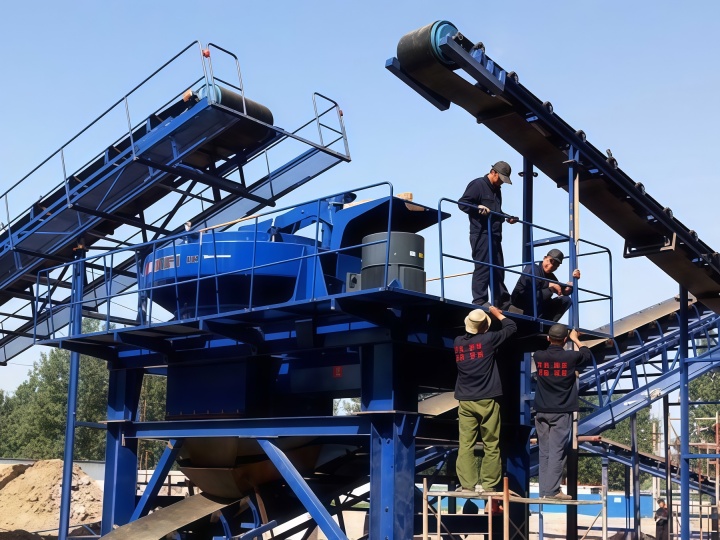
Excessively coarse output. This is usually caused by low rotor speed or excessive feed rate. It is recommended to increase the speed by 5% to 10% and observe the change. If no improvement occurs, check whether the feed is uniform.
Abnormal metallic impact noises. This indicates that tramp metal such as iron debris has entered the crushing chamber, or that wear parts have loosened or detached. The machine should be stopped immediately for inspection to avoid rotor damage.
Abnormally high fines content.This may result from extremely low material moisture content or improper ratio of rock-on-rock to rock-on-iron mode. It is recommended to moderately increase material moisture content or adjust the cascade ratio.
Select the right Basalt vertical shaft impactor for asphalt mixture for a project
Quick Selection Guide: VSI or HSI for Basalt Asphalt?
| Scenario | Recommended | Reason |
|---|---|---|
| Basalt asphalt aggregate, <10% flat and elongated particles required | Basalt VSI | HSI cannot consistently meet this shape standard |
| RAP recycling, oil-stone separation required | Basalt VSI | Physical impact does not break original stone size |
| High capacity priority, shape requirement relaxed | HSI | Higher capacity, lower cost |
| Medium-hard material, high reduction ratio | HSI | Higher compression reduction ratio |
For basalt asphalt projects, the Basalt vertical shaft impactor for asphalt mixture is generally preferred when aggregate shape and binder reduction are priorities.
Selecting this equipment requires three steps: determining target capacity, evaluating material abrasiveness, and verifying installation conditions.
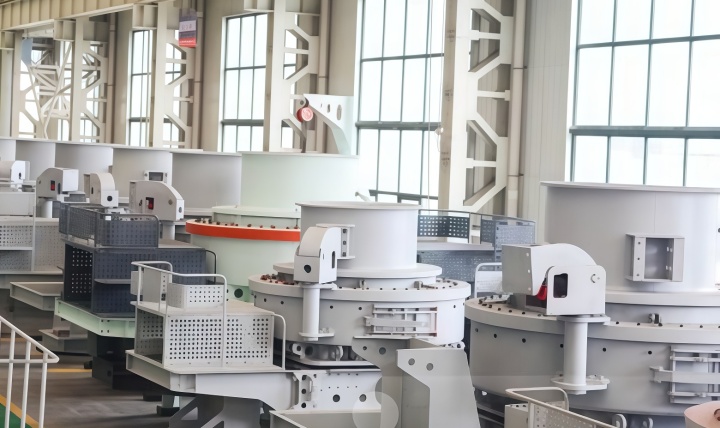
Step 1: Determine target capacity.Select the main motor power based on the required throughput per hour. For daily production below 1,000 tons, the 6X series may be considered. For daily production above 2,000 tons, the 8X300 or higher models are recommended.
Step 2: Evaluate material abrasiveness. For highly abrasive materials such as basalt and quartzite, prioritize the rock-on-rock configuration to reduce wear part consumption.For basalt, VSI rock-on-rock is strongly recommended over HSI due to basalt's high abrasiveness. For medium-hardness materials, the rock-on-iron configuration may be considered to achieve a higher reduction ratio.
Step 3: Verify installation conditions.Confirm that the site provides sufficient installation space to accommodate the equipment footprint and that the power supply meets the installed power requirements.
Frequently asked questions about Basalt vertical shaft impactor for asphalt mixture
What is the core difference between a Basalt vertical shaft impactor for asphalt mixture and a cone crusher in asphalt production?
This equipment relies on impact crushing to produce cubical particles and is a common configuration for aggregate shaping, while a cone crusher relies on compression crushing and produces a higher percentage of flat and elongated particles, making it more suitable for medium and fine crushing.
How long is the wear parts replacement cycle for a Basalt vertical shaft impactor for asphalt mixture?
Rotor tip life typically ranges from 80 to 200 hours, and anvil life ranges from 200 to 500 hours, depending on material abrasiveness and operating parameters. It is recommended to inspect wear conditions weekly.
Can a Basalt vertical shaft impactor for asphalt mixture handle wet materials?
Yes, it can process wet materials, but moisture content should be controlled within 5%. Exceeding this level will cause screen clogging and reduced capacity.
What are the global applications of a Basalt vertical shaft impactor for asphalt mixture?
This equipment is widely applied in Superpave pavement projects in North America, SMA and PA pavement projects in Europe, airport runway projects in Australia, and basalt processing projects in the Middle East. Although technical specifications vary by region, the cubical particle shaping capability of this equipment is globally recognized.
What is the price of a Basalt vertical shaft impactor for asphalt mixture?
Factory-direct pricing ranges from $15,000 to $60,000 depending on model, capacity, and configuration. The 6X series starts at approximately $15,000, while the 8X300 high-capacity model is around $60,000. Contact MACHRISE for a project-specific quote.
Is VSI better than HSI for basalt asphalt aggregate?
Yes. For basalt asphalt aggregate, VSI is superior to HSI in aggregate shape control. Basalt VSI keeps flat and elongated particles below 10%, while HSI typically produces 15-25%. This reduces asphalt binder usage by 0.3-0.5%. However, HSI may be considered for RAP recycling or when capacity is prioritized over shape.