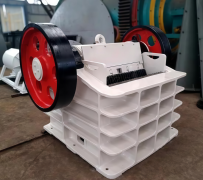
Jaw Crusher Machine
What Is Jaw Crusher Machine and What Are Its Main Applications?
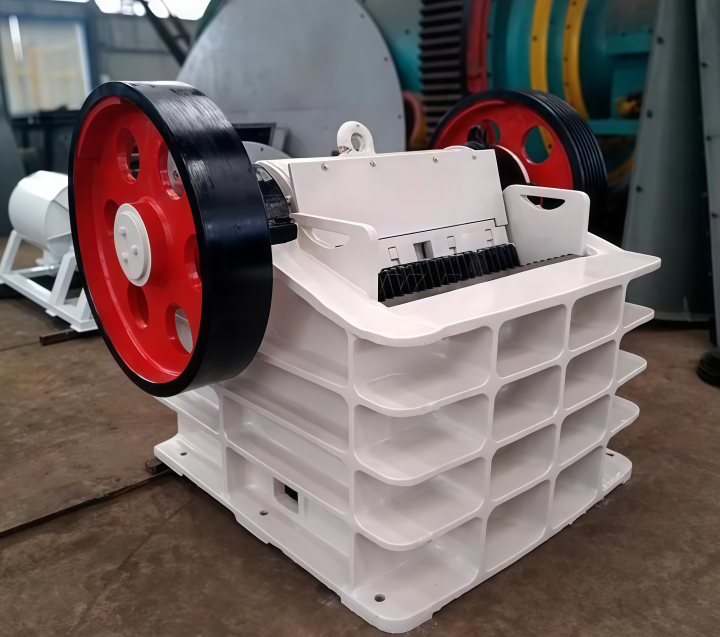
Jaw Crusher Machine is used for primary and secondary crushing of materials, originally invented by E.W. Black in 1858 and still in widespread use today. This equipment crushes materials through compression between two jaw plates forming a V-shaped crushing chamber, and can handle materials with compressive strength up to 320 MPa. The global Jaw Crusher Machine market is projected to reach $3.35 billion in 2026, with a compound annual growth rate of 5.6%.
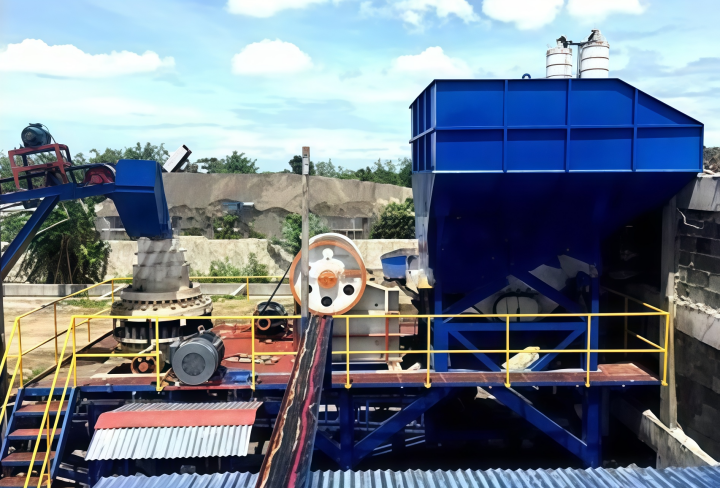
The core application of this machine is to reduce large raw materials from several hundred millimeters in diameter to below several dozen millimeters, providing properly sized feed for subsequent secondary crushing, fine crushing, or grinding operations. Based on feed opening width, the equipment is available in large, medium, and small specifications to suit different production scales. In mineral processing flowsheets and aggregate production lines, Jaw Crusher Machine typically serves as the core equipment for the primary crushing stage.
How Does Jaw Crusher Machine Work?
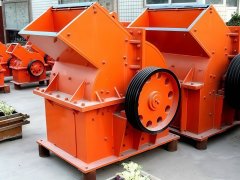
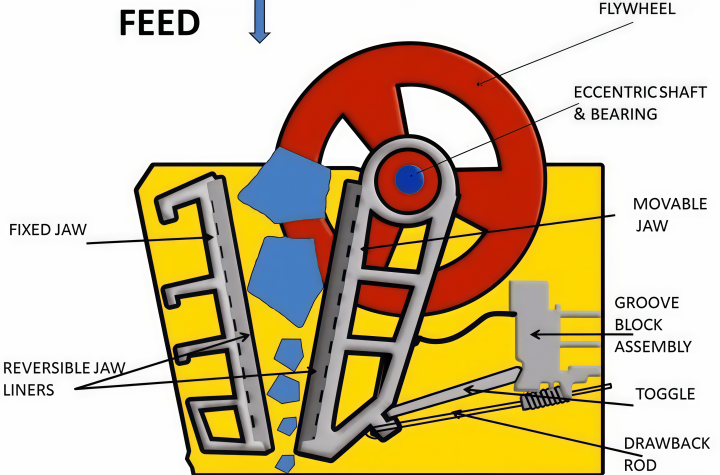
This equipment operates on a compression-crushing principle, with the working cycle alternating between crushing and discharge phases. The electric motor drives the eccentric shaft through belts and pulleys, causing the swing jaw to move periodically around the eccentric shaft.
During the upward movement of the swing jaw, the angle between the toggle plate and the swing jaw increases, bringing the swing jaw plate closer to the fixed jaw plate, and materials in the crushing chamber are fractured under compression, splitting, and bending forces.
During the downward movement of the swing jaw, the angle between the toggle plate and the swing jaw decreases, and the swing jaw plate moves away from the fixed jaw plate under the pull of the rod and spring, allowing crushed materials to discharge through the outlet by gravity. With continuous motor operation, this machine completes the crushing and discharge cycle repeatedly for continuous production.
Industry records show toggle plate seats and eccentric bearings fail more often than jaw plates. Seats crack under impact from rebar or oversized feed. Prefer cast frames over welded—40% longer life. Key parts: frame, eccentric shaft, jaw plates, toggle plate, adjustment device. Jaw plates use 12%-14% manganese steel.
The Technical Parameters and Models of Jaw Crusher Machine
The following table presents technical specifications for common models of this equipment for reference during selection:
| Model | Feed Opening (mm) | Max Feed Size (mm) | Discharge Opening Range (mm) | Capacity (t/h) | Motor Power (kW) | Weight (t) | Recommended Materials |
|---|---|---|---|---|---|---|---|
| PE150×250 | 150×250 | 125 | 10-40 | 2-6 | 5.5 | 1.1 | Limestone, shale |
| PE250×400 | 250×400 | 210 | 20-60 | 8-26 | 15 | 2.4 | Granite, concrete |
| PE400×600 | 400×600 | 350 | 40-100 | 25-64 | 30 | 5.8 | Iron ore, basalt |
| PE500×750 | 500×750 | 400 | 50-120 | 30-80 | 45 | 9.0 | Gold ore, copper ore |
| PE600×900 | 600×900 | 480 | 75-200 | 56-192 | 75 | 16.7 | Large aggregate lines, hard rock |
Actual capacity depends on material properties, feed size distribution, and discharge opening settings. The above figures are calculated based on medium-hardness ore with a bulk density of 1.6 t/m³. Selection should be validated with actual material testing results.
How Does Jaw Crusher Machine Perform in Real-World Operating Conditions?
The technical specification table provides reference values under ideal conditions, but real-world performance varies significantly depending on material properties.
Using the PE400×600 model processing granite with compressive strength of 180 MPa as an example, with feed size of 350 mm and discharge opening set to 80 mm, the average capacity reaches approximately 42 tons per hour, placing it in the mid-to-upper range of the rated capacity. Motor current stabilizes between 52 and 58 amperes, corresponding to energy consumption of approximately 0.9 kWh per ton of material. After 1,200 hours of continuous operation, the swing jaw plate shows wear depth of approximately 18 mm and the fixed jaw plate approximately 22 mm, projecting a total service life of 2,800 to 3,200 hours at this wear rate.
When the same model processes iron ore with compressive strength of 280 MPa, actual capacity drops to 28 to 35 tons per hour, with jaw plate life reduced to approximately 1,800 hours. Material hardness correction factors should be applied during selection as follows: medium-hardness materials coefficient 1.0, high-hardness materials coefficient 0.6 to 0.75, and low-hardness materials coefficient 1.15 to 1.3.
Select the Right Jaw Crusher Machine Model
Model selection is a critical step when purchasing this product, as improper selection can result in insufficient capacity or over-investment. The following calculation example illustrates the selection method.
A plant needs 50 t/h of material below 12 mm from 400 mm limestone feed. Reduction ratio = 400 ÷ 30 ≈ 13.3, exceeding this machine's 4-6 single-stage range—two-stage crushing is needed. Primary: PE400×600 at 80 mm discharge. For single-stage, use PE500×750 with closed-circuit screening at 50 mm, achieving 55-65 t/h with 15% margin.
Material hardness correction should also be considered during selection. Limestone is a low-hardness material with a correction factor of 1.2, meaning actual capacity can reach 1.2 times the rated value. Additionally, feeding method affects equipment capacity, with vibrating feeder systems typically achieving 8% to 12% higher capacity than loader direct feeding.
Jaw Crusher Machine vs. Cone Crusher: Which Is Better for Primary Crushing?
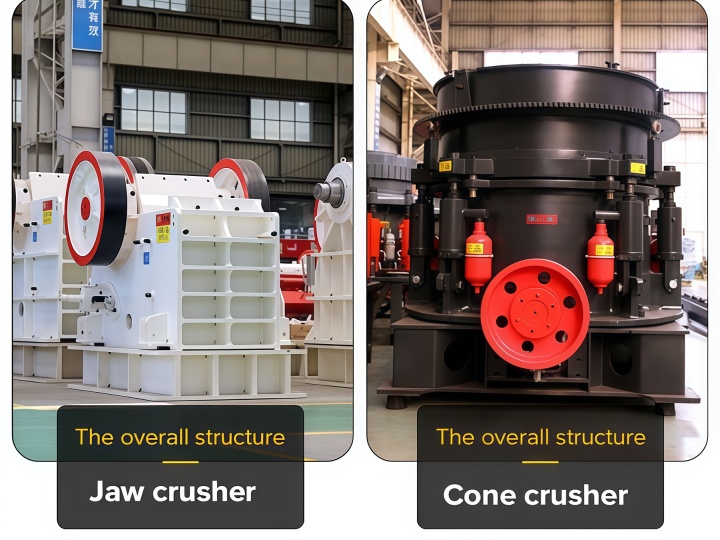
This equipment and cone crusher both belong to compression-type crushing equipment, but their applications differ significantly. Jaw Crusher Machine features larger feed opening capacity, handling materials up to 800 mm or more in diameter, while cone crushers typically require feed below 300 mm. The reduction ratio of this product ranges between 4 and 6, making it suitable as primary crushing equipment. Cone crushers are better suited for secondary and tertiary crushing with more uniform product shape.
In terms of procurement cost, one PE400×600 Jaw Crusher Machine costs approximately one-third of a cone crusher with equivalent capacity. Regarding maintenance, jaw plate replacement for this equipment takes only 2 to 4 hours, while cone crusher mantle and concave replacement typically requires over 8 hours. For large-scale mining operations and aggregate lines with annual production exceeding one million tons, Jaw Crusher Machine is typically used for primary crushing, followed by cone crushers for secondary and tertiary reduction.
What Are the Core Advantages of Jaw Crusher Machine?
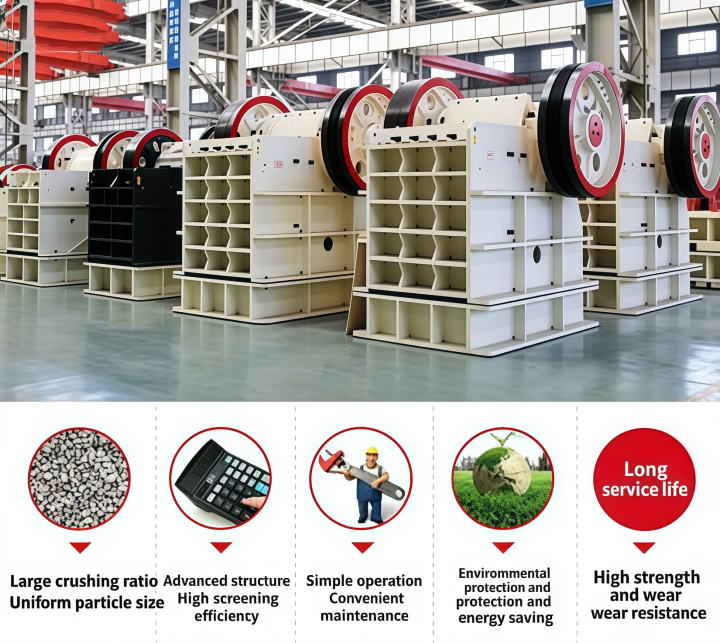
This product has undergone over a century of technical development and field verification across tens of thousands of installations worldwide, demonstrating proven advantages in capacity, adaptability, maintenance convenience, and operational economy. These are outlined in six aspects below.
Capacity. Deep crushing chamber with no dead zone delivers roughly 12% higher output than shallow-cavity designs.
Product consistency. Stable 4-6 reduction ratio ensures uniform gradation for downstream processes.
Flexibility. Discharge adjusts from 30 to 200 mm via shims or wedges to suit various product sizes.
Reliability. Centralized lubrication keeps bearings below 75°C.
Serviceability. Jaw plate change takes only 2-4 hours, minimizing downtime.
Durability. Optimized kinematics and wear-resistant materials extend jaw plate life by over 30% over conventional models.
Is Jaw Crusher Machine Expensive to Maintain and How Often Should It Be Serviced?
Based on 16 hours of daily operation and 300 operating days per year, the annual maintenance cost breakdown for a PE400×600 model of this equipment is as follows: jaw plate replacement twice per year at approximately $1,100 per set; toggle plate replacement once per year at approximately $200; bearing grease replacement four times per year at approximately $80; and liner inspection and bolt tightening labor at approximately $270. Total annual maintenance cost is approximately $1,650, equivalent to $0.011 to $0.016 per ton of material processed.
Routine maintenance recommendations include: check lubricating oil level and quality after every 8 hours of operation, with oil changes every 500 hours; inspect all bolts and anchor bolts for looseness before each startup, particularly the clamping bolts for fixed and swing jaw plates; regularly inspect jaw plate wear and replace when wear reaches half the original thickness; and check bearing clearance every 2,000 hours, with bearing replacement recommended when clearance exceeds 0.3 mm.
What Materials Can Jaw Crusher Machine Process and Which Industries Does It Serve?
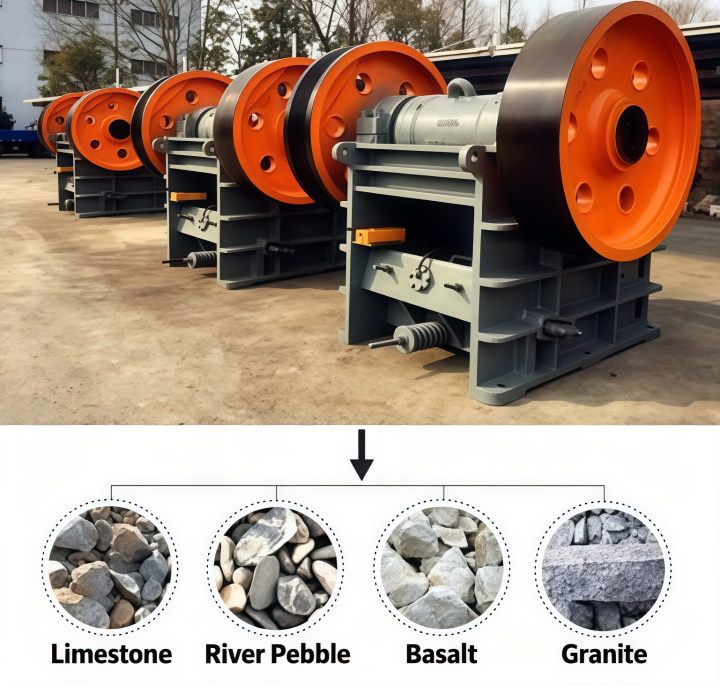
Jaw Crusher Machine finds application across three major areas: ore mining, construction aggregate production, and industrial waste recycling. This equipment performs primary crushing functions across numerous industries due to its crushing capability and adaptability to different material properties. These are categorized into three material types below.
Ore materials. Processes iron, copper, gold, manganese, and phosphate ores. As primary crusher, it reduces run-of-mine ore to below 100 mm for downstream grinding.
Rock materials. Crushes granite, limestone, basalt, river pebbles, quartzite, and shale for highways, railways, bridges, and dams.
Industrial waste. Handles coal gangue, steel slag, cement clinker, and demolished concrete. For concrete, install magnetic separators before feeding to protect jaw plates from rebar damage.
Jaw Crusher Machine Frequently Asked Questions
What causes excessive vibration and noise during Jaw Crusher Machine operation?
This is primarily caused by poor dynamic balance of the swing jaw assembly, severe bearing wear, or loose foundation anchor bolts. Shut down immediately to inspect bearing condition and tighten all mounting bolts.
How long do Jaw Crusher Machine jaw plates last and how to determine replacement timing?
Jaw plate service life depends on material hardness and throughput. For ordinary granite and limestone, jaw plates typically last 2,000 to 4,000 hours. For high-hardness materials like quartz and iron ore, inspect wear surfaces every 1 to 2 months.
Can Jaw Crusher Machine process wet and sticky materials with high moisture content?
Processing materials with moisture content exceeding 8% often causes blockage, with material adhering to jaw plates and accumulating in the crushing chamber. Installing screening and dewatering equipment before feeding is recommended.
What key components should be inspected when purchasing a used Jaw Crusher Machine?
Inspect the remaining thickness of jaw plates and liners, inspect the frame for fatigue cracks, check bearing and toggle plate wear conditions, and request the equipment's service history and maintenance records from the seller.