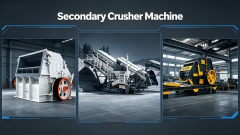
Secondary Crusher Machine
What Is Secondary Crusher Machine?
Secondary Crusher Machine is the second-stage equipment in a crushing plant, responsible for reducing primary-crushed material down to 30 to 80 millimeters. This size range is the ideal transitional state before tertiary crushing or screening.
The secondary stage carries the heaviest load in the entire crushing line——fluctuations in primary crusher output feed directly into this stage, while downstream tertiary crushers and screens have strict requirements for feed size and uniformity. It must strike a balance between the two. Its output quality heavily influences the final product's particle shape and overall yield.
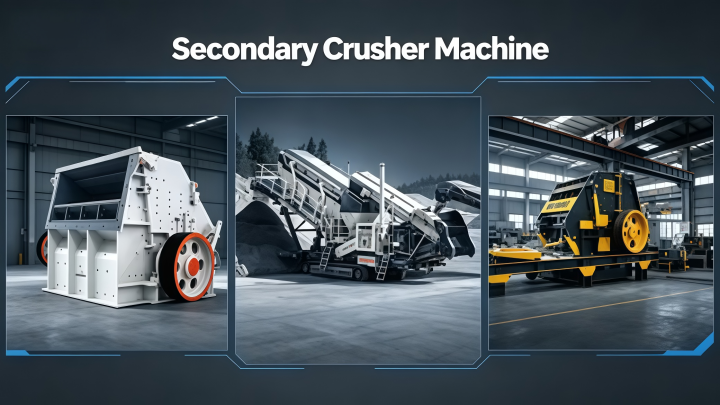
Secondary Crusher Machine Selection: Cone Crusher vs Impact Crusher
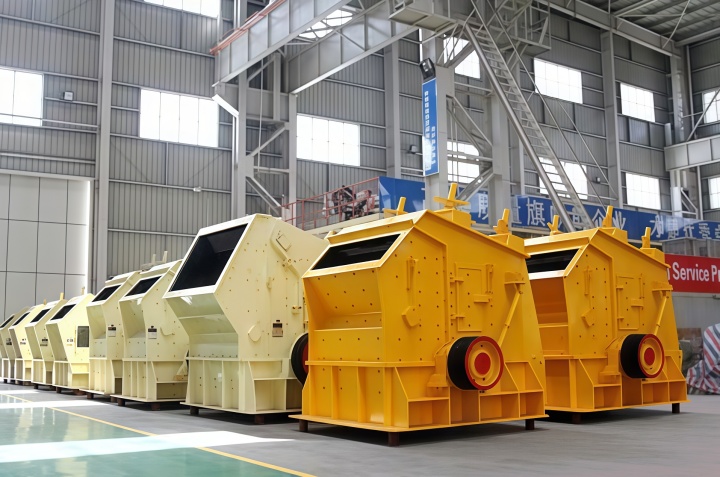
This is the most critical decision for most buyers. Secondary Crusher Machine selection branches into two distinct paths: cone crushers and impact crushers. Choosing the wrong route means either runaway wear costs or substandard particle shape.Cone crushers operate on the compression principle. The mantle gyrates eccentrically within the concave, and material is repeatedly compressed and fractured between the two crushing surfaces. The advantages are low wear cost and minimal fines generation, making cone crushers suitable for hard materials like granite, basalt, and iron ore. Large-scale mining operations favor cone crushers, with wear costs per tonne running at only one-half to two-thirds that of impact crushers.
Impact crushers operate on the impact principle. The rotor spins at high speed, flinging material against impact aprons where it shatters upon collision. The advantage is excellent product shape and high cubical particle content, but blow bar and impact plate wear costs are higher than cone crusher liners. Impact crushers are better suited for medium-hard materials like limestone and gypsum, and are commonly used in commercial concrete batching plants where aggregate shape is critical.
The core selection criterion is material hardness. For materials with compressive strength exceeding 200 MPa, cone crushers show clear economic advantages over impact crushers——while the equipment itself costs more, the savings in wear parts over two years more than cover the difference. For materials below 200 MPa, the particle shape advantage of impact crushers cannot be replaced. When producing high-grade concrete aggregates, impact crushers can keep flakiness and elongation content within 8%, compared to 10% to 15% for cone crushers.
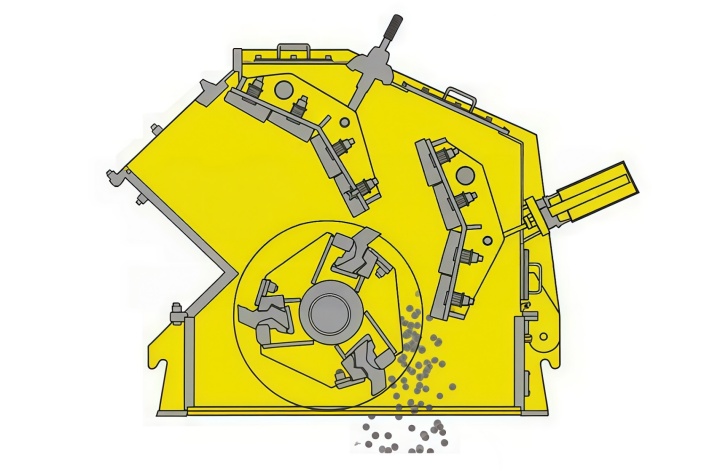
Secondary Crusher Machine Technical Specifications and Capacity Table
Below are key specifications for common Secondary Crusher Machine models, for reference during selection.
| Model | Max Feed (mm) | Discharge Setting Range (mm) | Motor Power (kW) | Capacity (t/h) |
|---|---|---|---|---|
| S75B | 120 | 9-22 | 75 | 45-135 |
| S155B | 180 | 13-38 | 160 | 100-325 |
| S240B | 230 | 16-51 | 250 | 200-630 |
Note: Capacities above are typical reference values based on medium-hard material and medium discharge settings. Actual performance varies with material hardness, abrasiveness, moisture content, feed gradation, and discharge setting.
Secondary Crusher Machine Selection Comparison Table
According to discussions on secondary crusher selection in Mineral Processing Plant Design, the boundary between cone crushers and impact crushers typically falls around 200 MPa compressive strength. Below this threshold, impact crushers offer better economics; above it, the wear cost advantages of cone crushers begin to emerge.
| Comparison Dimension | Cone Crusher | Impact Crusher |
|---|---|---|
| Applicable Material Hardness | ≤ 350 MPa, suitable for hard rock | ≤ 200 MPa, suitable for medium-soft rock |
| Product Particle Shape | Good, flakiness about 10%-15% | Excellent, flakiness can be controlled within 8% |
| Wear Part Life | Liners about 2000-4000 hours | Blow bars about 500-1500 hours |
| Wear Cost per Tonne | Lower | Higher |
| Feed Moisture Requirement | Not exceeding 5% | Not exceeding 8% |
Note: Data above are typical reference values based on standard operating conditions. Cone crushers are better suited for large-scale mining operations sensitive to operating costs; impact crushers are better suited for commercial concrete batching plants with high aggregate shape requirements.
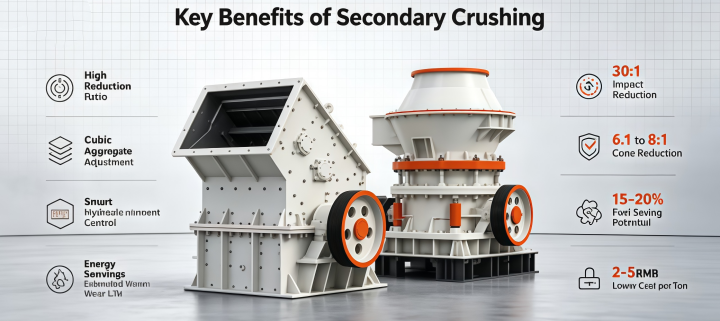
Why Secondary Crusher Machine Actual Capacity Falls Short of Nameplate Ratings?
One of the most common concerns buyers have is the gap between nameplate capacity and actual throughput. What truly affects Secondary Crusher Machine output efficiency are three often-overlooked factors.
Primary crusher discharge gradation.
If the primary crusher discharge setting is too wide, the proportion of oversized material entering the secondary stage increases, raising chamber load and potentially reducing actual capacity to only 60% of the nameplate rating. Setting it too narrow reduces primary crusher capacity and drags down the entire line. Matching upstream and downstream discharge settings requires sieve analysis curves, not guesswork.
Pre-screening efficiency.
If the pre-screen ahead of the secondary stage fails to effectively remove already-qualified fines, these fines enter the crushing chamber and cushion the crushing action of the liners, reducing capacity. One limestone project in China lost approximately 15% of capacity this way——adding a single screen solved the problem.
Feed fines content.
When fines content exceeds 15%, cone crusher throughput drops by roughly 20% to 30%, and the lower portion of the liners develops ring-shaped wear grooves, shortening replacement cycles. For this issue, adding a de-sliming screen on the feed conveyor is often more economical than upgrading to a larger secondary crusher.
Secondary Crusher Machine Case Study: From 240 t/h to 330 t/h
A basalt aggregate plant in central China had a design capacity of 350 tonnes per hour. Initially using a standard cone crusher as the Secondary Crusher Machine, actual throughput consistently hovered between 240 and 260 tonnes per hour.
Site investigation revealed three issues: insufficient feed conveyor belt width caused material bridging at the chamber entrance; the primary jaw crusher discharge setting was too wide, with material over 80 millimeters accounting for 40% of feed to the cone; and substantial fines entered the cone without pre-screening.
The solution: narrow the jaw crusher discharge setting from 175 millimeters to 150 millimeters, and install a double-deck vibrating screen on the feed conveyor to remove fines under 30 millimeters. After adjustments, Secondary Crusher Machine throughput stabilized at around 330 tonnes per hour.
One easily overlooked detail: the feed conveyor belt speed was about 15% higher than the design value, causing material to arc into the chamber entrance rather than feeding evenly. After returning belt speed to the design value, bridging frequency dropped by roughly 70%. This case shows that secondary stage capacity issues often originate not from the equipment itself, but from upstream-downstream mismatches and overlooked parameter settings.
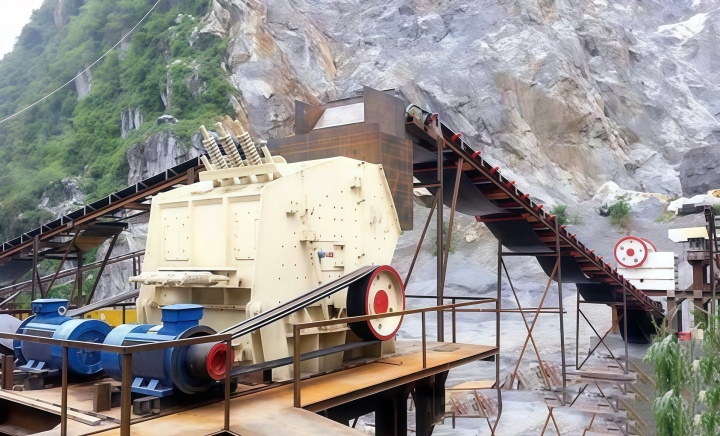
Four Differences Between Secondary Crusher Machine and Primary Crusher Machine
Though both are crushing machines, they differ in four fundamental design aspects.
Feed size is entirely different. Primary Crusher Machine handles run-of-mine material measured in meters; Secondary Crusher Machine feed is typically only about one-tenth that size.
Crushing ratio targets differ.Primary crushing needs only a 6:1 to 8:1 ratio; secondary crushing requires 10:1 to 12:1 to prepare proper feed for tertiary stages.
Crushing chamber design differs.Primary chambers prioritize wide openings and high throughput; secondary chambers feature a longer parallel zone in the lower section to ensure uniform discharge gradation. This parallel zone is the most distinctive structural feature separating secondary crushers from primary crushers.
Impact of downtime differs.Primary crusher downtime halts the entire production line——impact is greatest. Secondary crusher downtime allows the upstream primary to continue briefly, buffered by surge bins, so impact is comparatively manageable. But frequent secondary downtime still causes significant system efficiency loss; stable operation remains critical.
Frequently Asked Questions About Secondary Crusher Machine
What is the parallel zone in a Secondary Crusher Machine crushing chamber?
The parallel zone is a vertical section at the bottom of the liners where material is shaped rather than compressed, producing more uniform discharge gradation. A longer parallel zone improves particle shape but reduces capacity.
How does excessive fines in the feed affect Secondary Crusher Machine performance?
Excessive fines cushion the liners' crushing action, reducing capacity while accelerating localized wear at the liner bottom. The most economical approach is adding a de-sliming screen on the feed conveyor, rather than upgrading to a larger crusher.
Which has lower operating costs — cone crusher or impact crusher as a Secondary Crusher Machine?
Cone crusher wear parts cost roughly one-half to two-thirds that of impact crushers, but impact crushers produce better particle shape. Cone crushers are more economical for hard rock; impact crushers are better for medium-soft rock where shape requirements are high.
The core of Secondary Crusher Machine selection is matching material hardness and capacity requirements, not simply reading the nameplate rating. Spending a week on sieve analysis and upstream-downstream matching assessment is more effective than spending extra capital on a larger machine. Choose the right secondary crusher, and the whole line runs smoothly.
Sugested Products
Related news
- Quartz sand vertical impact crusher for glass batch selection
- Feldspar Toothed Crusher for Ceramic Body Preparation Price: How Much Does It Cost
- Chemical Cake Toothed Roll Crusher for Pigment Paste Price: 30-60 t/h Unit Cost Analysis
- Impact Crusher Price Guide – How Much Does an Impact Crusher Cost?