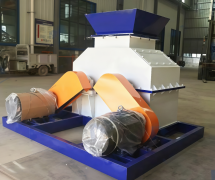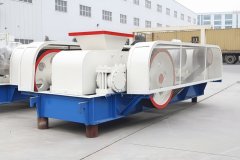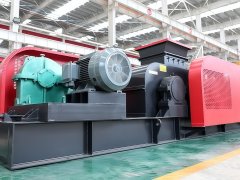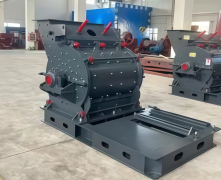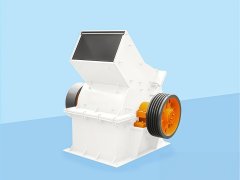
Barite hammer crusher for drilling mud
Barite hammer crusher for drilling mud product specifications, sizing calculation methods, and API 13A compliance information. Based on actual project data to help you select the right secondary crushing equipment for your barite grinding production line.
Barite hammer crusher for drilling mud What Is the Product?
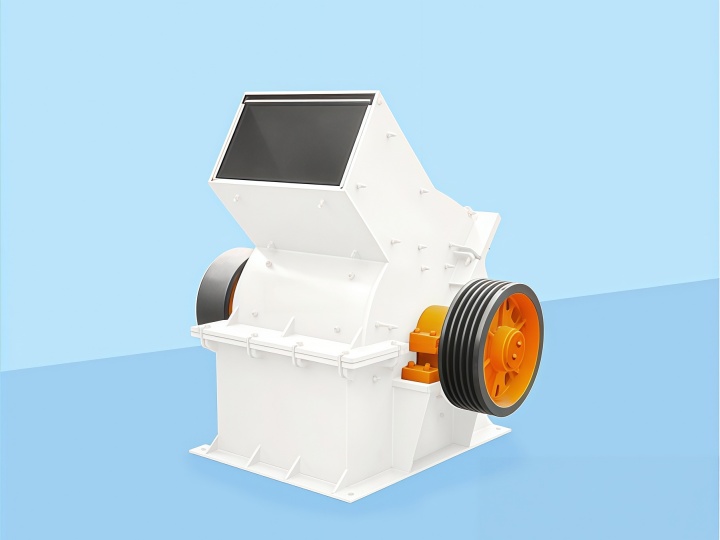
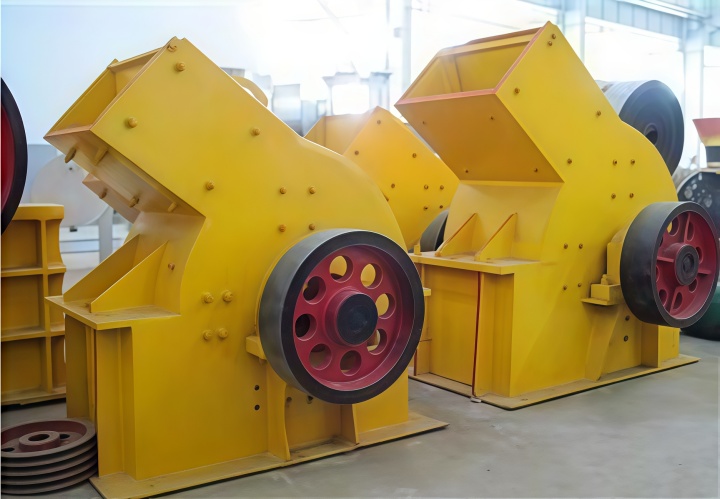
Barite hammer crusher for drilling mud is a specialized equipment for secondary crushing in barite grinding production lines, reducing coarse-crushed barite to a feed size suitable for grinding mills.
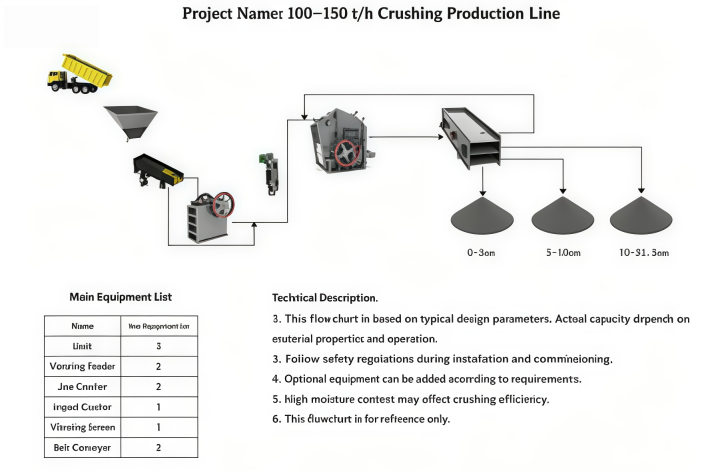
Barite has an average Vickers hardness of approximately 162Hv and a compressive strength ranging from 18 to 90 MPa, with a typical value of 38 MPa. This equipment is designed specifically for these medium-soft mineral characteristics. After installation at the Anshun, Guizhou project, the proportion of feed material exceeding 25 mm dropped from 17% to below 18 mm, and the finished product fineness pass rate increased from 89.5% to above 96%. This machine solves the core problem of stabilizing feed particle size to ensure smooth mill operation, and can be combined with jaw crushers and grinding mills to form a complete production line.
Barite hammer crusher for drilling mud Working Principle
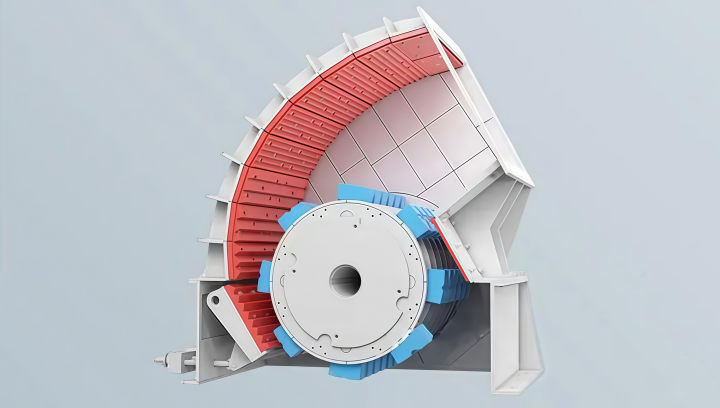
The core components are a high-speed rotating rotor and the hammers mounted on it. Material enters the crushing chamber and is fractured by impact from the high-speed hammers. The material gains kinetic energy, strikes the impact plates on the chamber wall for secondary crushing, then falls to the grate section. Particles smaller than the grate clearance are discharged, while larger particles continue to be impacted and ground until they pass through.
The material is primarily subjected to three types of forces: impact force from the hammers, collision force against the impact plates, and inter-particle friction and compression. Adjusting the rotor speed and grate clearance allows control over the discharge size. Higher speed and smaller clearance produce finer output. The single-machine crushing ratio can reach 10 to 35.
Barite hammer crusher for drilling mud Technical Specifications
| Model | Feed Size mm | Discharge Size mm | Capacity t/h | Motor Power kw | Weight t |
| PC400×300 | ≤100 | 5-15 adjustable | 3-10 | 11 | 0.86 |
| PC600×400 | ≤120 | 5-20 adjustable | 8-15 | 22 | 1.55 |
| PC800×600 | ≤150 | 8-25 adjustable | 10-40 | 55 | 4.8 |
| PC1000×800 | ≤200 | 10-30 adjustable | 16-65 | 110 | 8.1 |
| PC1300×1200 | ≤280 | 12-40 adjustable | 50-200 | 240 | 14.8 |
Barite hammer crusher for drilling mud Advantages
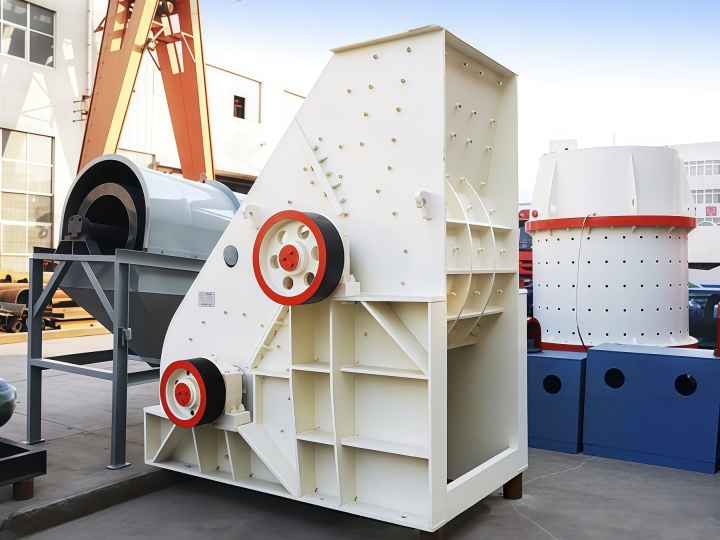
Barite hammer crusher for drilling mud offers advantages in crushing ratio, discharge uniformity, energy consumption, and wear parts replacement, as detailed below.
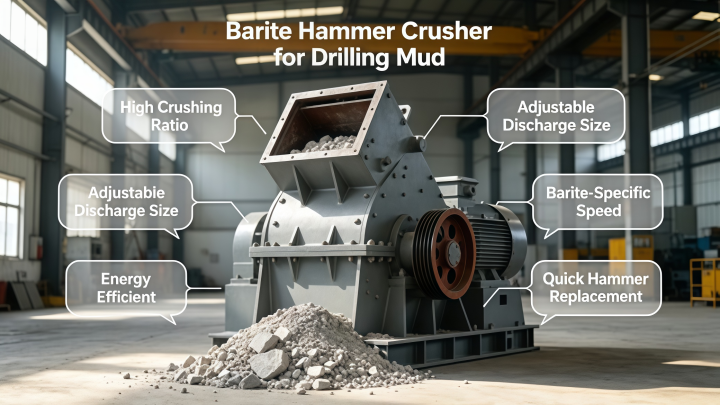
High crushing ratio, with a single-machine ratio of 10 to 35, reducing the number of equipment stages in the production line.
Uniform and adjustable discharge, with 96% of particles ≤19 mm when the grate clearance is set to 13 mm.
Rotor speed optimized for barite's medium-soft characteristics to minimize over-crushing.
Lower energy consumption, at 3.3 kWh per ton, compared to 4.5 kWh for impact crushers.
Easy replacement of wear parts such as hammers, with high-chromium alloy hammers processing 42,000 to 51,000 tons under normal operating conditions before replacement.
Barite hammer crusher for drilling mud Application Scenarios by Material
This equipment is suitable for secondary crushing of various medium-soft minerals and rocks. Different materials have different requirements for discharge size and hammer wear, as detailed by material category below.
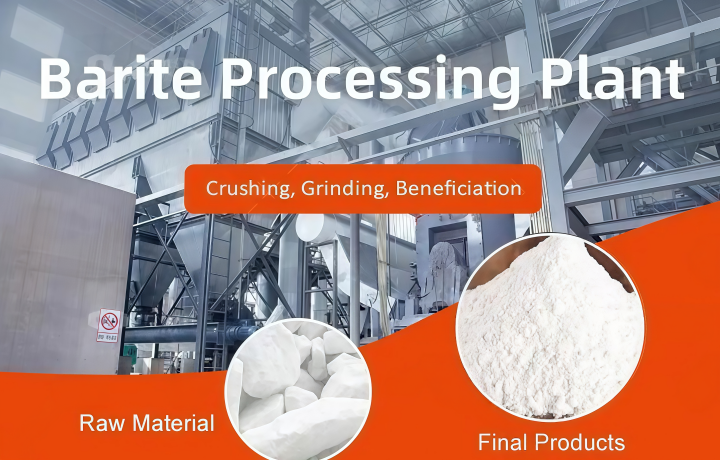
Barite: The primary application, with approximately 80% to 90% of global barite production used as drilling mud weighting agent. The equipment reduces material to below 20 mm, providing stable feed for producing API 13A standard barite powder.
Limestone: Mohs hardness 3, used in limestone grinding production lines for secondary crushing, with discharge size adjustable from 5 to 30 mm to suit Raymond mills or trapezium mills.
Gypsum: Mohs hardness 1.5 to 2, crushed to below 10 mm for building gypsum powder and model gypsum powder production.
Calcite: Mohs hardness 3, crushed from 50-80 mm down to below 15 mm to provide feed for ultra-fine grinding of heavy calcium carbonate.
Dolomite: Mohs hardness 3.5 to 4, crushed to below 20 mm for refractory materials and magnesium-based chemical product processing.
Materials with higher silica content accelerate hammer wear. Barite with 8% silica content shows approximately twice the hammer consumption rate compared to 3% silica content. Chrome content of 26% or higher in alloy hammers is recommended for high-silica materials.
Please provide material samples and daily throughput data to match the right model based on your material type and production capacity requirements.
Barite hammer crusher for drilling mud Sizing Calculation Method
Sizing calculations require determining three core parameters in sequence: capacity requirement, feed characteristics, and discharge size. The Anshun project example below illustrates the specific calculation steps.
Step one - determine capacity requirement: Target production of 200 tons of barite powder per day, with a mill efficiency coefficient of 0.85, requiring 235 tons of daily mill feed. Based on 20 operating hours per day, the capacity requirement is 11.75 tons per hour, leading to the selection of the PC1000×800 model.
Step two - verify feed characteristics: The jaw crusher discharge showed 6% of particles exceeding 150 mm. This exceeds the 5% threshold, requiring a larger feed opening model.
Step three - calculate discharge size: The mill requires feed ≤20 mm. The grate clearance was set to 13 mm, and actual operation showed 96% of discharge particles ≤19 mm.
Barite hammer crusher for drilling mud API 13A Compliance
API 13A/ISO 13500 specifies physical property requirements for barite powder used in drilling mud. This equipment ensures finished product compliance by stabilizing the feed particle size, as outlined below.
Standard requirements: specific gravity not less than 4.20 g/cm³, 200-mesh passing rate not less than 97%, soluble alkaline earth metals not exceeding 250 mg/kg.
The equipment stabilizes feed particle size within 20 mm, providing the conditions for the mill to consistently produce compliant finished products.
Academic research shows that flotation and acid-leached barite samples can achieve specific gravity from 4.04 to 4.26, with pH values of 7.2 to 7.3 within the API standard range.
When discharge particle size fluctuation exceeds 5 mm, the finished product pass rate decreases by 3% to 5%, requiring regular grate clearance measurement and adjustment.
Three Common Sizing Mistakes When Selecting Barite hammer crusher for drilling mud
Purchasers often make errors in three dimensions during equipment selection: feed particle size distribution, grate clearance setting, and ore silica content, as explained below.
Mistake one: ignoring feed particle size distribution.Selecting based on average particle size without calculating the proportion of oversize particles leads to frequent clogging. When oversize exceeds 5%, a larger feed opening model is required.
Mistake two: setting grate clearance directly to the mill's maximum requirement. Approximately 15% of discharge particles will be slightly larger than the clearance. Setting clearance at 60% to 70% of the mill's maximum feed size is recommended. In the Anshun project, the mill required 20 mm, and the clearance was set to 13 mm.
Mistake three: overlooking the impact of ore silica content on hammer life. Comparison between 3% and 8% silica content shows the latter has approximately twice the hammer consumption rate. High-silica ores require alloy hammers with chromium content of 26% or higher.
Barite hammer crusher for drilling mud FAQ
How much does high silica content in barite affect the hammer life of Barite hammer crusher for drilling mud?
Comparison between 3% and 8% silica content shows the latter has approximately twice the hammer consumption rate. Alloy hammers with chromium content of 26% or higher are recommended for high-silica ores.
How is dust controlled during operation of Barite hammer crusher for drilling mud?
Baghouse dust collectors can reduce dust to 45 mg/m³, and adding water mist spraying can further reduce it to 25 mg/m³.
How often should the grate clearance of Barite hammer crusher for drilling mud be adjusted?
Monthly measurement is recommended, with adjustment required when clearance increases by more than 20% due to wear.
What is the power consumption difference between Barite hammer crusher for drilling mud and impact crushers?
Impact crushers consume 4.5 kWh per ton, while this product consumes 3.3 kWh per ton, a difference of approximately 36%.
Product Certifications and Standards Compliance
Complies with JB/T 10883-2019 Hammer Crusher industry standard. Aligns with API 13A/ISO 13500 production requirements for drilling mud barite processing. Third-party material test reports are available for major component materials.