Quartz sand vertical impact crusher for glass batch selection
Monday September-14 2026 15:35:00
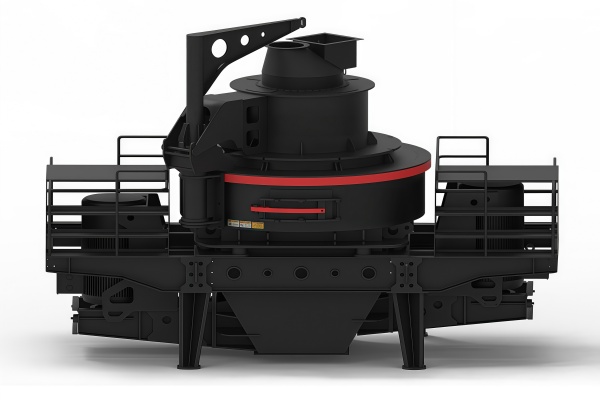
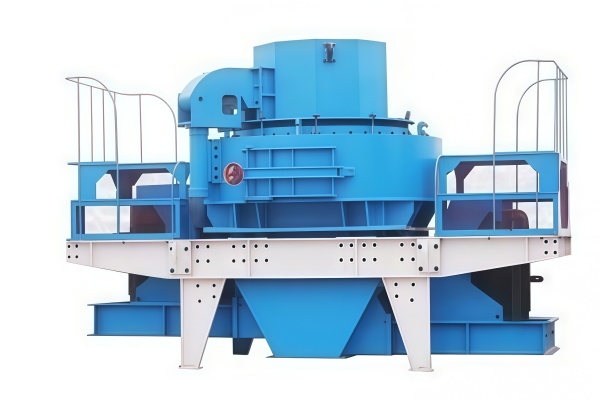
The core of Quartz sand vertical impact crusher for glass batch lies in stone-on-stone crushing, where materials collide with each other after being accelerated by a high-speed rotating impeller, completing the crushing through self-lining, thereby avoiding iron grinding contamination from the source. Selection must simultaneously match ore hardness, target particle size, and glass type; no single parameter can replace production line testing.
Ultra-clear glass quartz sand requires Fe₂O₃ content controlled below 150 ppm, while photovoltaic glass sand does not exceed 100 ppm. Quartz sand accounts for more than sixty percent of the batch mixture and is the primary factor affecting glass iron content. The following sections break down the selection logic from five dimensions: particle size, line speed, iron control, fine powder energy consumption, and fault diagnosis.
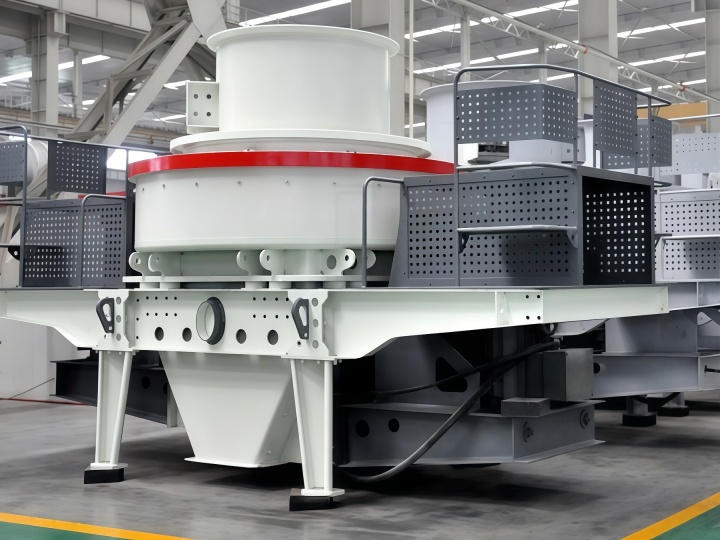
Quartz sand vertical impact crusher for glass batch selection particle size range setting
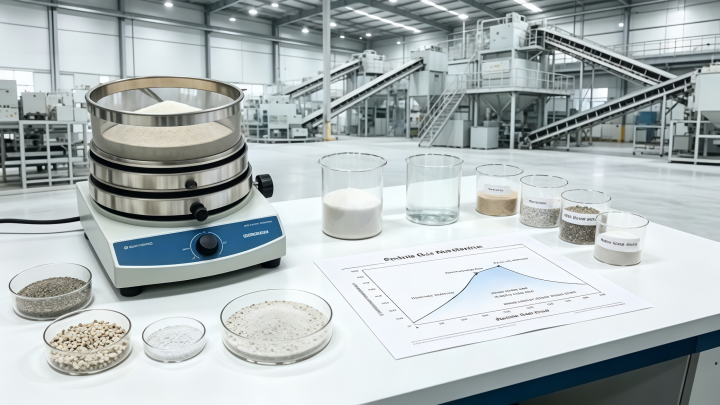
Float glass typically requires D50 between 0.25 and 0.35 mm, while photovoltaic glass requires the proportion of fines below 0.104 mm to not exceed 5 percent. The photovoltaic glass customer we serve requires stricter control, with fines kept within 3 percent, based on the actual working condition that this customer's fully oxygen-fired furnace is highly sensitive to dust carryover.
An incorrect particle size range setting will cause all subsequent adjustments to lose their baseline. The customer's ore source comes from a quartzite mining area in East China, with SiO₂ content of approximately 99.5 percent.
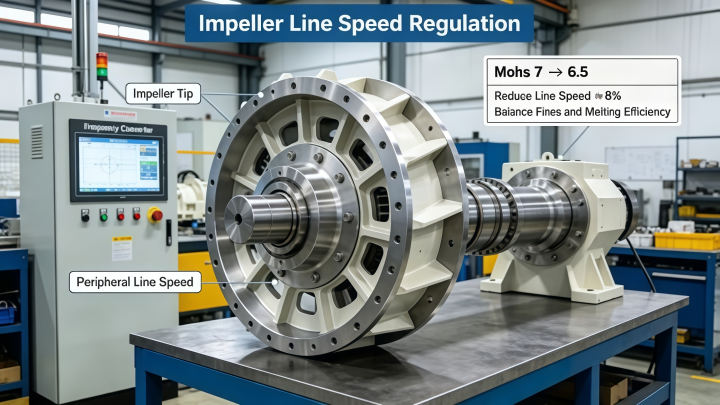
How to Regulate Line Speed for Glass Batch Quartz Sand
Impeller line speed is the primary variable controlling output particle size for a Quartz sand vertical impact crusher for glass batch selection. When ore hardness changes, line speed needs adjustment. At our factory in a quartzite mining area in East China, when the ore source switched from quartzite with Mohs hardness 7 to quartz sandstone with Mohs hardness 6.5, the line speed was reduced by approximately 8 percent to maintain the same gradation. This adjustment was based on continuous operation data comparison, not theoretical derivation.
For every 10 percent increase in line speed, fine powder yield typically rises by 3 to 5 proportional units. Speed regulation requires finding a balance between fine powder proportion and melting efficiency.
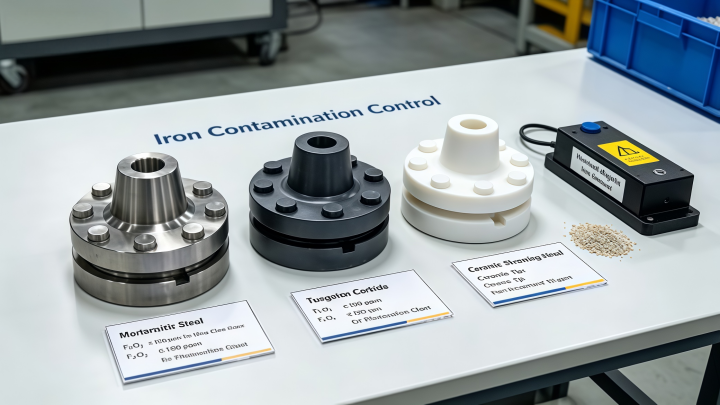
Quartz sand vertical impact crusher for glass batch selection iron contamination control
Quartz sand has a Mohs hardness of 7, making it a highly abrasive material. According to public data from equipment manufacturers, ordinary martensitic steel throwing heads may last only 40 to 60 hours when processing quartzite, while tungsten carbide throwing heads can last 300 to 500 hours.
For a certain batch of quartz sand we processed, the initial Fe₂O₃ was approximately 300 ppm. After 500 hours of operation, the iron increment rose from 8 ppm to 34 ppm. After replacing with ceramic throwing heads, it dropped back to 12 ppm. The material self-lining design on the inner wall of the crushing chamber reduces metal contact area, and a permanent magnetic iron remover is installed at the discharge outlet as a final barrier.
Fine Powder Management and Energy Consumption in Glass Sand Production
Excessive fine powder forms a dust carryover into the regenerator, reacting with alkali vapor to form low-melting-point compounds that block the checker bricks. This is a recognized batch carryover phenomenon in glass furnaces. A Quartz sand vertical impact crusher for glass batch selection can influence this through gradation control.
Industry test data shows that the lowest point of energy consumption per unit of finished sand occurs near an impact speed of approximately 60 meters per second. The electricity consumption range for vertical shaft impact crushers used for sand making is between 0.8 and 1.5 kWh per ton. In actual operation, the processing capacity margin is set at 25 percent, higher than the conventional recommendation of 20 percent, based on the judgment that continuous-operation furnaces have low tolerance for supply fluctuations.
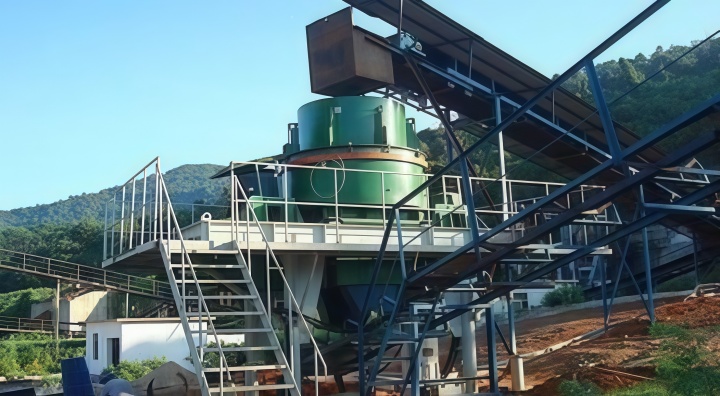
Operational Faults and Selection Matching for Vertical Impact Crushers
A sudden increase in vibration value usually points to unilateral wear of the impeller throwing head or rotor dynamic balance deviation. Replacement must be done in pairs of equal weight. If production declines but no error is reported, first check whether the screening return material volume has increased. Excessive return material means qualified particle sizes are not being discharged in time.
A sudden coarsening of output particle size is mostly due to offset of the impact plate gap, requiring shutdown calibration. Before changing the ore source, conduct a small-batch crushing test to confirm the particle size curve and iron increment. This is more convincing than any parameter comparison for a Quartz sand vertical impact crusher for glass batch selection.
Conclusion
The reasonable selection of this equipment is reflected in improved melting efficiency and reduced glass defect rate, rather than simple equipment price comparison. From the correspondence between line speed and target particle size, to the suppression of iron contamination by wear-resistant material, to fine powder gradation control and the trade-off between kWh per ton, each link needs verification based on one's own ore source and glass type.
If you are planning a quartz sand crushing production line, it is advisable to bring actual ore samples and target particle size requirements for an on-machine test.
Frequently Asked Questions
What are the requirements for the installation foundation of Quartz sand vertical impact crusher for glass batch selection?
An independent concrete foundation is required, with a dynamic load coefficient typically taken as 1.5 to 2.0. Leave space around the foundation for lifting and maintenance, and a value closer to 2.0 can avoid foundation resonance.
Can this crusher adapt to quartz ore sources of different hardness?
Yes, but hardness changes will affect output particle size and wear part service duration. A Quartz sand vertical impact crusher for glass batch selection may need a small-batch crushing test before changing the ore source, as hardness changes by more than 1 Mohs level may cause throwing head service duration variation of 30 to 40 percent.
How does this vertical impact crusher control noise and dust?
Install sound insulation covers on the crushing chamber and motor, and set negative pressure dust collection at the feed inlet. Dust emissions can stably meet standards, and rubber liners can reduce some medium-to-high frequency noise from impeller rotation and material impact.
What is the actual tolerance of Quartz sand vertical impact crusher for glass batch selection for feed moisture content?
The equipment can process materials with moisture content up to approximately 8 percent, but when it exceeds 5 percent, fine particles begin to stick to the impeller flow channels. It is recommended to reduce surface water to below 3 percent before entering the crushing chamber to avoid downtime losses from frequent flow channel cleaning.