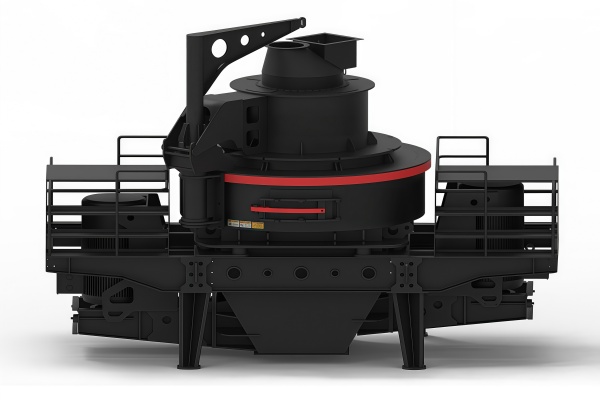
Quartz sand vertical impact crusher for glass batch
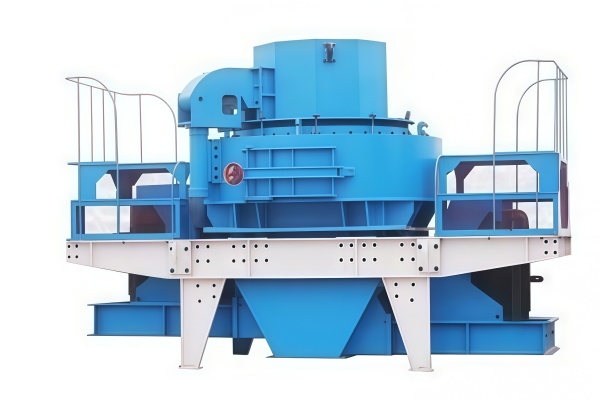
Quartz sand vertical impact crusher is specially designed for producing glass raw material quartz sand, performing medium and fine crushing on quartz stone to get well-shaped quartz sand with uniform grain size, widely used in glass batch processing, mining and construction industries. Prices typically range from $25,000 to $420,000. Feed opening size: ≤420mm Production capacity: 15-850 tons/hour Discharge opening adjustment range: 0-20mm Spindle speed: 1200-1800 rpm Motor power: 55-315kW
Product Highlights Summary about Quartz sand vertical impact crusher for glass batch
Quartz sand vertical impact crusher for glass batch is designed for high-purity quartz sand used in float glass and photovoltaic glass. Capacity: 70-1000 TPH. Output: 0-5mm. SiO₂ retention >99.2%. Iron oxide increase <0.02%. Unit power consumption is 12-20% lower than mainstream similar equipment, wear parts replacement interval is 40% longer, and operating rate reaches 92%. Factory-direct price from $35,000.
It reduces feed material below 50mm to 0-5mm finished sand for glass batch preparation. SiO₂ retention stays above 99.2%, and iron oxide increase is controlled within 0.02%. Average wear parts replacement cycle is 600-800 hours. The machine has been verified by multiple glass raw material processors in China, including a float glass plant in Luoyang.
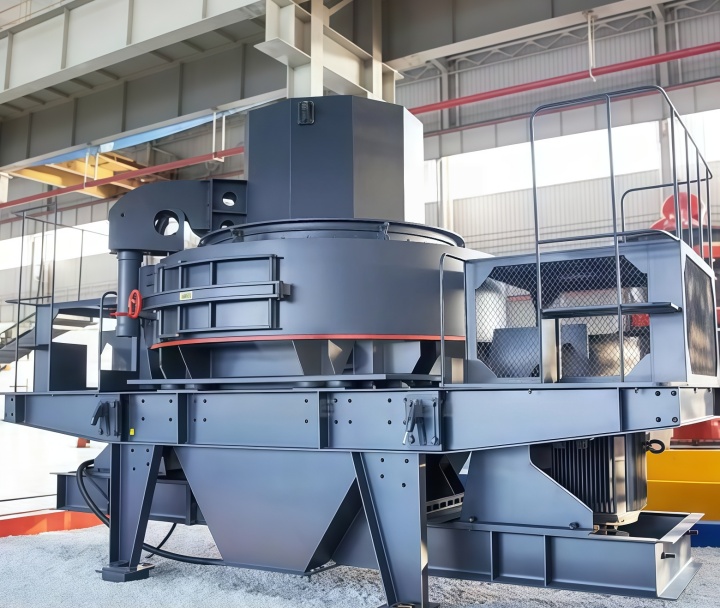
Quartz sand vertical impact crusher for glass batch Video Showcase
How It Works: Rock-on-Rock Autogenous Crushing
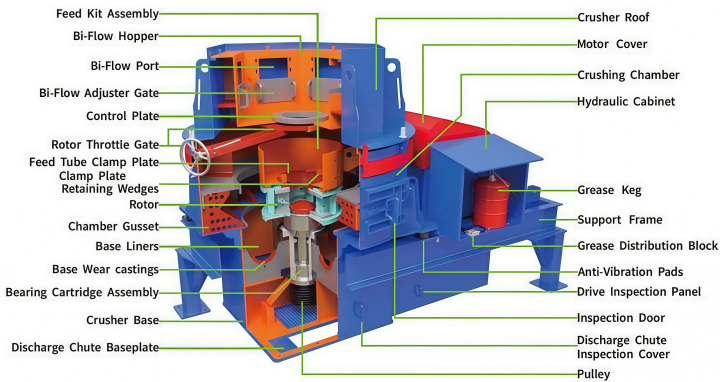
It operates in four stages: feeding, acceleration, impact, and discharge. Material enters vertically from the top into the high-speed rotor and is accelerated to 60-70 m/s under centrifugal force, then ejected from the rotor channels. The ejected material first collides at high speed with partially falling material diverted by the distributor. Both streams then impact the material lining layer on the crushing chamber wall, bounce back, change direction, and collide again with subsequently ejected material. This material-on-material collision is the key to keeping iron contamination below 0.02% for glass batch.
Why Material-on-Material Crushing Matters for Glass Batch?
A single quartz sand particle undergoes multiple impacts, friction, and grinding actions within the vortex crushing chamber before being discharged from the bottom outlet. Material collides with material, and the rotor body does not directly participate in the crushing process. This design prevents metallic wear debris from mixing into the finished sand. The rotor features an integral cast steel structure with high-chromium alloy wear-resistant liners embedded in the flow passages, and both the distribution cone and wear rings can be replaced on-site.
Technical Specifications
The equipment is available in multiple models for different production scales. The key technical parameters are shown in the table below.
| Model | Max Feed Size mm | Capacity t/h | Rotor Speed r/min | Motor Power kW | Overall Dimensions mm |
|---|---|---|---|---|---|
| VSI5X7615 | 35 | 70-140 | 1700-1900 | 75×2 | 4100×2330×2300 |
| VSI5X8522 | 40 | 120-190 | 1500-1700 | 110×2 | 4140×2500×2700 |
| VSI5X9532 | 45 | 180-280 | 1300-1510 | 160×2 | 4560×2600×2900 |
| VSI5X1145 | 50 | 250-360 | 1100-1310 | 220×2 | 5000×2790×3320 |
| VSI6X9026 | 35 | 160-215 | 1200-1500 | 132×2 | 4200×2400×3150 |
| DLVSI20100R | 200 | 700-1000 | 600 | 2×400 or 2×500 | — |
All models achieve iron oxide increase below 0.02% and SiO₂ retention above 99.2% when processing quartz sand for glass batch. For model selection by capacity, feed size, and iron control requirement, contact our engineers.
Applications: Float Glass, Photovoltaic Glass & Ceramics
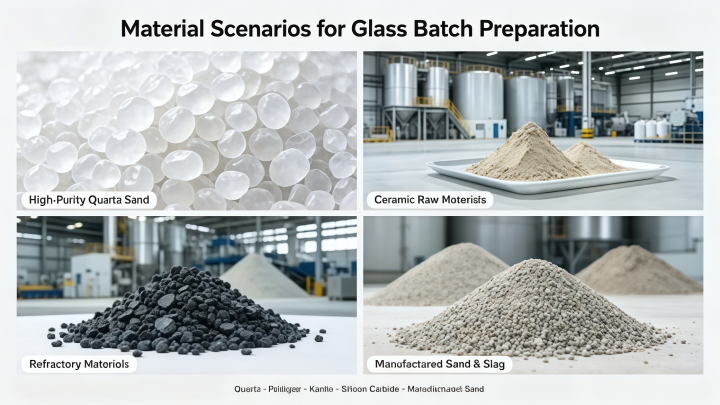
Quartz sand vertical impact crusher for glass batch is applied in the crushing of glass raw materials, ceramic raw materials, refractories, abrasives, and manufactured construction sand.
Float Glass Application
For float glass batch, the crusher processes high-purity quartz, fused quartz, calcined quartz, and waste glass. Output is 0-5mm with uniform particle shape and low flat/elongated content. Iron oxide increase stays below 0.02%, meeting float glass furnace feed requirements.
Photovoltaic Glass Application
Photovoltaic glass requires extremely low iron content. The rock-on-rock autogenous crushing principle prevents metal wear debris from entering the finished sand. Measured iron oxide increase is below 0.02%, and SiO₂ retention is above 99.2%, suitable for high-purity photovoltaic glass raw materials.
Ceramics, Refractories, Abrasives & Manufactured Sand
It is also suitable for medium-hardness brittle minerals such as potassium feldspar, sodium feldspar, and kaolin; refractories including magnesia and silicon carbide; abrasives such as emery and sintered bauxite; and manufactured sand, aggregate shaping, and metallurgical slag processing.
Core Advantages: Iron Control, Particle Shape & Wear Life
Operational data of the equipment demonstrates its core advantages in iron contamination control, particle shape quality, maintenance costs, operating modes, dust control, and lubrication protection.
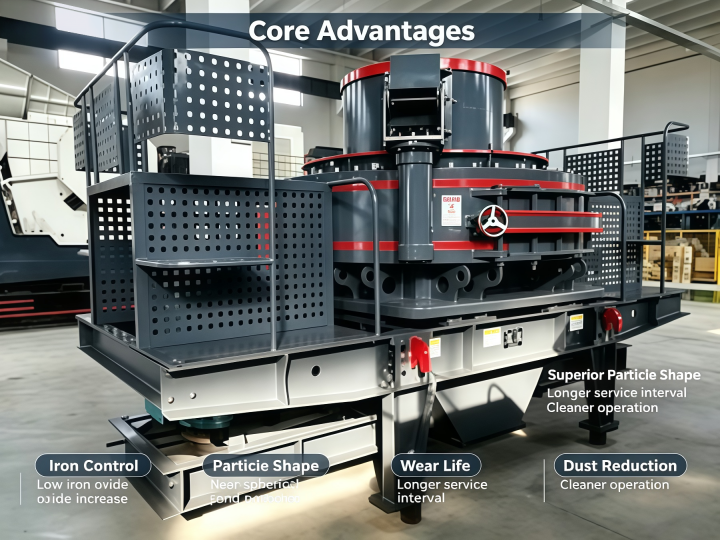
Iron Contamination Control
Material collides with material, and the rotor body does not participate in crushing. Measured iron oxide increase is below 0.02%.
Particle Shape Quality
Finished sand particles are nearly spherical. Flat and elongated particle content is below 5%, and bulk density is 12-15% higher than conventional methods.
Maintenance Cost
The autogenous lining layer in the crushing chamber stays at 80-120mm. Wear parts replacement interval reaches 720 hours, about 40% longer than conventional equipment.
Operating Modes
Full-center feed and cascade feed are switchable. Rock-on-rock and rock-on-metal modes are adjustable for different materials.
Dust and Noise Control
The vortex chamber airflow self-circulation design reduces dust emissions. Measured noise is below 75 dB.
Lubrication Protection
The lubrication system uses an automatic oil station with temperature and pressure monitoring. It protects the bearing system during continuous operation and reduces unplanned downtime.
VSI vs. Rod Mill & Conventional VSI: Measured Comparison
The measured comparison data between the equipment and mainstream similar equipment in China under identical working conditions are as follows. Testing conditions include feed size of 45mm, target output of 0 to 5mm, processing the same batch of calcined quartz raw material.
| Comparison Item | Quartz sand vertical impact crusher for glass batch | Brand A VSI Crusher | Brand B VSI Crusher |
|---|---|---|---|
| Unit Power Consumption kWh/t | 2.8 | 3.2 | 3.5 |
| Flat and Elongated Particle Content % | 4.2 | 6.8 | 7.5 |
| Wear Parts Replacement Interval hours | 720 | 480 | 420 |
| Operating Rate % | 92 | 85 | 82 |
Rock-on-Rock vs. Rock-on-Iron VSI for Glass Batch
| Comparison Item | Rock-on-Rock | Rock-on-Iron |
| Iron Increase | <0.02% | 0.05-0.15% |
| Particle Shape | Nearly spherical | Good |
| Wear Parts Cost | Lower | Higher |
| Best For | Photovoltaic glass, float glass | Construction sand, slag |
| Recommended for Glass Batch | Yes | Not for high-purity glass |
Conclusion: For glass batch, especially photovoltaic glass, rock-on-rock is the preferred mode because it minimizes iron contamination. Rock-on-iron is more suitable for construction sand and slag where iron content is not critical.
Case Study: Luoyang Float Glass Plant
Luoyang Float Glass Plant, China
A float glass processor in Luoyang purchased a VSI5X1145 in Q4 2025 for calcined quartz. Feed size was kept below 45mm, with 0.5-2mm fraction at 68% and daily throughput of 280-320 tons. During the first trial run, some oversized particles over 50mm caused blockage. On-site engineers adjusted the vibration feeder and replaced the screen mesh, raising the oversized particle interception rate to 99%. After that, the equipment ran smoothly. Production manager Zhang reported that after 8 months of continuous operation, the rotor body showed no significant wear and the operating rate reached 92%. Compared with the previous ring hammer crusher which needed quarterly hammer changes, this equipment extended wear parts replacement to 10 months, cut annual maintenance man-hours from 240 to 120, and reduced spare parts costs by about 40%.
Middle East Glass Manufacturer
A Middle Eastern glass manufacturer reported a 30% output increase and 15% fine reduction after switching to this crusher. Finished sand meets ASTM C144 standards.
Customer Quote
“The iron increase is stable and below our limit. The wear parts last much longer than our previous crusher.” — Production Manager Zhang, Luoyang
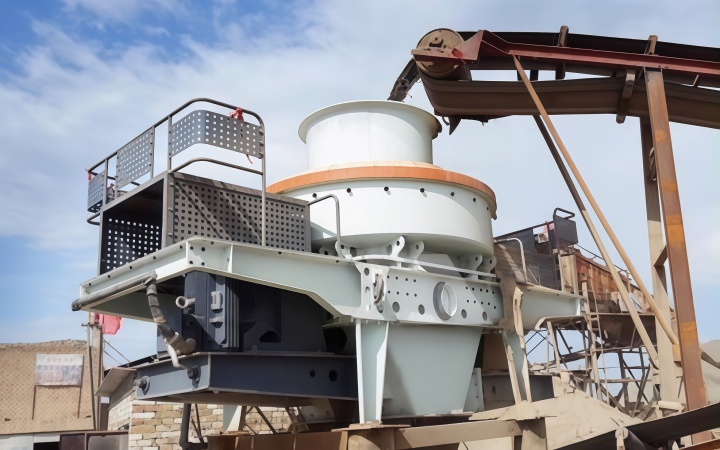
Selection Guide: How to Choose the Right VSI for Glass Batch
Selection of the equipment requires matching from five aspects: material hardness, feed moisture content, target output size, hourly throughput, and installation conditions.
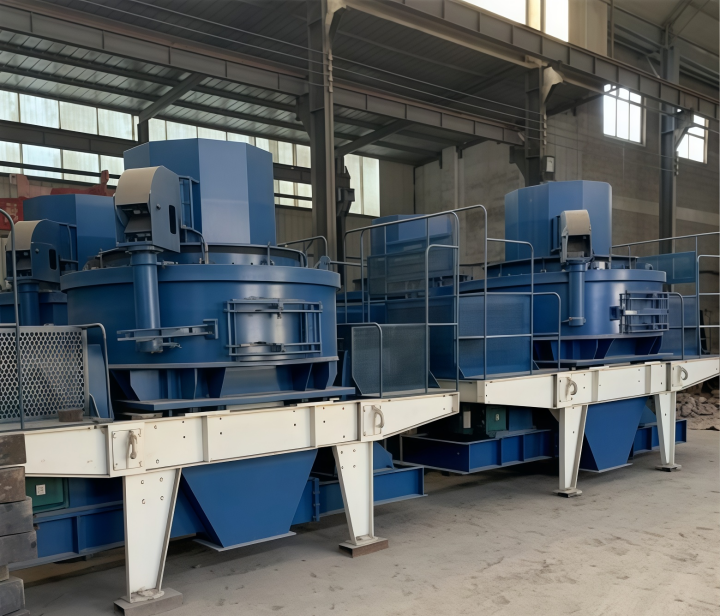
1.Material Hardness and SiO₂ Purity
Harder materials require more wear-resistant rotor and liner materials. For high-purity quartz, choose rock-on-rock mode and tungsten carbide or ceramic wear parts.
2.Feed Moisture Content
When feed moisture exceeds 8%, fine particles tend to adhere to the crushing chamber wall. Test moisture before feeding and equip drying or screening pretreatment.
3.Target Output Size
Target output size affects speed settings and crushing mode. For glass raw material with high particle shape requirements, use rock-on-rock mode.
4.Hourly Throughput
Hourly throughput affects model selection. Undersized selection leads to insufficient capacity; oversized selection increases initial investment and energy consumption.
5.Installation Conditions
Confirm site clearance height, power capacity, and lifting equipment configuration during the selection stage. For altitudes above 2000m, choose plateau-type motors and reduce capacity by 10-15%.
Common Selection Mistakes
Choosing rock-on-iron for photovoltaic glass, causing iron contamination.
Selecting a model based only on price, ignoring wear part life and power consumption.
Ignoring feed moisture and causing blockage.
Not reserving enough space for maintenance and liner replacement.
Frequently Asked Questions About the Quartz sand vertical impact crusher for glass batch
How should the quartz sand vertical impact crusher for glass batch be handled at altitudes above 2000 meters?
Reduced air density affects motor cooling and output. Plateau-type motors should be selected with increased fan power, and processing capacity should be reduced by 10 to 15 percent.
What is the actual power consumption of the quartz sand vertical impact crusher for glass batch?
Actual operating power consumption is typically 60 to 75 percent of rated total power, with measured specific power consumption of 2.5 to 3.5 kWh per ton in quartz sand processing.
Does the quartz sand vertical impact crusher for glass batch introduce iron contamination when processing high-purity quartz?
Since material collides with material and the rotor does not participate in crushing, the measured iron oxide increase in finished sand is below 0.02 percent, meeting the furnace feed standard of iron content below 0.012 percent for photovoltaic glass.
What after-sales services are included with the quartz sand vertical impact crusher for glass batch?
The equipment includes installation guidance, operator training, periodic inspections, and remote support. Critical faults receive telephone response within 4 hours during the warranty period.
What is the price range?
Factory-direct price is typically $35,000-120,000 by capacity and configuration. Contact us for a project-specific quote.
Can this VSI process quartz sand for photovoltaic glass?
Yes. With rock-on-rock mode and high-chromium or ceramic wear parts, iron oxide increase stays below 0.02%, meeting photovoltaic glass furnace feed requirements.
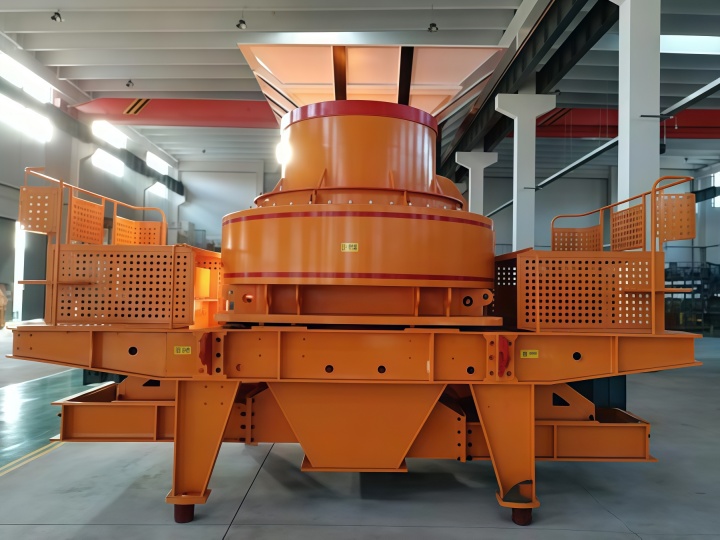
Why Choose MACHRISE for Glass Batch Crushing?
MACHRISE quartz sand VSI crusher processes quartz ore into finished sand with SiO₂ content above 98% and iron oxide below 0.1%, meeting furnace feed standards for float glass and photovoltaic glass. It has been verified at multiple glass raw material processing sites in China for particle shape control, purity maintenance, and operating costs. Proper selection and routine maintenance are the prerequisites for qualified finished sand.
Manufacturer & Factory Quality Control
MACHRISE operates a dedicated VSI crusher production base with CE and ISO 9001 certification. Each unit undergoes raw material inspection, assembly inspection, no-load test, and load test before shipment. We export to glass plants in Asia, the Middle East, Africa, and South America. Warranty: 12 months. After-sales response: within 4 hours for critical faults.