Packaging Machine Agitator
What is a Packaging Machine Agitator?
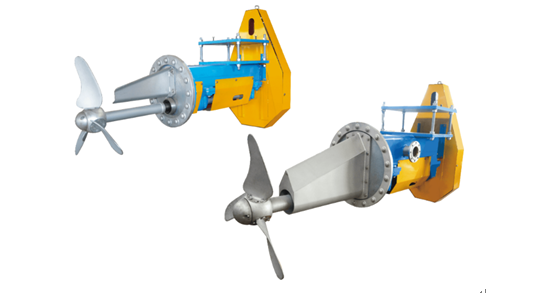
In the papermaking process, the agitator is a key piece of equipment ensuring pulp quality and process stability. It is mainly responsible for mixing, preventing sedimentation, and promoting reactions. It is suspended from the tank wall by flanges, requiring no cement foundation for fixation, thus occupying a small area and being easy to install.
It mainly consists of six parts: impeller, transmission unit, packing sealing unit, belt drive unit, frame unit, mounting ring, and protective cover.
The impeller consists of an impeller seat, blades, and a ball head cover. The blades and impeller seat are connected by locating pins and bolts. The impeller angle can be adjusted by adjusting the combination of locating pin holes and the blade angle.
The transmission unit consists of a bearing housing, bearings, main shaft, bushing, water-slinging ring, and spacer. The bearing housing and bearings support the main shaft. The bushing is fitted to the corresponding packing on the main shaft to protect it. The spacer is fitted to the part of the main shaft that extends into the pulp tank to prevent corrosion.
The packing sealing unit consists of a packing chamber, packing, water-slinging ring, gasket, and gland. The gasket is removed only when replacing the packing with pulp. After tightening the packing chamber, the packing can be replaced.
The belt drive unit consists of a motor, motor pulley, main pulley, V-belt, motor base plate, and screw. The motor transmits power to the main shaft via the belt.
The frame unit is welded from square tubing and steel plates. It is used to fix the bearing housing and the screw of the belt drive unit. The front flange connects to the mounting ring.
What are the uses of a packaging machine agitator?
Pulping and mixing: Thoroughly mix water, chemicals, and pulp fibers (such as waste paper and hay) to form a homogeneous pulp. Driven by a motor, the agitator blades rotate within the tank. Various designs are available, such as angled agitator bars to increase the mixing range, or a planetary gear structure that allows the agitator blades to rotate both on their own axis and around a central point, achieving thorough mixing.
Chemical mixing and bleaching: During the bleaching or chemical treatment stage, quickly and uniformly mix pulp with bleaching agents (such as hypochlorite), alkali solutions (such as sodium hydroxide), and other chemicals. High-strength, specialized mixers are employed. For example, a two-roll mixer features two rollers with stirring arms rotating in opposite directions at high speed, both mixing and propelling the pulp. The equipment is typically equipped with a steam interface to accelerate chemical reactions through heating.
Advantages of Packaging Machine Mixers
High and uniform mixing efficiency effectively prevents fiber clumping, laying a good foundation for subsequent processes. Simultaneously, by replacing manual labor, it reduces the workload of workers, shortens the papermaking process cycle, and is suitable for large-scale production.
Fast mixing speed ensures thorough chemical reactions (such as bleaching and causticizing), improving reagent utilization. It is also equipped with a steam heating function for precise temperature control of the reaction.
| Model | FJB600 | FJB800 | FJB1000 | FJB1300 | FJB1600 |
|---|---|---|---|---|---|
| Impeller Diameter (mm) | 600 | 800 | 1000 | 1300 | 1600 |
| Pulp Consistency (%) | ≤ 4.5 | ||||
| Pulp Tank Volume (m³) | 20–50 | 50–80 | 80–120 | 100–150 | 150–250 |
| Motor Power (kW) | 5.5–11 | 5.5–15 | 11–30 | 30–55 | 55–90 |