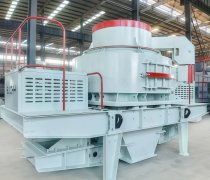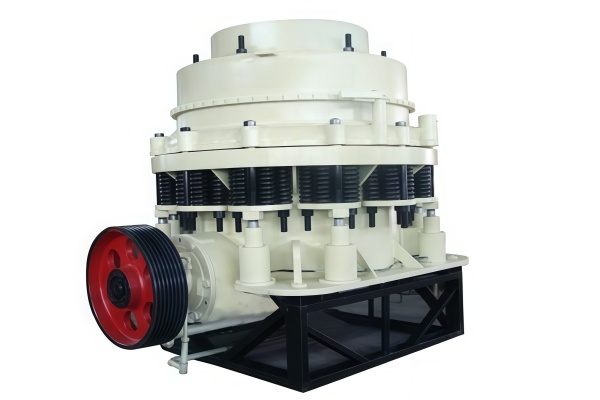
Compound Cone Crusher
Compound Cone Crushers are used for secondary and fine crushing of hard rock, ore and aggregate materials, producing high‑quality finished aggregates of varying particle sizes for use in quarry, mining, construction and building materials industries. Prices typically range from $28,000 to $480,000. Feed opening size: ≤490mm Production capacity: 27‑1800 tons/hour Discharge opening adjustment range: 3‑51mm Spindle speed: ≤460 rpm Motor power: 75‑630kW
What Is a Compound Cone Crusher?
Compound Cone Crusher is a cone-type crusher equipped with mechanical springs and a hydraulic assistance system. The crushing chamber cone angle of this equipment is calculated to allow the material to be compressed 1.3× more frequently than in conventional models of the same class.
The moving cone speed of Compound Cone Crusher is set at 300 r/min to 360 r/min , and together with an eccentric stroke of 18–30 mm, each piece of material experiences at least three effective compression actions during a single pass through the chamber. The product offers different chamber configurations ranging from standard coarse to short-head fine crushing, with the standard type focusing on mid-crushing capacity and the short-head type enhancing fine-particle shape.
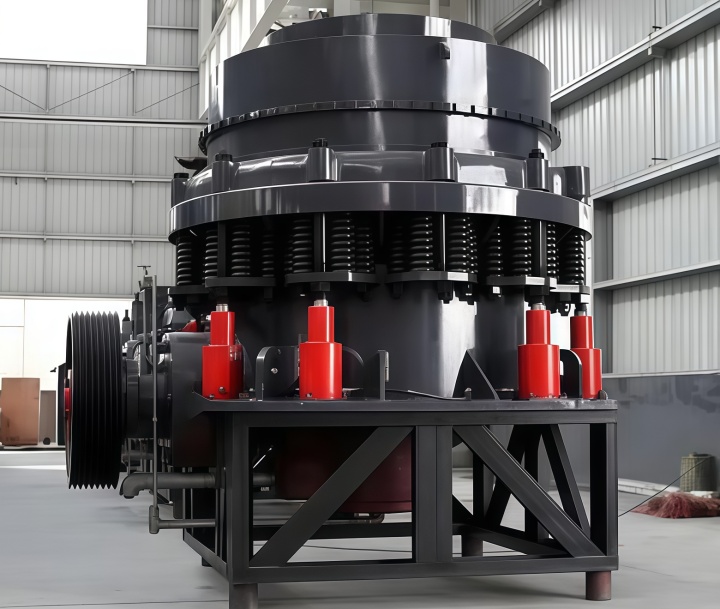
Compound Cone Crusher Video Showcase
How Does a Compound Cone Crusher Achieve Crushing?
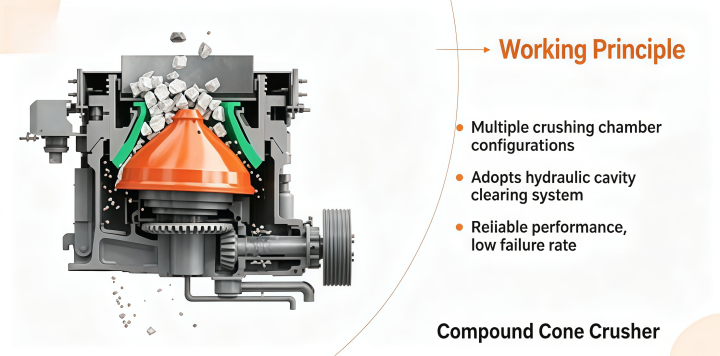
The eccentric mechanism drives the moving cone in a gyratory motion. Motor power transmits through the shaft to the eccentric sleeve, causing the cone to approach and retreat from the fixed cone, squeezing material until it reaches target size.
The spring assembly of Compound Cone Crusher acts as overload protection and rapidly enlarges the discharge opening when uncrushable material enters. Springs compress 8 % to 12 %, then reset. Medium and large units have hydraulic cleaning that raises the cone within five minutes.
This crusher shows a clear trade‑off: narrowing the setting from twenty‑two to 16mm raises power use eighteen to twenty‑two percent but cuts throughput only 8% to 10%. Every two‑millimeter reduction increases fines 6% to 8% and decreases capacity 5%. The effect varies—granite causes a steeper capacity loss than limestone. For shape‑focused operations, a 9 to 20 millimeter setting on Compound Cone Crusher offers a practical balance. No single setting fits all; choose based on feed and product needs.
Technical Parameters for Compound Cone Crusher Models
This equipment is available in multiple specifications. The following table summarizes the core parameters of typical models. All capacity data are measured under working conditions where the feed material has a compressive strength of one hundred fifty megapascals and moisture content below three percent.
| Model | Cone Base Diameter | Max Feed Size | Discharge Range | Open-Circuit Capacity | Recommended Motor Power | Net Weight |
|---|---|---|---|---|---|---|
| PSG300 Series | 1295 mm | 137 mm | 13–31 mm | 109–181 t/h | 160 kW | 23 t |
| PSG300 Series | 1295 mm | 210 mm | 16–38 mm | 132–253 t/h | 160 kW | 23 t |
| PSG400 Series | 1510 mm | 241 mm | 19–51 mm | 172–349 t/h | 250 kW | 33.5 t |
Actual Performance of Compound Cone Crusher Under Real Working Conditions
The equipment shows different capacity output and liner life when processing limestone versus granite, with actual performance being correlated with material compressive strength.
Granite production case: In March 2025, a three-thousand-ton-per-day granite aggregate plant in Quang Ngai Province, Vietnam, installed a PSG300 Series model as its secondary crusher. The unit processed eighty to one hundred twenty millimeter jaw crusher discharge at a twenty-millimeter closed-side setting for six consecutive months, achieving eighty-two percent of rated throughput. The manganese liners of this crusher lasted five hundred twenty hours – approximately 15% longer than a spring cone crusher operating in the same quarry.
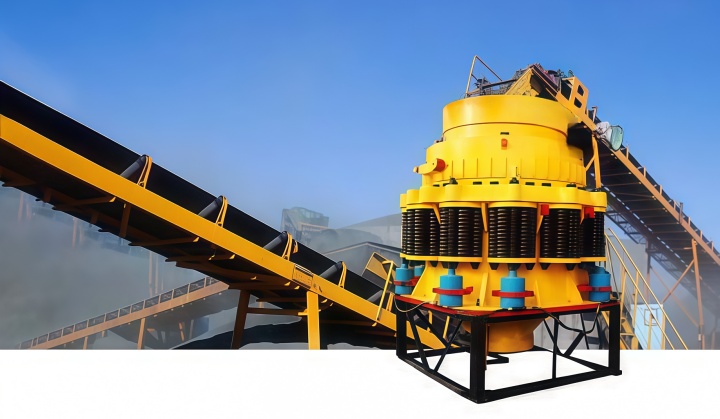
Based on operational data from multiple sites, it has been observed that the product delivers its consistent performance when feed moisture is kept below four percent. Above this threshold, packing in the crushing chamber of the device becomes the dominant failure mode regardless of the crusher setting.
Limestone capacity: When processing limestone with a compressive strength of one hundred fifty megapascals, feed size below one hundred millimeters, and discharge opening set at sixteen millimeters, the capacity of Compound Cone Crusher generally maintains between ninety-two and ninety-eight percent of the rated value.
Granite capacity: When processing granite with a compressive strength of two hundred fifty megapascals, feed size below one hundred twenty millimeters, and discharge opening set at twenty-two millimeters, the capacity of the equipment is about seventy-eight to eighty-five percent of the rated value.
Liner consumption rate: The liner consumption rate of this crusher is also related to material hardness. When crushing limestone, the accumulated service life of the bowl liner and mantle of the product commonly ranges from eight hundred to one thousand two hundred hours; when crushing granite, the service life drops to four hundred to six hundred hours.
Quantifiable Performance Advantages of Compound Cone Crusher
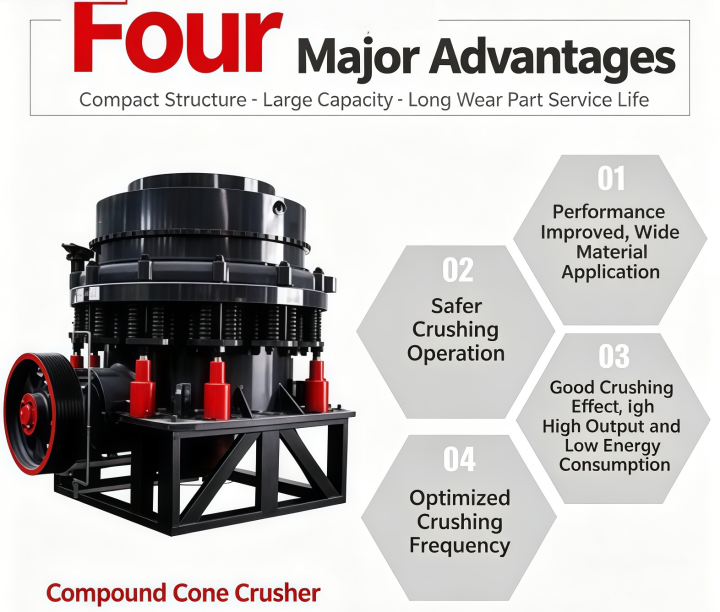
Compared with traditional spring-type models, this equipment offers verifiable improvements in five dimensions: specific energy consumption, product particle shape, operational reliability, adjustment efficiency, and high-temperature adaptability.
Specific power consumption: The specific power consumption of the machine is approximately 0.8 kW·h/t to 1.2 kW·h/t, which is about 8%-12% lower than that of pure spring machines.
Flakiness content: The flakiness and elongated particle content in the product of this crusher can be controlled within 12%, compared with the range of 8-22% typical of ordinary cone crushers.
Mean time between failures: The main shaft of Compound Cone Crusher is made of high-strength alloy forgings, giving it an average trouble-free operating interval of over nine hundred fifty hours.
Discharge adjustment time: Changing the discharge opening setting of the equipment requires hydraulic station operation, reducing the time from twenty minutes with traditional wrench methods to less than three minutes.
Oil temperature control under high-temperature conditions: Under continuous summer operation with an ambient temperature of forty-five degrees Celsius, the lubrication system of the product can keep the oil temperature within sixty-five degrees Celsius, allowing the equipment to operate during hot seasons without stopping.
Specific Application Scenarios for Compound Cone Crusher
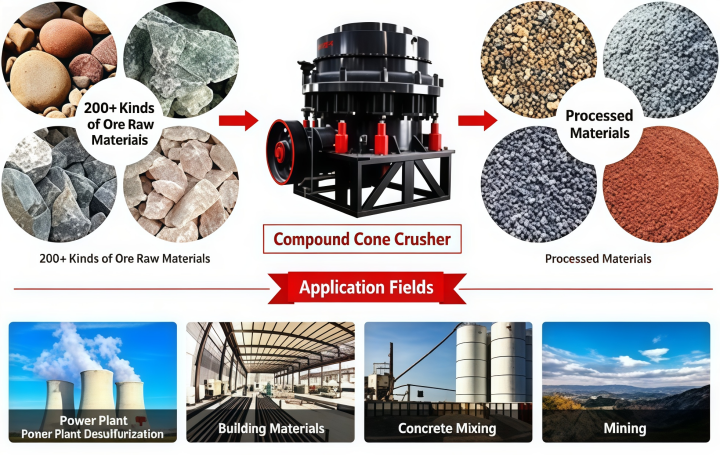
This crusher plays the role of medium or fine crushing in four typical scenarios: metal mines, aggregate production, metallurgical slag processing, and mobile crushing stations.
Metal mines: In metal mines, the machine takes the coarse product from jaw crushers and further reduces it to below twenty-five millimeters, providing feed for ball mills.
Aggregate production: In aggregate production, the equipment processes granite or basalt to produce secondary or tertiary aggregates with favorable particle shape for asphalt and concrete batching plants.
Metallurgical slag: In metallurgical slag treatment, this crusher is used to crush steel slag and ferroalloy slag, achieving dissociation of metal from the slag matrix.
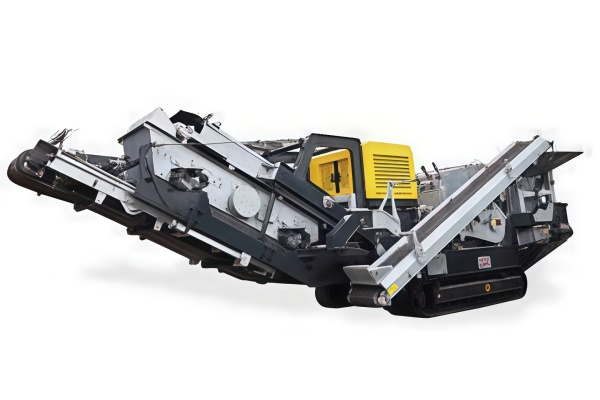
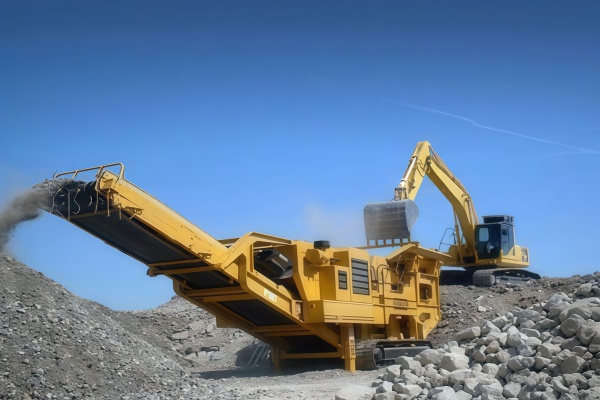
Mobile crushing stations: The product is also suitable for mobile crushing plants, combining with feeders and vibrating screens to form a relocatable production unit, suitable for operations that move between multiple job sites.
How to Select a Compound Cone Crusher and How Does It Differ from Pure Spring and Full-Hydraulic Machines?
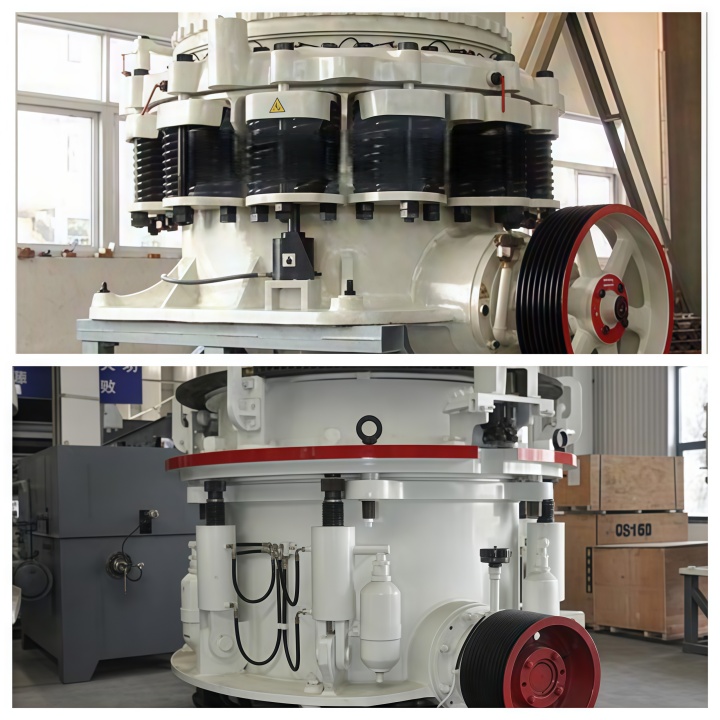
The selection of this equipment should be based on two core indicators – material hardness and target product fineness – while its structural differences from pure spring and full-hydraulic machines are clear in terms of adjustment method, overload response, and manufacturing cost.
Selection criteria: If the feed material has a compressive strength below two hundred megapascals and the main requirement is medium crushing, a standard-chamber model is recommended; if the material strength exceeds two hundred eighty megapascals and the final product must be smaller than twenty millimeters, a short-head chamber Compound Cone Crusher is more suitable.
Difference from pure spring type: The main difference between this crusher and pure spring cone crushers lies in the discharge adjustment method – the former uses hydraulic jacking adjustment, while the latter relies on manual rotation of the adjustment ring, making the product more efficient in adjustment.
Difference from full-hydraulic type: Compared with full-hydraulic cone crushers, the machine retains the spring overload mechanism. When encountering hard foreign objects, the spring compression response of Compound Cone Crusher is approximately zero point three seconds faster than pure hydraulic release, allowing faster discharge opening expansion to protect the main frame. In terms of manufacturing cost, the equipment is about sixty-five to seventy-five percent of the cost of a full-hydraulic model, offering a lower investment threshold.
Frequently Asked Questions about Compound Cone Crusher
Why does the oil temperature of the equipment rise during operation?
Low oil level, a clogged cooler, or worn bearings are the usual causes. Keep the return oil temperature of the product below fifty-five degrees Celsius.
What causes vibration or noise in the machine?
Uneven feeding, moisture above five percent, or tramp iron entering the cavity. Operators can address these by ensuring uniform feed and installing iron removal equipment ahead of the crusher.
Why does the production capacity of this crusher decrease over time?
Liner wear and high feed moisture are the primary reasons. Regular liner thickness monitoring and keeping feed moisture below four percent for the product can help maintain capacity.
What should be done when the equipment experiences a sudden shutdown or material blockage?
Stop the feed and clear the discharge opening. For models with hydraulic cleaning, raise the cone to release packed material within five minutes.