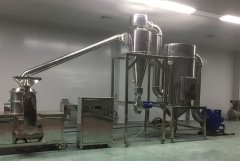
Ultrafine Pulverizer Machine
What is Ultrafine Pulverizer Machine?
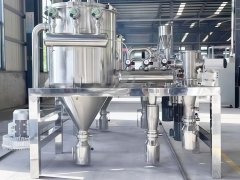
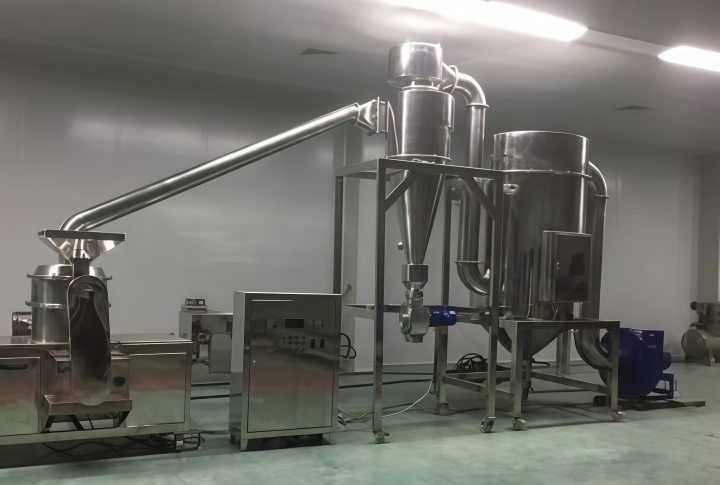
Ultrafine Pulverizer Machine is an industrial ultra-fine grinding device capable of reducing materials with Mohs hardness below 6 to fineness ranging from 400 mesh to 1350 mesh, with some materials reaching up to 2500 mesh. The equipment integrates mechanical impact grinding and air classification into one system, with a rotor linear speed reaching 85 m/s, simultaneously completing fine powder screening during the grinding process to avoid over-grinding. The whole unit operates under negative pressure in a sealed design, with workplace dust concentration controllable below 10 mg/m³, meeting emission standards.
Compared to conventional grinding equipment, Ultrafine Pulverizer Machine differs in that grinding and classification are integrated into a single sealed system, so users do not need additional classification equipment to obtain qualified fine powder. The unit features a modular design with a small footprint and flexible installation, allowing deployment in existing workshops. This equipment has already been put into use in powder processing production lines in multiple countries overseas.
How Does Ultrafine Pulverizer Machine Work?
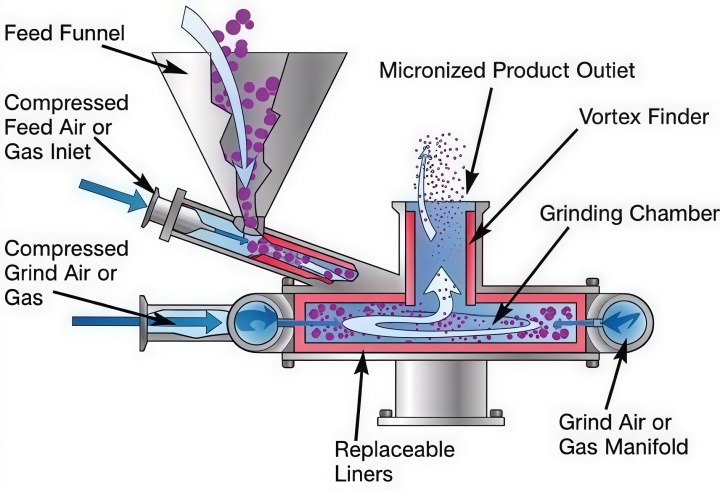
Ultrafine Pulverizer Machine operates on the principle of "grinding while classifying". Material enters the grinding chamber through the feed port, where it is crushed into fine particles by the high-speed rotating rotor and fixed stator rings through extrusion, impact, and shearing forces. The crushed material is carried upward by airflow to the classification zone, where the classifier wheel determines which particles can pass through based on its set speed — particles meeting the fineness requirement pass through the classifier wheel into the collection system, while oversized particles are returned to the grinding chamber for further grinding.
The entire grinding, classification, and collection process is completed in a closed-loop system without the need for external auxiliary equipment, enabling continuous production with single feeding and single powder output.
Technical Details Often Overlooked When Purchasing Ultrafine Pulverizer Machine
When purchasing, users tend to focus only on model and price, but the following three details often become issues only after the equipment arrives on site, at which point adjustments are more costly.
Every 1% Increase in Material Moisture Reduces Efficiency by 2%-3%
According to data from 87 factories compiled at an industry conference in Q3 2025, moisture is the primary factor affecting grinding efficiency. When moisture rises from 8% to 12%, capacity drops by 8%-12%. Drying should be a standard step in production line planning.
The Balanced Point for Classifier Speed on Model 800 is Approximately 2600 r/min
For Model 800, classifier speed within the 2000–3000 r/min range shows a nearly linear fineness increase; beyond 3000 r/min, fineness improvement slows while energy consumption rises. Test data show 2600 r/min is the balance point between energy consumption and fineness. Users should start with this value and fine-tune based on actual material.
Weight Difference Between Two Sets of Hammers Must Not Exceed 5 Grams When Replacing
Hammers are symmetrically arranged on the rotor. If the weight difference between two sets on the symmetrical axis exceeds 5 grams, rotor balance is disrupted, causing vibration to rise from 1.5 mm/s to over 7 mm/s, directly affecting bearing life. Precision balance weighing must be used after replacement.
Key Technical Specifications of Ultrafine Pulverizer Machine
Ultrafine Pulverizer Machine is available in three standard models — 500, 800, and 1000 — allowing users to choose according to capacity requirements.
| Parameter | Model 500 | Model 800 | Model 1000 |
|---|---|---|---|
| Feed Size | 10-30 mm | 10-35 mm | 10-35 mm |
| Material Hardness | Mohs <6.5 | Mohs <6.5 | Mohs <6.5 |
| Grinding Fineness | 400-1350 mesh | 400-1350 mesh | 400-1350 mesh |
| Production Capacity | 200-1500 kg/h | 600-2500 kg/h | 800-4000 kg/h |
| Main Shaft Speed | 3600 r/min | 2940 r/min | 2820 r/min |
| Main Motor Power | 22/2 kW | 37-45/2 kW | 55-75/2 kW |
| Machine Weight | 2500 kg | 2700 kg | 4050 kg |
It should be noted that the above capacity data are measured under standard conditions using calcite with moisture content below 8%. If material moisture exceeds 12%, drying pretreatment is recommended before feeding into Ultrafine Pulverizer Machine; otherwise, capacity may drop by more than 30%.
The coordinated adjustment of main shaft speed and classifier speed is key to controlling finished product fineness, and users can flexibly set within the 400–1350 mesh range according to target fineness, with slight variation across different models.
Core Advantages of Ultrafine Pulverizer Machine
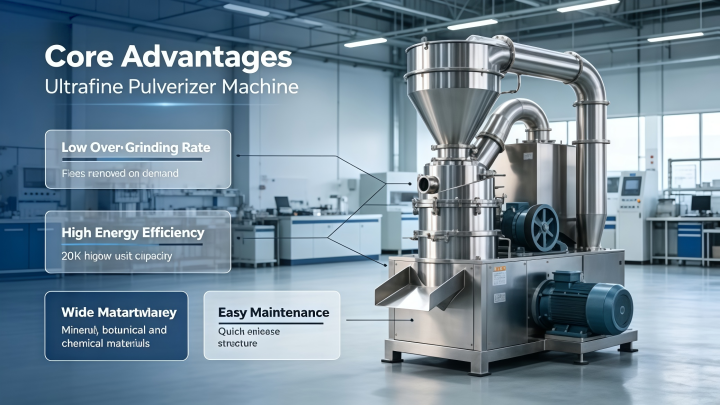
Ultrafine Pulverizer Machine differs from conventional grinding equipment in that it integrates grinding and classification into a single unit, bringing about the following four characteristics.
Lower Over-Grinding Rate: This equipment separates qualified fine powder from the grinding zone the moment it reaches the set fineness, keeping over-grinding rate within 3%, compared to 15%-20% for traditional equipment.
Reduced Energy Consumption per Unit Capacity: Because qualified fines are removed promptly, the grinding chamber always processes coarse particles that need to be ground, improving energy utilization; under the same energy input, unit capacity increases by more than 20%.
Wider Material Adaptability: For sticky materials, a high-volume air intake system can be configured to reduce adhesion; for heat-sensitive materials, a water-jacket cooling system can be added to keep grinding chamber temperature below ambient by 20°C.
Convenient Maintenance and Operation: The grinding disc, classifier wheel, and liners feature a quick-release structure that can be disassembled by hand without tools; cleaning the entire machine takes about 40 minutes, whereas similar equipment typically requires over 1.5 hours.
Which Materials Are Suitable for Ultrafine Pulverizer Machine?
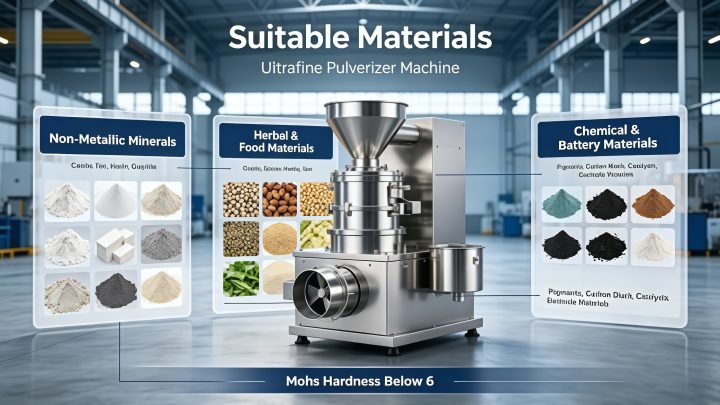
The material adaptability of Ultrafine Pulverizer Machine is defined by one core criterion — Mohs hardness 6 is the dividing line. Materials with hardness below 6 can be processed, with different material categories requiring different configurations and yielding different fineness levels.
Non-Metallic Minerals: Calcite, talc, marble, limestone, barite, kaolin, graphite, etc. With hardness mostly between 3 and 5, these are the most suitable processing targets for this equipment, with finished fineness stably reaching above 1250 mesh.
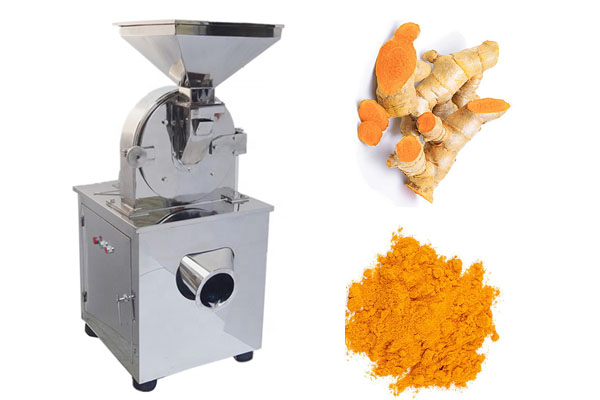
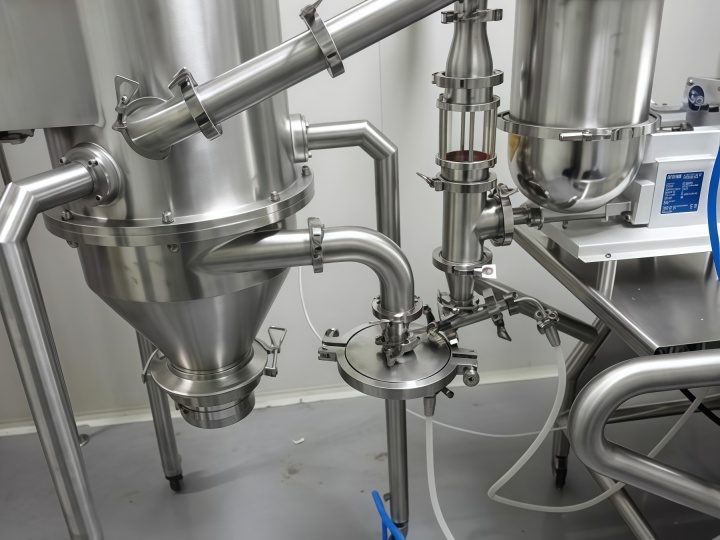
Botanical Materials: Chinese medicinal herbs, grains, spices, tea leaves, dehydrated vegetables, etc. Models built with stainless steel can meet hygiene standards for food and pharmaceutical industries.
Chemical Synthetic Materials: Coatings, pigments, dyes, pesticides, catalysts, carbon black, flame retardants, and lithium battery cathode/anode materials. The classification system of this equipment can control particle size distribution within ±5%.
How to Choose the Right Model of Ultrafine Pulverizer Machine?
Model selection is based on two primary dimensions: material characteristics and production capacity requirements.
Material Dimension
Material hardness below 6 on the Mohs scale is the fundamental prerequisite for this equipment to process the material effectively. If material moisture exceeds 12%, drying equipment must be installed at the front end of the production line; without this preparation, the equipment will not achieve its rated capacity regardless of the model selected. For heat‑sensitive materials, adding a water‑jacket cooling system is recommended for any model choice, which keeps the grinding chamber temperature below ambient by 20°C to prevent melting and wall sticking.
Capacity Dimension
Model 500 delivers 200‑1500 kg/h, suitable for laboratory use or small‑batch production. Model 800 provides 600‑2500 kg/h, covering the daily needs of most medium‑sized operations. Model 1000 achieves 800‑4000 kg/h, designed for large‑scale production lines processing dozens of tons per day.
After the initial selection, it is advisable to provide material samples for small‑scale trial grinding to confirm actual grinding performance and capacity against expectations.
Frequently Asked Questions about Ultrafine Pulverizer Machine
How long does the hammer of Ultrafine Pulverizer Machine last?
Approximately 1500 to 2000 hours when processing calcite and similar materials with hardness around 3; shorter, about 800 to 1000 hours, when hardness approaches 6.
What causes back-spray at the feed inlet of Ultrafine Pulverizer Machine?
Clogged dust collection bags reducing permeability or pipe blockages; stop the machine, clean the dust collection bags, then inspect pipes and air dampers.
What temperature is considered abnormal for bearings on Ultrafine Pulverizer Machine?
A temperature rise exceeding 60°C or absolute temperature above 85°C is abnormal; reduce feed rate and check whether lubricating grease has dried out.
Can Ultrafine Pulverizer Machine process heat-sensitive materials?
Yes, but a water-jacket cooling system must be installed, which can keep the grinding chamber temperature below ambient by 20°C.