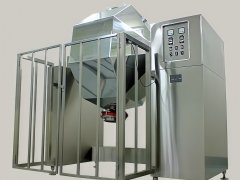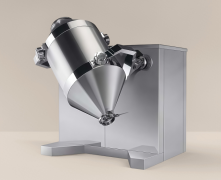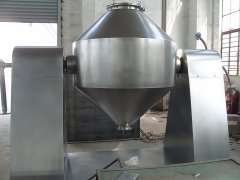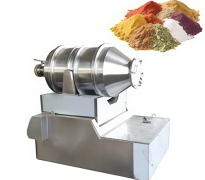
Two-Dimensional Mixer for Chemical Particles
Two-Dimensional Mixer for Chemical Particles is specifically designed for powder and granular materials in the chemical industry. Through the dual compound motion of drum rotation and swing frame oscillation, it achieves high-uniformity mixing and is suitable for various dry powders and granules in chemical production. The content of this article is compiled based on years of on-site service experience in the chemical mixing equipment field and actual operating data from multiple users. All measured data come from on-site user records and follow-up surveys.
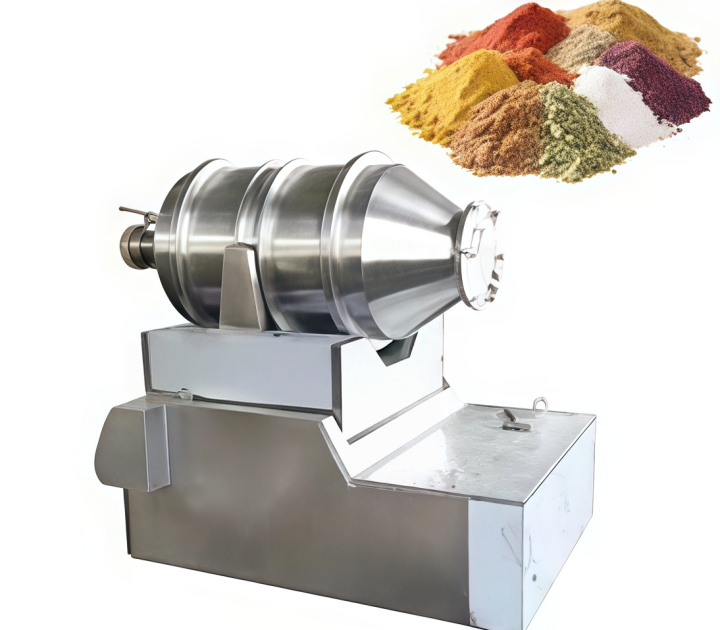
What Is Two-Dimensional Mixer for Chemical Particles?
Two-Dimensional Mixer for Chemical Particles derives its name from its unique motion logic: it generates mechanical motion in two dimensions simultaneously during operation. The first dimension is the continuous rotation of the material-loaded drum around its own central axis, and the second dimension is the reciprocating oscillation of the entire drum together with the swing frame around a horizontal axis. The two motions are perpendicular in space and synchronized in time, together forming the essential characteristic that distinguishes this equipment from single-dimensional mixers.
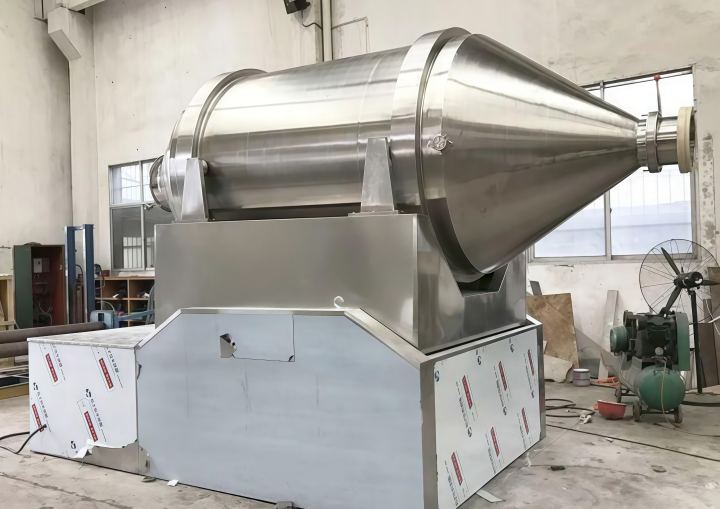
The complete machine structure consists of three parts: the mixing drum that holds the material, the swing frame that supports the drum and enables the oscillating motion, and the base frame fixed to the ground. The mixing drum is positioned and driven by a roller system, and the swing frame is connected to the frame through a crank-connecting rod mechanism. The mixing drum is made of stainless steel with a polished inner surface to meet the chemical industry's requirements for cleanliness and corrosion resistance.
How Does Two-Dimensional Mixer for Chemical Particles Work?
The operation of the equipment involves two simultaneously occurring motion components. The rotation of the mixing drum continuously lifts the materials inside, carries them upward, and naturally drops them upon reaching a certain height, completing circumferential tumbling and displacement. The reciprocating oscillation of the swing frame causes the entire mixing drum along with the internal materials to shake left and right.
With the two motions superimposed, the materials inside the drum are simultaneously subjected to pushing forces from two directions. The rotation continuously tumbles and exchanges materials on the drum cross-section, while the oscillation repeatedly transports and blends materials along the drum axis. This combined motion forms a three-dimensional material convection pattern within the drum. Each batch typically takes 6 to 30 minutes, with single-batch processing capacities ranging from tens of kilograms to several tons.
Taking the processing of materials containing both 80-mesh and 300-mesh particles as an example, traditional single-dimensional mixing equipment tends to cause segregation due to differences in particle settling velocity. The two-dimensional compound motion of this equipment continuously changes the relative positions of light and heavy particles, and measurements show the uniformity standard deviation can be reduced from 0.8 with single-dimensional equipment to within 0.2.
Two-Dimensional Mixer for Chemical Particles Selection Guide
When selecting the equipment, users frequently encounter three core questions, answered below.
Material bulk density decides the volume needed. A 2000-liter model loads 500 kg for density 0.5 powder and 1200 kg for density 1.2 granules. Base selection on required batch weight.
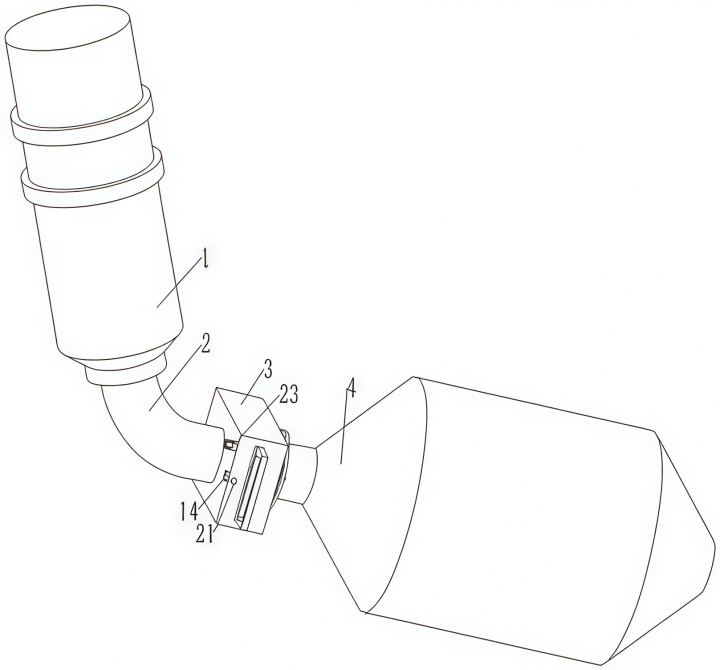
Discharge method affects throughput. Larger outlets with spiral assist cut batch discharge from eight to three minutes, boosting daily output 15%. Choose larger when cleaning exceeds three times daily.
Two-Dimensional Mixer for Chemical Particles suits fragile materials like catalysts and resin crystals. Three-dimensional mixers handle poor-flow or agglomerating materials but cause higher breakage. Test both with actual materials and compare results.
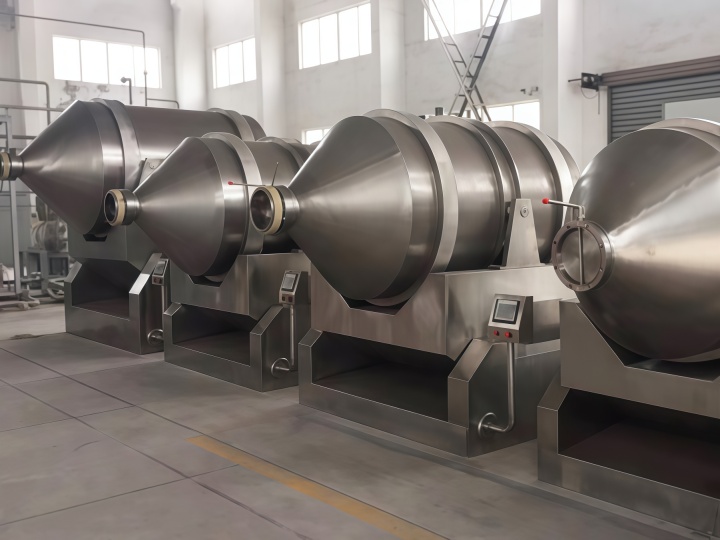
Technical Specifications of Two-Dimensional Mixer for Chemical Particles
The equipment is available in various models ranging from 60 liters to 20,000 liters. The key technical specifications for major models are as follows:
| Model | Drum Capacity (L) | Load Capacity (L) | Max Load (kg) | Oscillation/Rotation (r/min) | Total Power (kW) |
|---|---|---|---|---|---|
| EYH-60 | 60 | 36 | 18 | 50 | 0.4 |
| EYH-150 | 150 | 90 | 45 | 37 | 1.15 |
| EYH-300 | 300 | 180 | 90 | 30 | 1.15 |
| EYH-600 | 600 | 360 | 180 | 23.6 | 3 |
| EYH-800 | 800 | 480 | 240 | 19.8 | 3 |
| EYH-1000A | 1000 | 600 | 300 | 19.8 | 3 |
| EYH-1500A | 1500 | 900 | 450 | 16.2 | 4.4 |
| EYH-2000A | 2000 | 1200 | 600 | 16.2 | 7.4 |
| EYH-3000A | 3000 | 1800 | 900 | 13.8 | 11 |
| EYH-4000A | 4000 | 2400 | 1200 | 12.8 | 13 |
| EYH-6000A | 6000 | 3600 | 1800 | 11.2 | 18.5 |
| EYH-8000A | 8000 | 4800 | 2400 | 10.4 | 22 |
| EYH-10000A | 10000 | 6000 | 3000 | 9 | 30 |
| EYH-12000A | 12000 | 7200 | 3600 | 7 | 30 |
| EYH-15000A | 15000 | 9000 | 4500 | 6 | 50 |
| EYH-20000A | 20000 | 12000 | 6000 | 6 | 60 |
The loading coefficient is generally fifty to sixty percent of the total drum volume. Loading capacity is calculated based on material bulk density of 0.6 g/cm³. If the actual material bulk density exceeds this value, special notification is required when placing an order.
Core Advantages of Two-Dimensional Mixer for Chemical Particles
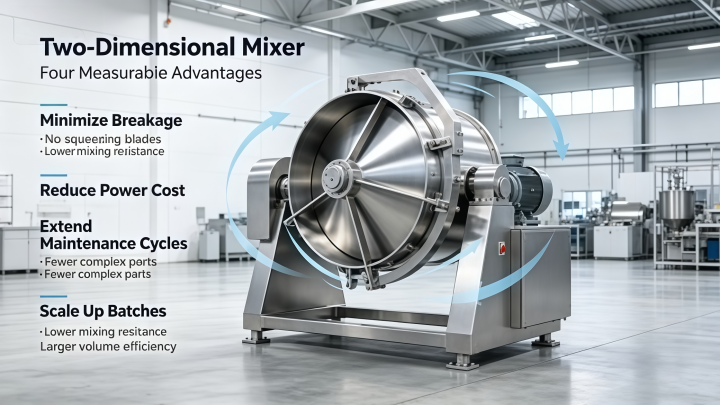
The equipment demonstrates four measurable advantages in chemical particle mixing applications, covering breakage reduction, energy efficiency, maintenance frequency, and batch capacity.
Material loss is minimal.No blades inside the drum means no squeezing or impact. Breakage dropped from 4.7% to 0.3% at a Henan catalyst plant after switching to this unit.
Energy consumption is relatively low. Power usage is about 2.1 kWh per ton for density-0.8 powder, versus 3.8‑4.5 kWh for bladed mixers at the same capacity.
Maintenance requirements are modest.The simple drive system keeps unplanned downtime below two incidents per year, per records from multiple users.
Large-batch capability is strong.A Shandong fertilizer maker upgraded to a 6000-liter model, raising load from 1200 to 1800 kg and uniformity from 96.5% to 99.1%.
Customer Case Studies for Two-Dimensional Mixer for Chemical Particles
The following are actual operating data from three users of the equipment across different regions and industries.
Case One: Spherical catalyst manufacturer in Henan Province. The company previously used a vertical high-speed mixer, with a spherical catalyst breakage rate of approximately 4.7%, negatively impacting product yield. After switching to this equipment, the breakage rate dropped to 0.3%, and product yield increased by over four percent.
Case Two: Compound fertilizer manufacturer in Shandong Province. With an annual output of 50,000 tons, the company originally used a dual-shaft paddle mixer with a single-batch capacity of 1200 kilograms and uniformity of 96.5%. After upgrading to the 6000-liter model, single-batch capacity increased to 1800 kilograms, uniformity reached 99.1%, and unit energy consumption decreased by approximately thirty percent.
Case Three: Titanium dioxide post-treatment workshop in Jiangsu Province. The workshop needed to uniformly mix titanium dioxide with multiple surface treatment agents, with the original process taking 25 minutes per batch. After implementing this equipment, mixing time was reduced to 12 minutes, and batch-to-batch color difference ΔE was consistently maintained within 0.5.
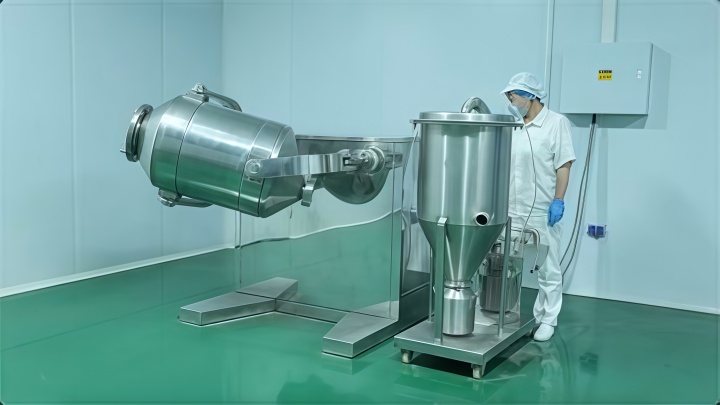
Material Types Suitable for Two-Dimensional Mixer for Chemical Particles
The applications of the equipment can be categorized by material properties.
Free-flowing powder materials include chemical raw material powders, catalyst powders, and additive powders. These materials have good flowability and can quickly achieve convection and diffusion under the two-dimensional motion, resulting in high mixing efficiency.
Granular materials cover chemical granular raw materials, resin pellets, plastic particles, and fertilizer granules. The blade-less design prevents secondary breakage of granules, with particle integrity rates maintained above ninety-nine percent.
Dyes and pigment mixtures are widely used in color matching applications. Different colored powders or granules achieve uniform distribution under the two-dimensional motion, meeting color difference control requirements.
Pesticides and fertilizer formulations are equally suitable for the equipment, with large-capacity models particularly well-suited for high-volume production demands. Additionally, the equipment has mature applications in food additives, feed premixes, and metallurgical powders.
Commissioning Process for New Two-Dimensional Mixer for Chemical Particles
The commissioning quality after equipment installation directly affects operational stability and service life. The process consists of three steps.
Step One: Inspection and tightening. Confirm all anchor bolts are tightened to the specified torque, the joint bearings at the swing frame-to-frame connections are secure, and all drive component protective covers are properly installed.
Step Two: No-load trial run. After startup, observe whether the swing amplitude is uniform, the rotation is smooth, and listen for any abnormal noise. The no-load run should last no less than two hours, with bearing temperature checks every thirty minutes—temperature rise should not exceed forty degrees Celsius above ambient temperature.
Step Three: Load commissioning. Gradually increase the loading coefficient in stages of thirty percent, fifty percent, and seventy percent, running for fifteen minutes at each stage while checking whether the motor current remains within the rated range. For a 2000-liter model at a sixty percent loading coefficient, normal operating current is typically between seventy and eighty percent of the rated current.
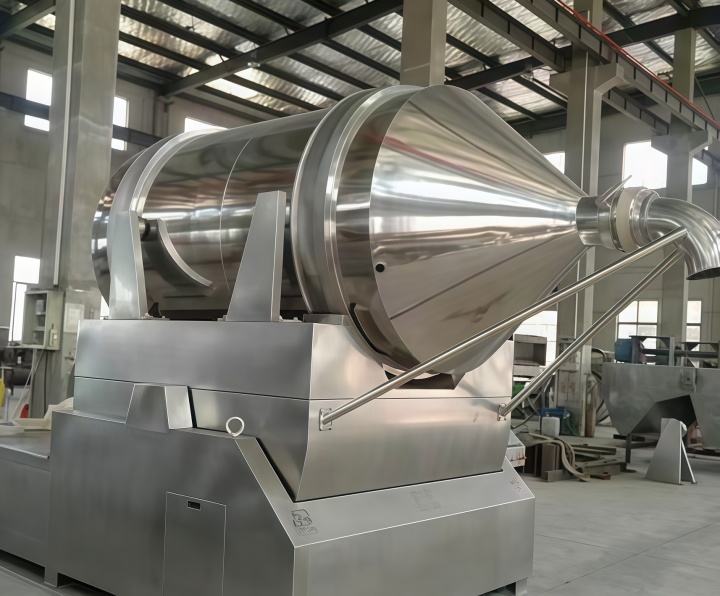
Daily Maintenance Essentials for Two-Dimensional Mixer for Chemical Particles
There is a correlation between daily maintenance quality and the service life of mixing accuracy. Maintenance focuses on the following three areas.
Roller and drum track contact surfaces. The rollers bear the combined weight of the drum and materials, and surface wear will alter the drum's rotation center position. It is recommended to inspect the roller surface for visible wear grooves weekly and replenish specialized lubricating grease monthly.
Crank-connecting rod mechanism joint bearings. This bearing is the core transmission component for the oscillating motion and continuously withstands alternating loads during operation. It is recommended to replenish grease through the grease nipple every two weeks and inspect bearing clearance every six months. When clearance exceeds fifteen percent of the factory standard value, replacement should be scheduled.
Drive belt tension. Insufficient belt tension causes slipping and unstable speed, while excessive tension accelerates bearing wear. It is recommended to check belt tension monthly. When pressing the middle of the belt with a finger, approximately fifteen millimeters of deflection is desirable.
Frequently Asked Questions About Two-Dimensional Mixer for Chemical Particles
Why does mixing uniformity gradually decrease after extended operation of Two-Dimensional Mixer for Chemical Particles?
Wear in the crank-connecting rod joint bearings reduces swing amplitude over time. Statistics show an average degradation of 8‑15% over three years; if it exceeds 5%, check the angle every six months and replace worn parts.
How can residual materials be cleaned when changing product types with Two-Dimensional Mixer for Chemical Particles?
Using drum rotation with compressed air blowing cuts cleaning time to under 25 minutes, versus 75 minutes for manual cleaning. Run the empty drum at 70% speed and blow 0.6 MPa air through the feed port for 8‑10 minutes.
What should be done when mixing effectiveness decreases in winter low‑temperature environments with Two‑Dimensional Mixer for Chemical Particles?
Low workshop temperatures (below 5°C) can drop uniformity from 98.7% to 95.2% for greasy premixes. Warm materials indoors for 24 hours before feeding, or add insulation to keep the drum wall above 15°C.
Why is the loading coefficient of Two-Dimensional Mixer for Chemical Particles recommended to be kept within seventy percent?
Exceeding 70% loading leaves insufficient headspace for material drop and reduces mixing efficiency. Tests show that increasing from 60% to 80% doubles the time needed for the same uniformity and raises motor current by 22%.