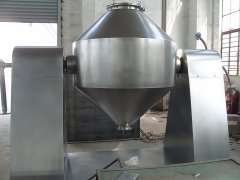
Food-Grade Double Cone Blender for Granules
What Is the Food-Grade Double Cone Blender for Granules and What Is Its Application Value?
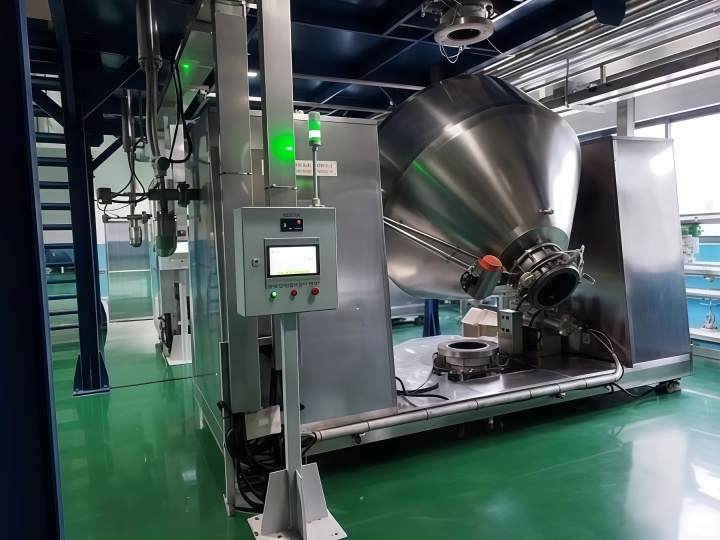
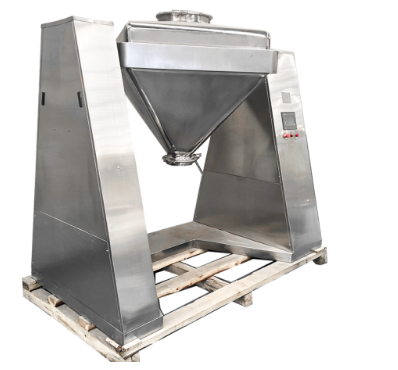
The Food-Grade Double Cone Blender for Granules is a rotary mixing device designed for uniform blending of granular materials in the food industry, with a feeding capacity ranging from 25 kg to 3,000 kg to meet the full spectrum of needs from laboratory R&D to industrial-scale production.
In May 2026, we provided equipment commissioning services for a large coffee powder manufacturer in Vietnam. The customer had previously experienced a breakage rate as high as 4.7% when processing ground coffee beans using conventional mixing equipment. After adopting the SZH-500L Food-Grade Double Cone Blender for Granules and reducing the rotational speed from 12 rpm to 8 rpm, the breakage rate dropped to below 0.3%.
All product-contact parts are constructed from SS316L stainless steel with a mirror-polished internal surface finish of Ra less than 0.8 micrometers, verified by SGS to comply with EHEDG hygienic design standards.
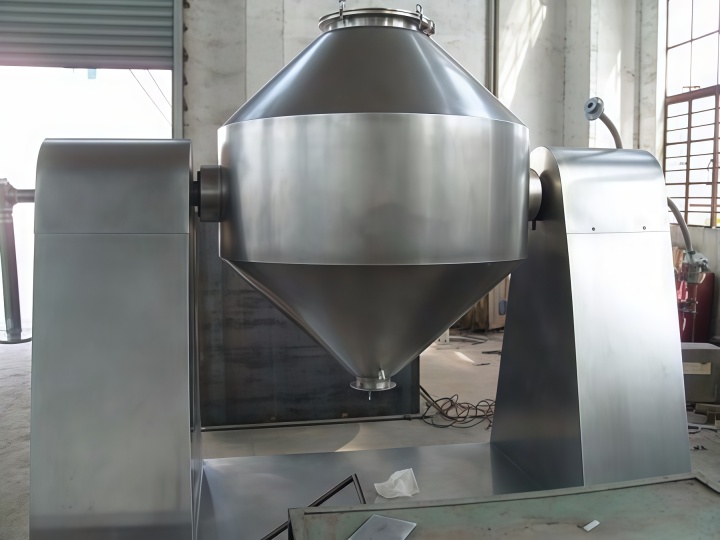
The Mixing Principle of the Food-Grade Double Cone Blender for Granules
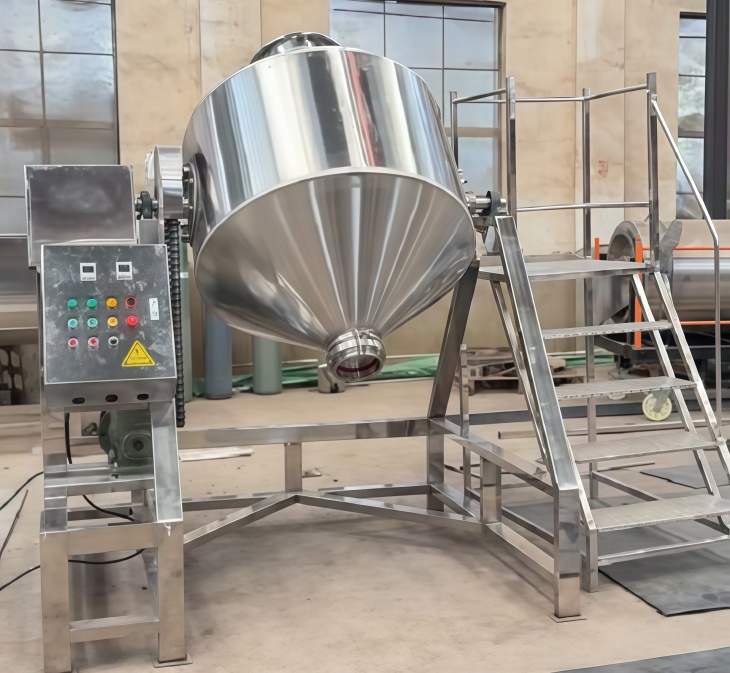
The core operating principle is based on the rotation of the double-cone shell around a horizontal axis. Material enters the double-cone shell and rotates at speeds from 6 to 25 rpm, climbing from the cone bottom toward the apex and falling back under gravity, creating combined axial and radial motion.
The double-cone geometry subjects the material to different gravitational force components at the two conical ends, causing particles to accelerate and decelerate during each revolution while generating extremely low shear forces. Discharge is accomplished through a butterfly valve by gravity, with residual material below one percent.
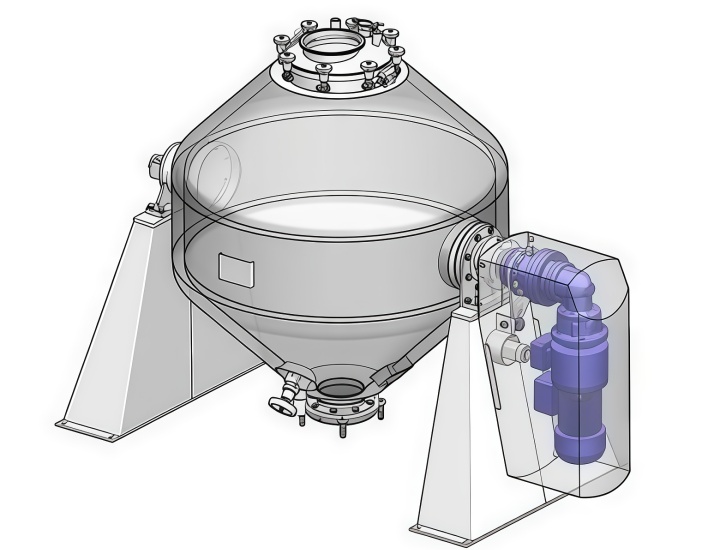
Food-Grade Double Cone Blender for Granules Technical Specifications
| Model | Total Volume | Working Volume | Feed Capacity | Speed | Power | Weight |
|---|---|---|---|---|---|---|
| SZH-50L | 50L | 20-30L | 15-25kg | 15 rpm | 0.55 kW | 120kg |
| SZH-100L | 100L | 40-60L | 30-50kg | 12 rpm | 0.75 kW | 180kg |
| SZH-200L | 200L | 80-120L | 60-100kg | 9 rpm | 1.1 kW | 250kg |
| SZH-300L | 300L | 120-180L | 100-150kg | 9 rpm | 1.5 kW | 350kg |
| SZH-500L | 500L | 200-300L | 150-250kg | 0-9 rpm | 2.2 kW | 550kg |
| SZH-1000L | 1000L | 400-600L | 300-500kg | 0-9 rpm | 4.0 kW | 1000kg |
| SZH-1500L | 1500L | 600-900L | 500-750kg | 0-6 rpm | 5.5 kW | 1200kg |
| SZH-2000L | 2000L | 800-1200L | 750-1000kg | 0-6 rpm | 5.5 kW | 1600kg |
All product-contact parts are made of SS316L stainless steel with a mirror-polished internal surface finish of Ra less than 0.8 micrometers. Seals are constructed from food-grade EPDM rubber with a temperature resistance range of -20°C to 120°C. The complete unit complies with GMP standards.
How to Select the Right Food-Grade Double Cone Blender for Granules?
Selection requires comprehensive evaluation across three dimensions: batch size, material characteristics, and installation space.
The working volume of this equipment is 65% of the total volume, and the feed quantity should be no less than 40% and no more than 70% of the working volume. Fill levels below 40% cause material to slip along the shell wall, while levels above 70% reduce the available tumbling space. A fill rate between 50% and 60% yields relatively ideal mixing efficiency and uniformity. For friable materials such as ground coffee beans, a polyurethane-lined shell is recommended to reduce breakage rates. Prior to installation, confirm that ceiling height accommodates the equipment's tumbling clearance and that floor load-bearing capacity meets the fully loaded total weight requirements.
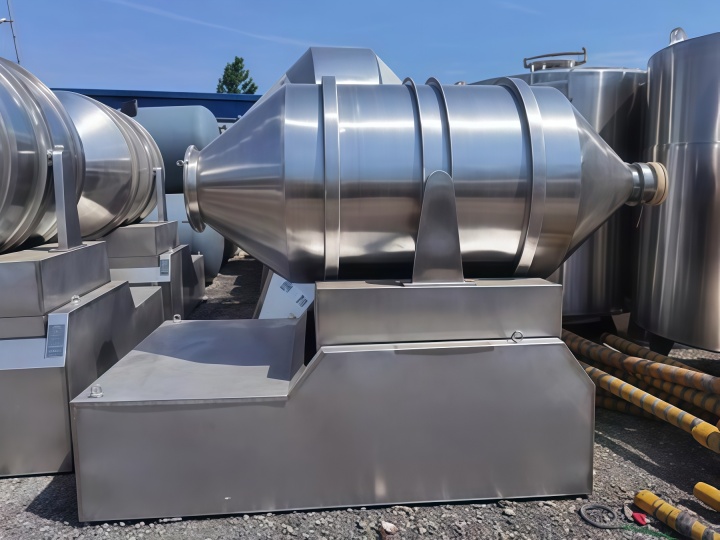
Food-Grade Double Cone Blender for Granules Material Testing Data
Led by an R&D team with fifteen years of food powder engineering experience, the laboratory has completed mixing tests on over 200 materials. Below is a summary of test data for representative materials:
| Material | Model | Feed | Speed | Time | CV Value | Key Indicator |
|---|---|---|---|---|---|---|
| Spice Particles | SZH-200L | 60kg | 9 rpm | 12min | 2.3% | Caking rate 0.5% |
| Ground Coffee | SZH-500L | 150kg | 10 rpm | 15min | 2.1% | Breakage rate 0.3% |
| Infant Formula | SZH-100L | 30kg | 12 rpm | 10min | 1.8% | Nutrient deviation ≤±5% |
| Cocoa + Sugar | SZH-300L | 90kg | 9 rpm | 8min | 2.5% | Ratio 1:1 |
| Dehydrated Vegetable Granules | SZH-500L | 180kg | 8 rpm | 12min | 2.7% | Integrity rate 98.2% |
Test results demonstrate that Food-Grade Double Cone Blender for Granules maintains CV values within 3% across different material types.
Core Advantages of the Food-Grade Double Cone Blender for Granules
Food-Grade Double Cone Blender for Granules is supported by measured data in five areas: dead-angle-free discharge, low particle breakage, high hygienic standards, reduced energy consumption, and automation capability. The following performance metrics have been verified across seven customer sites.
Dead-angle-free discharge. Measured residual material across seven customer sites averaged 0.7% of feed weight, compared to 2% to 3% for paddle mixers under equivalent conditions
Low particle breakage. Breakage rate for coffee beans is 0.3%, versus 4.7% for paddle mixers, a difference of more than fifteen-fold
High hygienic standards. SGS testing shows surface bacterial counts below 5 CFU/cm² after 48 hours on Ra<0.8μm mirror-polished surfaces, with cleaning time reduced by approximately 40% compared to the customer's previous equipment
Reduced energy consumption. The SZH-500L processing 150kg of material consumes 2.2 kWh, compared to 3.5 kWh for a V-type mixer of equivalent volume, representing a 37% energy reduction
Optional vacuum feeding and PLC automatic control systems enable fully automated production
Application Scenarios for the Food-Grade Double Cone Blender for Granules
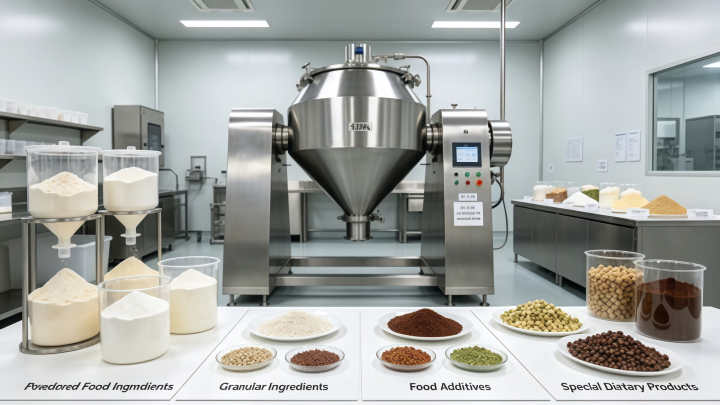
Food-Grade Double Cone Blender for Granules has proven applications across four major areas: powdered food ingredients, granular ingredients, food additives, and special dietary products. The following is a breakdown by material type.
Powdered Food Ingredients: Bulk blending of flour, starch, milk powder, and similar products. Multiple dairy processors in Southeast Asia have verified CV values ≤3%, outperforming the industry standard of 5%.
Granular Ingredients: Blending of ground coffee, dehydrated vegetables, spices, and similar granular materials. Equipment is operating stably in Buon Ma Thuot, Vietnam, a major global coffee production region, and in Nonthaburi, Thailand, a Southeast Asian dehydrated spice production hub.
Food Additives: Precise blending of micronutrients, flavors, pigments, and other minor components with base materials, achieving CV values ≤3%.
Special Dietary Products: Infant formula, meal replacement powders, and other products requiring high blending uniformity. The equipment complies with EHEDG and FDA standards (21 CFR Part 117), and SGS material test reports are available upon request.
Production manager feedback from the Vietnamese coffee manufacturer: After six months of operation, the breakage rate dropped from 4.7% to 0.3%, and customer complaint rates decreased significantly.
Frequently Asked Questions About the Food-Grade Double Cone Blender for Granules
Q: How can segregation be prevented when mixing materials of different densities with the Food-Grade Double Cone Blender for Granules?
A: The stepwise feeding method is recommended, where the lower-density material is loaded first, followed by the higher-density material. A mixing time of 8 to 15 minutes effectively prevents segregation.
Q: Will the seals of the Food-Grade Double Cone Blender for Granules degrade under high-temperature operating conditions?
A: The standard EPDM rubber seals tolerate temperatures from -20°C to 120°C. For continuous operation above 80°C, PTFE seals are recommended for extended service life.
Q: Does the Food-Grade Double Cone Blender for Granules have any cleaning dead zones?
A: The double-cone shell interior is a continuous smooth curved surface with no flanged joints, gaps, or bolt protrusions. Fluorescent tracer testing has confirmed the absence of dead zones.
Q: What level of mixing uniformity can the Food-Grade Double Cone Blender for Granules achieve?
A: This equipment can achieve CV values within 3%, exceeding the 5% industry standard requirement for food-grade applications.