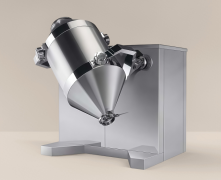
Three-Dimensional Mixer for Ceramic Powder
What Is a Three-Dimensional Mixer for Ceramic Powder?
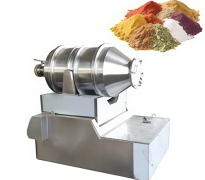
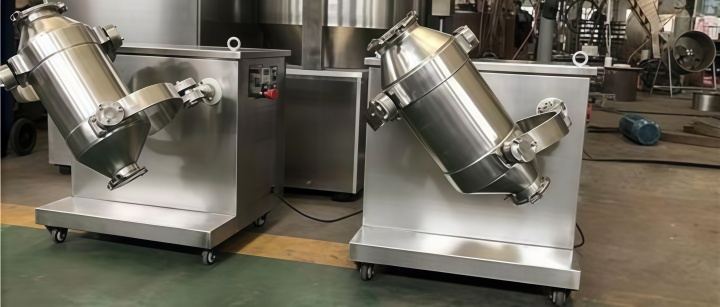
Three-Dimensional Mixer for Ceramic Powder is a specialized device for uniform mixing of ceramic powders, including alumina, silicon nitride, silicon carbide, and zirconia. It uses compound motion of the drum in three-dimensional space to achieve multi-directional diffusion and convective mixing without centrifugal force.
The equipment achieves mixing uniformity of 99.5% to 99.9% and a loading coefficient of 80% to 90%, compared to 40% to 50% for conventional mixers. The stainless steel drum has mirror-polished surfaces to prevent residue and cross-contamination. Three-Dimensional Mixer for Ceramic Powder serves electronic ceramics, structural ceramics, and advanced ceramic powder processing. In Europe, Japan, and South Korea, it is a mainstream choice for ceramic powder mixing.
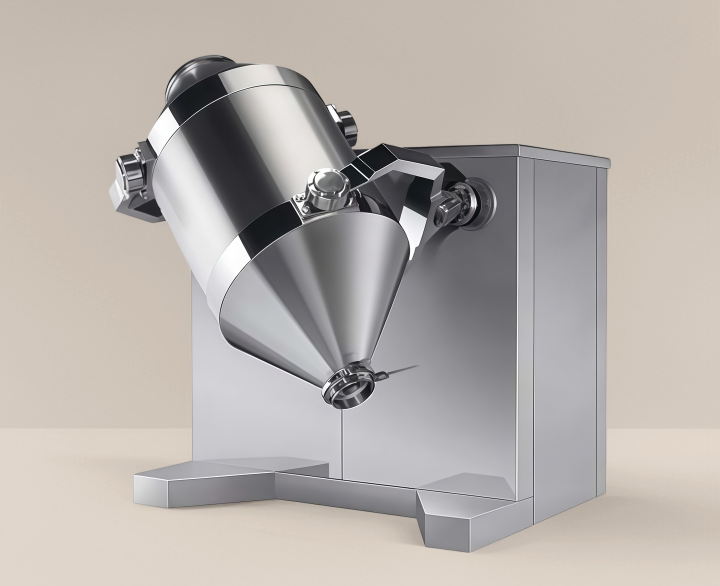
How Does a Three-Dimensional Mixer for Ceramic Powder Work?
The drum is suspended on two Y-type universal joints orthogonally arranged in space. When the driving shaft rotates, the drum performs translation, rotation, and tumbling simultaneously.
Three-Dimensional Mixer for Ceramic Powder generates alternating pulsed flow, continuously changing particle positions. Materials move circumferentially, radially, and axially for diffusion, accumulation, and blending. The motion avoids centrifugal force, preventing specific gravity segregation. The suspended structure gives no fixed rotation axis; each revolution produces different displacement trajectories, with at least 12 diffusion–convection cycles per batch, enabling uniform mixing within minutes.
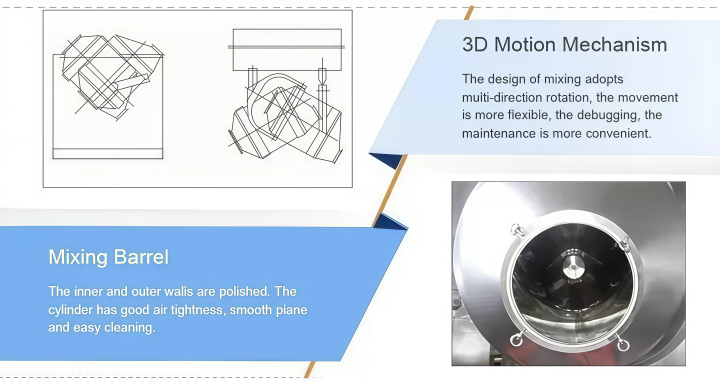
Models and Technical Parameters about Three-Dimensional Mixer for Ceramic Powder
Loading weight is calculated based on a ceramic powder bulk density of 1.8 g/cm³; actual values depend on material density.
| Model | Drum Volume L | Loading Volume L | Loading Weight kg | Spindle Speed r/min | Motor Power kW |
|---|---|---|---|---|---|
| SYH-5 | 5 | 4.5 | 1.5-2.7 | 0-20 | 0.25 |
| SYH-15 | 15 | 13.5 | 4-8.1 | 0-20 | 0.37 |
| SYH-50 | 50 | 45 | 15-27 | 0-20 | 1.1 |
| SYH-100 | 100 | 90 | 30-54 | 0-20 | 1.5 |
| SYH-200 | 200 | 180 | 50-108 | 0-15 | 2.5 |
| SYH-400 | 400 | 360 | 100-216 | 0-15 | 4 |
| SYH-600 | 600 | 540 | 150-324 | 0-13 | 5.5 |
| SYH-800 | 800 | 720 | 200-432 | 0-10 | 7.5 |
| SYH-1000 | 1000 | 900 | 250-540 | 0-10 | 11 |
Loading volume should be 75%–80% of drum volume. Dimensions range from 700×1000×1000 mm to 2600×2500×2350 mm. Speed is steplessly adjustable via frequency converter. The SYH-100 model (100 L drum, 1.5 kW) suits 1–3 t/day lines; SYH-400 and above handle large-scale production with 100–216 kg loads.
What Are the Core Advantages of Three-Dimensional Mixer for Ceramic Powder?
Three-Dimensional Mixer for Ceramic Powder excels in uniformity, loading efficiency, cleaning, and sealing.
Uniformity: Measured at 99.5%–99.9%, with CV values of 3%–5% per GB/T 21154-2007. Even with large specific gravity differences, uniform distribution is achieved in minutes, improving sintering yield.
Efficiency: Loading coefficient of 0.9 versus 0.4–0.6 for conventional mixers. Single-batch throughput is 1.5–2 times higher, reducing capital cost per unit capacity.
Cleaning: Rounded transitions and polished surfaces enable fast material changeovers, minimizing downtime.
Sealing: Fully sealed design supports dust-free operation, ideal for high-purity ceramic powder processing.
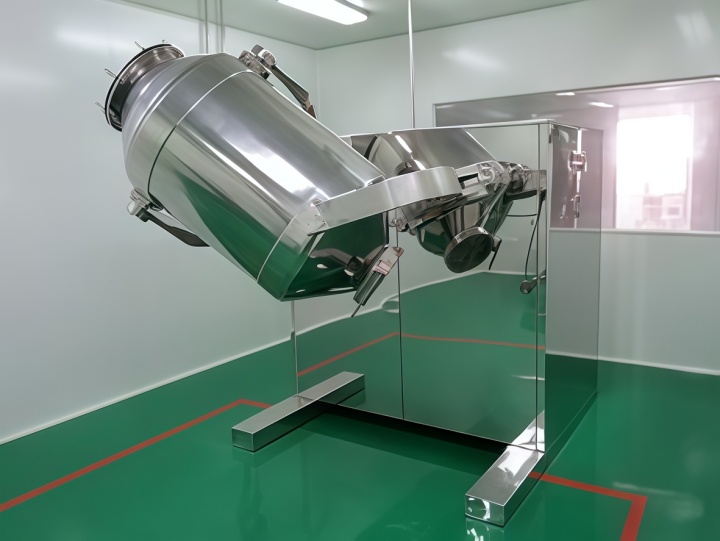
What Material Scenarios Are Suitable for Three-Dimensional Mixer for Ceramic Powder?
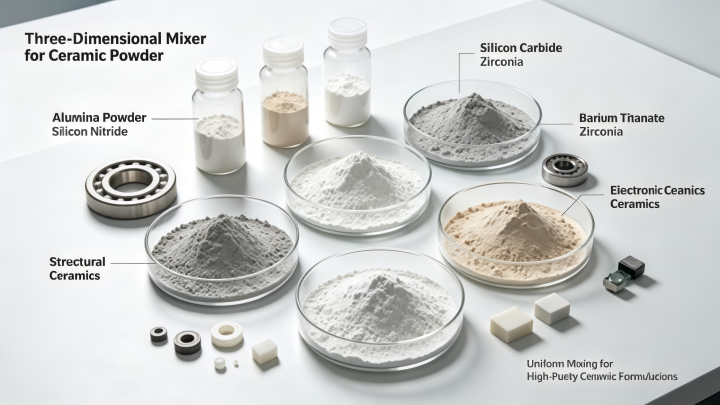
Three-Dimensional Mixer for Ceramic Powder applies to alumina, silicon nitride/silicon carbide, electronic ceramics, and advanced functional ceramics.
Alumina powder: Mixes with sintering aids and binders for 95% and 99% alumina ceramics, ensuring batch consistency. Major manufacturers like Kyocera (Japan) and CeramTec (Germany) use such equipment.
Silicon nitride and silicon carbide: Breaks agglomerates, improves sintered density, and performs well in bearings and seals. CoorsTek (US) and Sandvik (Sweden) employ it in high-performance ceramic lines.
Electronic ceramics: For piezoelectric and dielectric materials, it preserves grain structure, suitable for precision formulations. Murata (Japan) and Samsung Electro-Mechanics (Korea) standardly use it.
Advanced/functional ceramics: Suitable for zirconia, barium titanate, and lab-scale R&D batches.
In alumina mixing, sintering aid distribution deviation is within ±0.05%; in silicon nitride, powder flowability improves by 15%–20%, confirmed by lab and field tests. The equipment is not suitable for long-fiber reinforced materials or simultaneous grinding/mixing. For materials with >5% liquid content, choose a model with spray function.
How Does Three-Dimensional Mixer for Ceramic Powder Compare with Similar Equipment?
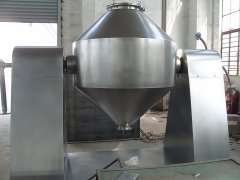
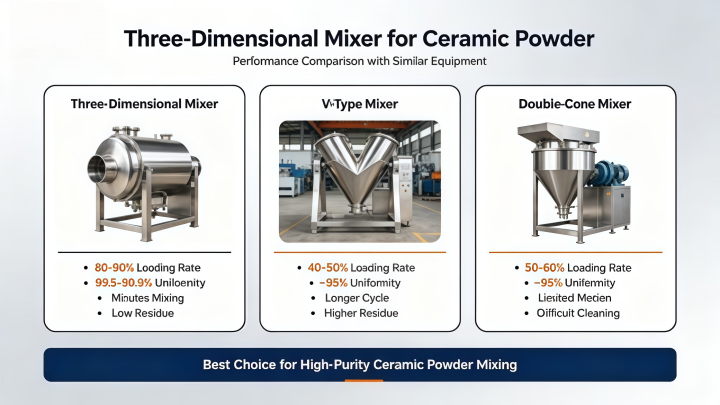
Three-Dimensional Mixer for Ceramic Powder offers clear advantages over V-type and double-cone mixers. V-type mixers have loading rates of 40%–50% and uniformity around 95%, while this equipment achieves 80%–90% loading and 99.5%–99.9% uniformity. Mixing takes only minutes, shortening production cycles. It is especially effective for components with large specific gravity differences, such as alumina with graphite—a challenging task for traditional mixers. In such cases, V-type mixers achieve only ~92% uniformity after 15 minutes due to floating, whereas this equipment reaches >99% in 10 minutes, with drum wall residue one-fifth that of V-type mixers.
How to Quickly Select the Right Three-Dimensional Mixer for Ceramic Powder?
Selection for Three-Dimensional Mixer for Ceramic Powder is based on daily capacity, batch time, and loading coefficient. Example: 2 t/day, 10 min/batch, 6 operating hours/day → 36 batches/day → 55.5 kg/batch → ÷0.8 loading coefficient = 69 L required → choose SYH-100. Allow 15%–20% capacity margin. For bulk density below 1.5 g/cm³ (e.g., zirconia at 1.2 g/cm³), choose one size larger (SYH-200 instead of SYH-100). For density above 2.0 g/cm³, verify motor load capacity.
Certifications and Quality Control
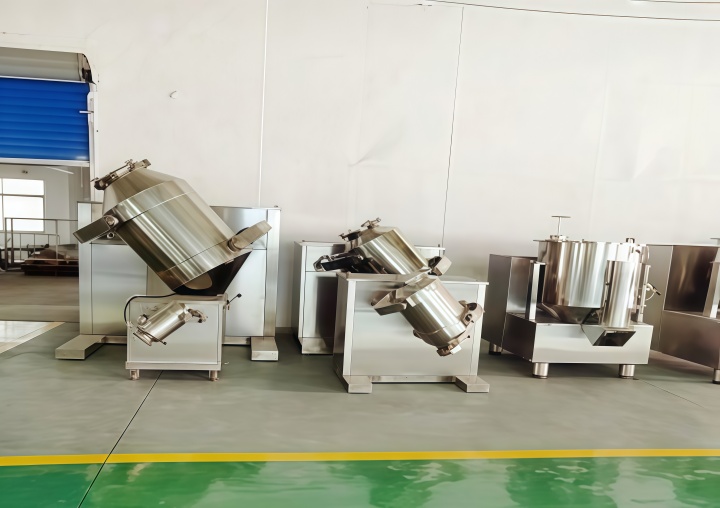
Three-Dimensional Mixer for Ceramic Powder can be supplied with CE, ISO 9001, and ASTM-standard stainless steel drums. Each unit undergoes no-load and load tests before shipment to confirm uniformity and stability.
Technical Note: Parameters and principles are compiled from over 10 years of field data for the SYH series, derived from lab reports and multiple customer verifications across alumina and electronic ceramics applications.
FAQs About Three-Dimensional Mixer for Ceramic Powder
Can Three-Dimensional Mixer for Ceramic Powder run continuously for long periods?
Yes, but regular lubrication checks are advised to extend service life.
Can Three-Dimensional Mixer for Ceramic Powder use liner bags inside the drum?
Yes, PE or PP bags can reduce cleaning time, but ensure they are securely fixed.
Does Three-Dimensional Mixer for Ceramic Powder have floating issues with ultrafine powders (D50 < 1 µm)?
Reduce speed and adjust loading to mitigate.
Does Three-Dimensional Mixer for Ceramic Powder support vacuum mixing?
SYH-200 and above can be equipped with vacuum (to -0.08 to -0.095 MPa).
How to verify uniformity of Three-Dimensional Mixer for Ceramic Powder?
Take samples from different drum positions and calculate CV value, typically controlled within 5%.
What is the wear part replacement cycle for Three-Dimensional Mixer for Ceramic Powder?
Depends on usage; inspect regularly and replace when wear is detected.