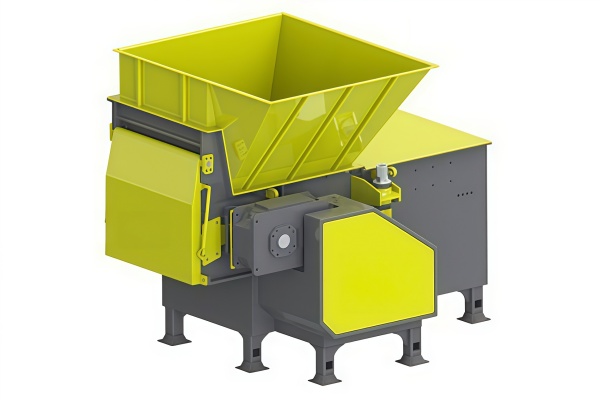
Single Shaft Shredder Crusher
Single Shaft Shredder Crusher is suitable for shredding bulky waste, plastic, wood, rubber and industrial scrap materials, outputting uniform‑size shredded materials for recycling and waste‑to‑energy industries. Prices typically range from $15,000 to $220,000. Feed opening size: ≤1200mm Production capacity: 1‑45 tons/hour Discharge particle size adjustment range: 10‑120mm Rotor speed: ≤120 rpm Motor power: 22‑160kW
What is a Single Shaft Shredder Crusher?
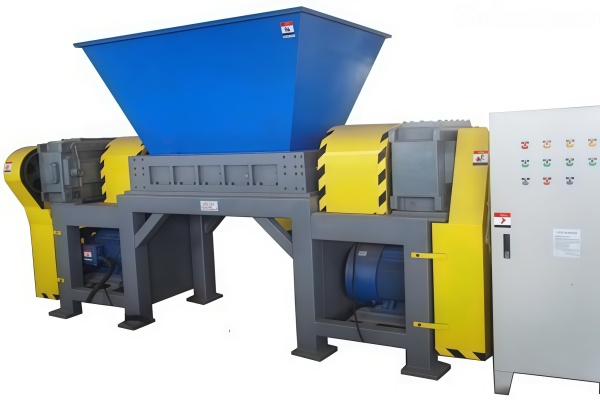
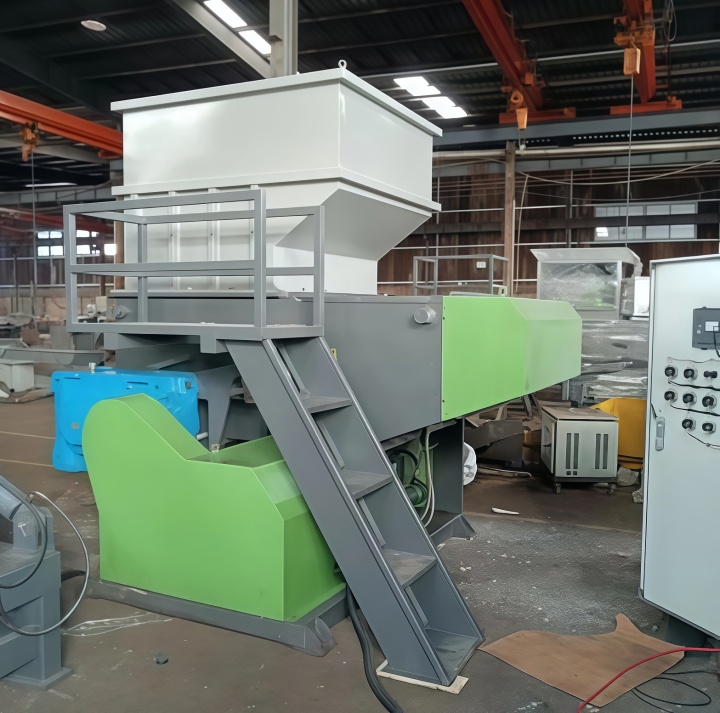
At the heart of a Single Shaft Shredder Crusher is a single rotating cutter shaft, which shreds bulky waste materials into uniform small particles. The equipment consists of a cutter spindle, stationary blades, bearing housing, feeding system, hydraulic pusher system, power system, and electrical control system. This equipment features medium-speed, high-torque design with rotational speeds typically ranging from 45 to 83 RPM. After shredding, material particles are uniform in size and can be directly recycled or sent to the next processing stage.
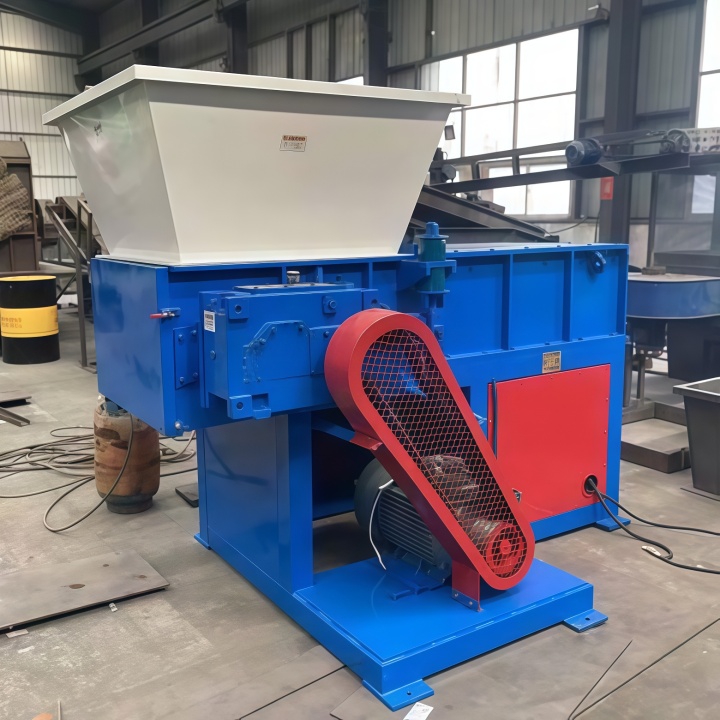
Single Shaft Shredder Crusher Video Showcase
The Four Operating Stages of a Single Shaft Shredder Crusher
The operating process of a Single Shaft Shredder Crusher is divided into four stages: forced feeding, shearing and shredding, screen size control, and discharge. These stages work together to achieve efficient shredding.
Forced Feeding Stage ensures continuous and uniform material entry into the crushing chamber, preventing bridging. After material enters through the hopper, the hydraulic pusher system continuously pushes the material toward the rotating cutter shaft.
Shearing and Shredding Stage involves the rotary blades and stationary blades shearing and tearing the material. The gap between the rotary blades and stationary blades can be adjusted to 0.1 mm, ensuring consistent shredding results.
Screen Size Control Stage uses a screening screen to control output particle size. Only particles smaller than the screen aperture can pass through; oversized material is returned to the crushing chamber for further shredding. The screen aperture can be customized from 20 mm to 100 mm.
Discharge Stage continuously outputs qualified particles to the next process.
Single Shaft Shredder Crusher Model Specifications and Selection
The following are technical specifications for several common models of Single Shaft Shredder Crusher:
| Model | Crushing Chamber Size mm | Cutter Shaft Diameter mm | Motor Power kW | Machine Weight kg |
|---|---|---|---|---|
| P260 | 500×580 | 250 | 18.5 | 1750 |
| P380 | 850×800 | 400 | 37 | 4150 |
| P3120 | 850×1200 | 400 | 55 | 5300 |
| P3150 | 850×1400 | 400 | 75 | 5900 |
| WES800 | 800×750 | 400 | 37/45 | 4200 |
| WES1200 | 1200×750 | 400 | 55 | 5400 |
| WES1500 | 1500×1100 | 480 | 90 | 11200 |
Material characteristics should be considered during selection. For processing film-type materials, the P3120 is recommended, as its crushing chamber width of 1200 mm effectively prevents film wrapping. For materials containing small amounts of metal contaminants, D2-grade blades are recommended. Although the cost is approximately 20% higher, the wear resistance is significantly improved, and blade life can be extended by over 40%.
What Performance Advantages Does This Equipment Offer?
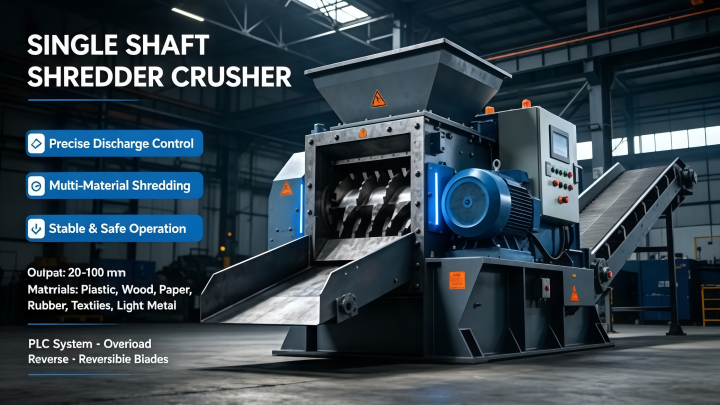
The core advantages of the Single Shaft Shredder Crusher lie in precise output control, wide material adaptability, and stable operating performance.
By changing the screen aperture, output particle size can be controlled between 20 and 100 mm. The equipment can process various materials including plastics, wood, paper, rubber, textiles, and light metals. It is equipped with a PLC automatic control system and overload reverse protection, and blades can be reversed and reused after wear.
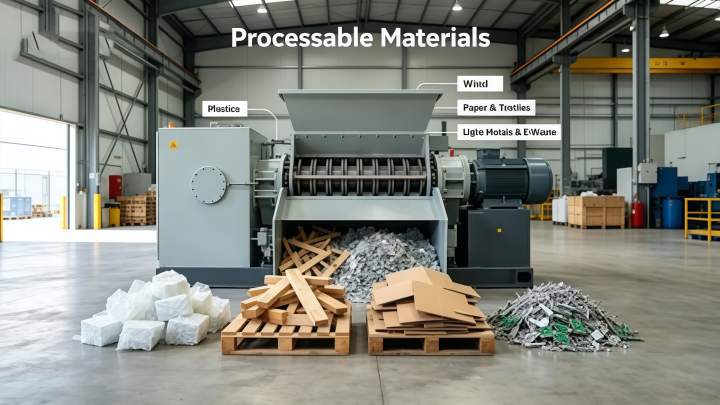
What Materials Can This Equipment Process?
A Single Shaft Shredder Crusher can process various materials including plastics, wood, paper, textiles, light metals, and e-waste. Plastic materials include purgings, pipes, films, woven bags, appliance housings, and engineering plastics such as ABS and PC. Wood materials include waste lumber, wooden pallets, logs, and tree roots. Paper and textile materials include cardboard, books, leather scraps, and cotton fabric. For metals and e-waste, it can process aluminum profiles, wire and cable, and circuit boards. It can also be used for volume reduction of straw, bamboo, and household waste.
How to Calculate Power Requirements?
The motor power calculation formula is P = K × Q × ln(D/d).
In this formula, K is the material coefficient: 0.8 for film, 1.2 for hard plastics, 1.0 for wood, and 1.5 for rubber. Q is the throughput in tons per hour. D is the maximum feed size in millimeters, and d is the target output size in millimeters.
For example, when processing LDPE film with a maximum feed size of 1000 mm, target output size of 20 mm, and throughput of 2 tons per hour with a K value of 0.8, the calculation yields P ≈ 6.3 kW. Considering starting torque and operating fluctuations, a 7.5 kW or 11 kW motor is recommended.
How Often Does It Need Maintenance?
Daily maintenance for a Single Shaft Shredder Crusher focuses on three core areas: blades, hydraulic system, and gap calibration.
Blades should be inspected weekly for edge condition and promptly flipped or replaced when visibly dull. The hydraulic system requires daily oil level checks to ensure it remains above the midpoint mark. When the oil level approaches the lower limit, pusher speed will noticeably decrease. The gap between rotary and stationary blades should be calibrated monthly, with a standard range of 0.1 to 0.3 mm. Based on operating experience, when the gap exceeds 0.25 mm, the oversize particle ratio increases from approximately 5% to over 15%. Adjustment is recommended when the gap reaches 0.2 mm to avoid throughput fluctuations.
During one on-site service visit, a client reported frequent equipment shutdowns. Inspection revealed the pusher pressure was set at 12 MPa. After reducing the pressure to 7 MPa, the problem was resolved, and energy consumption dropped from 8.1 kWh per ton to 6.7 kWh per ton. Hydraulic oil should be changed quarterly. Gear oil in the reducer should be changed after the first 500 hours of operation, then every 2000 hours or every six months thereafter. Annual comprehensive inspections should be performed by qualified technicians.
Common Operating Misconceptions
Based on years of on-site service experience, there are several easily overlooked issues when operating a Single Shaft Shredder Crusher.
Higher pusher pressure is not always better. One client set the pressure at 12 MPa, believing higher pressure would increase feed rate. In practice, material was pushed into the crushing chamber in large quantities at once, causing the motor current to spike rapidly and trigger the overload protection, resulting in frequent shutdowns.
Blade gap requires regular calibration rather than one-time setting. The standard gap is 0.1 to 0.3 mm, but blades wear during operation. Gap should be checked with a feeler gauge every 200 operating hours. For processing PP woven bags, setting the gap to 0.15 mm achieves good cutting results.
High-moisture materials require more frequent screen checks. When material moisture content exceeds 12%, fine particles tend to adhere to the screen surface, forming a pasty layer that can reduce throughput by over 30%. It is recommended to stop and check screen condition every 2 hours when processing wet materials, or install a compressed air blow-off device.
Measured Data for Different Materials
The following is data recorded during actual operation of a Single Shaft Shredder Crusher processing different materials:
| Material Type | Material Form | Screen Aperture mm | Hourly Output kg | Energy Consumption kWh/ton | Blade Life Hours |
|---|---|---|---|---|---|
| PP Woven Bags | Baled | 40 | 1500-2000 | ~6.3 | ~800 |
| LDPE Film | Rolled | 30 | 800-1200 | ~7.1 | ~600 |
| ABS Plastic | Purgings | 50 | 2000-2500 | ~5.8 | ~1200 |
| Wood Scraps | Loose | 60 | 1800-2200 | ~6.8 | ~500 |
| Waste Rubber | Block | 50 | 1000-1400 | ~8.2 | ~400 |
| Cardboard | Baled | 40 | 2200-2800 | ~5.2 | ~1500 |
Two patterns can be observed from the data above. Material hardness has the most significant impact on blade life. Processing harder waste rubber yields a blade life of only approximately 400 hours, while processing softer cardboard extends blade life to 1500 hours—a difference of nearly four times. Material form also significantly affects throughput: loose wood scraps process faster than baled PP woven bags because baled materials require more shredding time to fully break apart. The above data is for reference only during equipment selection.
Frequently Asked Questions about Single Shaft Shredder Crusher
How uniform are the particles produced by a Single Shaft Shredder Crusher?
Particle uniformity is determined by the screen aperture. As long as the screen is intact, output particle size can be controlled within the set range.
Can a Single Shaft Shredder Crusher be used with only 380V power supply?
Yes. 380V, 50Hz is a standard configuration option.
How long does it take to change the blades on a Single Shaft Shredder Crusher?
Skilled maintenance personnel can typically complete a full set of blade changes within 2 to 4 hours.
Will processing waste plastic with small amounts of metal contaminants damage the Single Shaft Shredder Crusher?
The equipment can process light metals such as aluminum chips, but hardened metals like nails and screws pose a risk of blade damage. Magnetic separation at the source is recommended, and the equipment's overload protection system can automatically reverse or shut down when anomalies are detected.