Concrete Crusher
What is a Concrete Crusher?
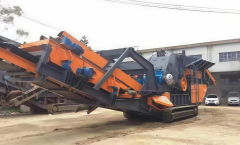
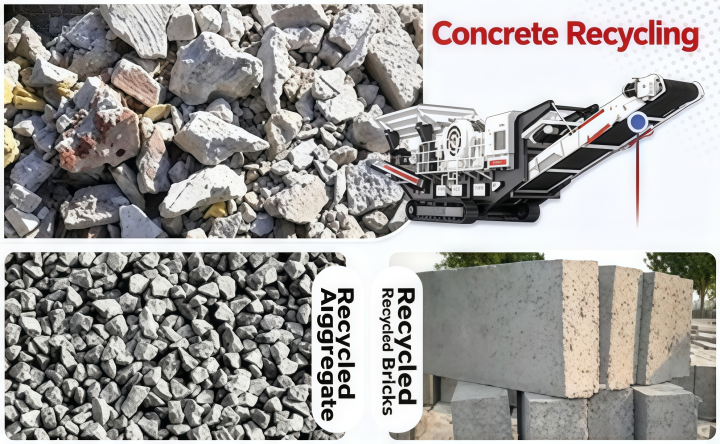
Concrete Crusher processes waste concrete blocks, reinforced components, and construction debris into recyclable aggregates. Feed opening widths range from 300mm to over 650mm, with an 8:1 crushing ratio, reducing 600mm concrete blocks to below 75mm. The equipment is used in building demolition, road repair, and concrete recycling stations.
In the 2025 renovation of Austria's A2 motorway, 250,000 tons of demolished concrete were processed on-site into certified recycled aggregates using it, with the crushing plant positioned hundreds of meters from the construction site, eliminating thousands of kilometers of transport.
What Material Scenarios Is Concrete Crusher Suitable For?
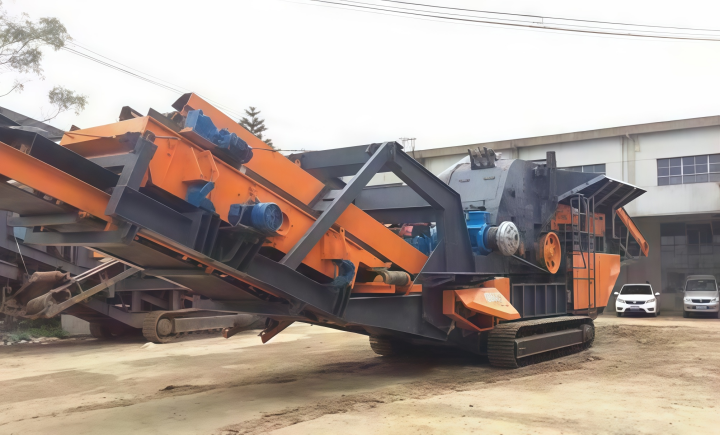
Concrete Crusher processes the main waste types from demolition projects, which fall into two categories based on material composition.
For hard materials with rebar, the machine handles structures up to 600mm thick and cuts rebar up to 28mm in diameter. The solid steel rotor prevents rebar entanglement. In the Austrian A2 project, the SBM REMAX 600 Concrete Crusher processed 0/800mm mixed debris into four aggregate types in a single pass, with hydraulic temperature below 80°C after 12 hours at 200 tons per hour.
For lightweight materials, the product processes washout, asphalt, and construction debris, switching types through blow bar and screen changes. The crusher bucket mounts on 3 to 10-ton excavators, eliminating haul-off and purchase costs.
How Does Concrete Crusher Work?
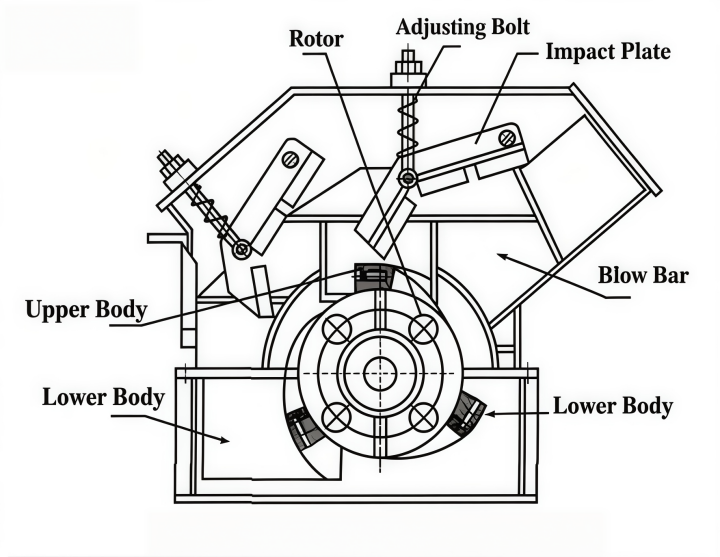
The equipment is powered by an electric motor driving the eccentric shaft, causing the moving jaw plate to move along a predetermined trajectory. Material enters the crushing chamber and is progressively broken by the jaw's periodic squeezing action. Rotor speed ranges from 600 to 1500 RPM, with a deep-chamber no-dead-zone design improving feed capacity, and the shim adjustment controls finished aggregate size.
Concrete Crusher Technical Specifications
| Model | Carrier Weight | Operating Weight | Max Jaw Opening | Jaw Width | Close Cycle | Open Cycle | Oil Flow | Pressure | Max Crushing Force |
| U-21 JA | 19-28 t | 2180 kg | 800 mm | 460 mm | 1.6 s | 0.8 s | 100-200 L/min | 260 bar | 645 kN |
| U-21 JRA | 19-28 t | 2565 kg | 800 mm | 460 mm | 1.6 s | 0.8 s | 100-200 L/min | 260 bar | 645 kN |
| U-31 JA | 28-48 t | 2835 kg | 980 mm | 590 mm | 2.9 s | 1.6 s | 100-250 L/min | 280 bar | 1150 kN |
| U-31 JRA | 28-48 t | 3310 kg | 980 mm | 590 mm | 2.9 s | 1.6 s | 100-250 L/min | 280 bar | 1150 kN |
| U-45 J | 41-50 t | 4265 kg | 1130 mm | 650 mm | 3.0 s | 1.6 s | 175-275 L/min | 300 bar | 1260 kN |
| U-45 JRA | 41-50 t | 4500 kg | 1130 mm | 650 mm | 3.0 s | 1.6 s | 175-275 L/min | 300 bar | 1260 kN |
R-series models include 360-degree hydraulic rotation. For C40 or higher-grade concrete, select it with crushing force above 1000kN.
What Are the Core Advantages of Concrete Crusher?
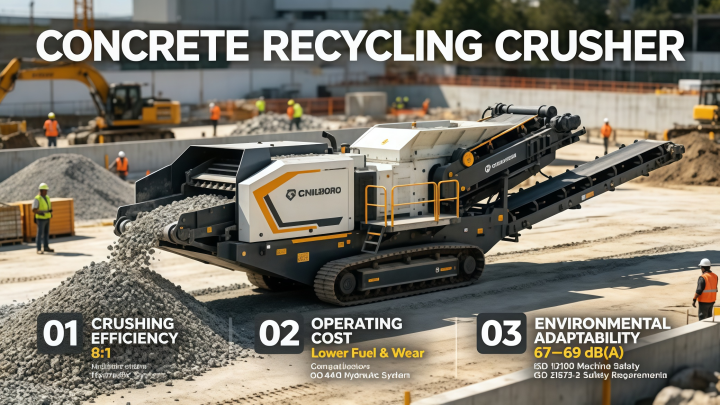
Concrete Crusher delivers its core advantages across three areas: crushing efficiency, operating costs, and environmental adaptability.
Crushing efficiency: the equipment achieves an 8:1 ratio, reducing large blocks in a single pass. The boost hydraulic system converts flow to pressure when the jaw encounters high resistance. The hydraulic system complies with ISO 4413.
Operating costs: the machine reduces energy consumption by 15% to 30% compared to traditional models. With diesel-electric hybrid drive, fuel consumption is 0.7 liters per ton. High-manganese steel jaw plates with premium alloy cost 50% to 75% more but last two to three times longer, lowering cost per ton.
Environmental adaptability: the product measures 67 to 69 dB(A) at 7 meters, based on Hong Kong EPA data, suitable for urban areas. Structural safety complies with ISO 12100, and safety requirements comply with ISO 21873-2.
Concrete Crusher Return on Investment
Concrete Crusher delivers different payback periods depending on project scale. Two typical scenarios are presented below based on North American market data.
Small project processing 100 tons per day: haul-off costs $25/ton, aggregate purchases $18/ton. The equipment eliminates haul-off costs, producing 85 tons of usable aggregate. After fuel, labor, and wear parts, monthly net profit is $18,000. With $250,000 investment, payback is 14 months.
Large project processing 300 tons per day: the machine with mobile screening saves $22,500/month in haul-off and generates $46,000/month in aggregate sales. After costs, monthly net profit is $45,000. With $450,000 investment, payback is 10 months.
Concrete Crusher Energy Consumption and Operating Costs
Concrete Crusher operating costs consist of energy consumption and wear parts replacement. The following data covers both fuel-powered and electric-powered configurations.
Fuel-powered: the REMAX 600 in the Austrian A2 project recorded 38 L/hour, or 0.19 L/ton at 200 tons/hour. Metso data shows diesel generator-driven it consumes 0.7 L/ton.
Electric-powered: the equipment consumes 0.8 to 1.2 kWh/ton. At 200 tons/day for 250 days, annual consumption is 40,000 to 60,000 kWh. Variable frequency drive saves 30% energy.
Wear parts: high-manganese steel jaw plates last through 2,000 to 3,000 tons. Select models carry CE certification.
Concrete Crusher Cold-Weather Startup Performance
Below -10°C, the machine's hydraulic oil viscosity rises significantly. The following performance data compares units with and without preheating systems.
With preheating, oil warms from -15°C to 40°C in 8 minutes, 12 minutes faster than without preheating, reducing idling time and preventing pump wear. For projects over 200 days/year, preheating saves 2% in annual maintenance costs.
How to Select the Right Concrete Crusher Model?
Concrete Crusher model selection depends on five factors: feed size, throughput capacity, carrier weight, concrete grade, and rebar content. The following recommendations are based on these criteria.
Select the equipment based on feed size: U-21 for under 600mm, U-31 for 600-800mm, U-45 for over 800mm. Throughput ranges from tens to over 200 tons/hour. Operating weight ranges from 2.18 to 4.5 tons. For C40 or higher concrete, select crushing force above 1000kN. For heavily reinforced concrete, select an R-series it with rebar cutting blades. For plain or low-rebar materials, standard models suffice.
Concrete Crusher FAQs
What if Concrete Crusher has insufficient crushing force for high-grade concrete?
The product has a hydraulic boost system that converts flow to pressure when encountering resistance. Select U-31JA or above, with tip crushing force reaching 1150kN.
How often should Concrete Crusher jaw plates be replaced?
For standard demolition concrete, high-manganese steel jaw plates last through 2,000 to 3,000 tons. Inspect wear daily.
Can Concrete Crusher operate near residential areas?
The equipment measures 67 to 69 dB(A) at 7 meters, based on Hong Kong EPA data.
What is the typical payback period for Concrete Crusher?
Excavation Touchette in Canada recovered investment within two years using an MB BF70.2 crusher bucket.
Summary
Concrete Crusher transforms concrete waste into recycled aggregates through on-site crushing, from Austria's A2 motorway 250,000-ton recycling loop to North American contractors reducing haul-off costs.