Coarse Crusher Machine
What is a Coarse Crusher Machine?
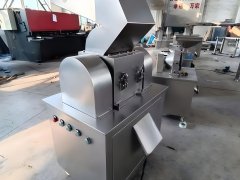
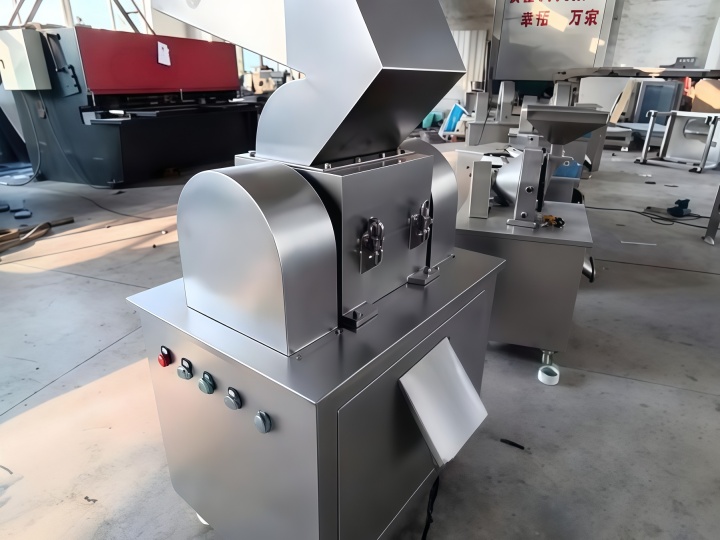
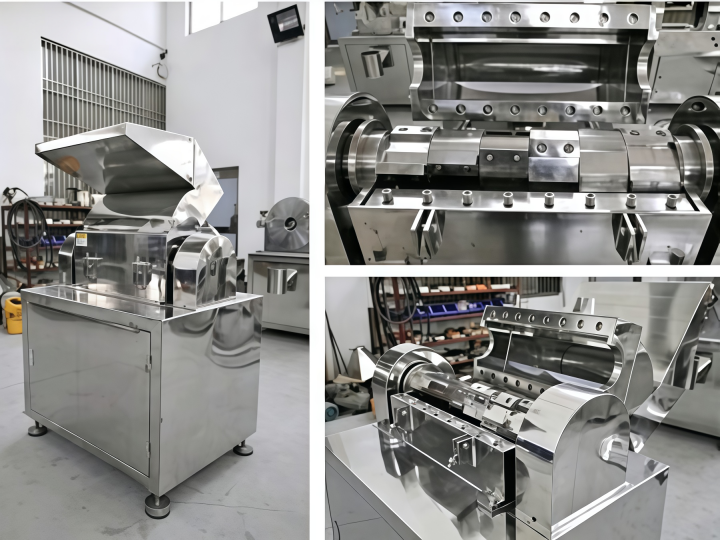
Coarse Crusher Machine is a preprocessing device used in the coarse crushing stage of material size reduction. It shears and breaks large chunks of material into fine particles ranging from 0.5 to 20 millimeters, providing uniform feed for subsequent medium crushing, fine grinding, or ultra-fine pulverization processes.
All product-contact components of the equipment are constructed from SUS304 stainless steel with mirror polishing to a surface roughness of Ra≤0.4μm, meeting GMP requirements for surface finish and hygiene in direct material contact applications. The rotating and stationary blades are manufactured from Cr12MoV alloy steel and undergo vacuum heat treatment to achieve a hardness of HRC58 to 62, ensuring durability in continuous production environments. Since material residence time within the crushing chamber is adjustable, the equipment accommodates processing requirements for materials with varying hardness and toughness.
How Does a Coarse Crusher Machine Work?
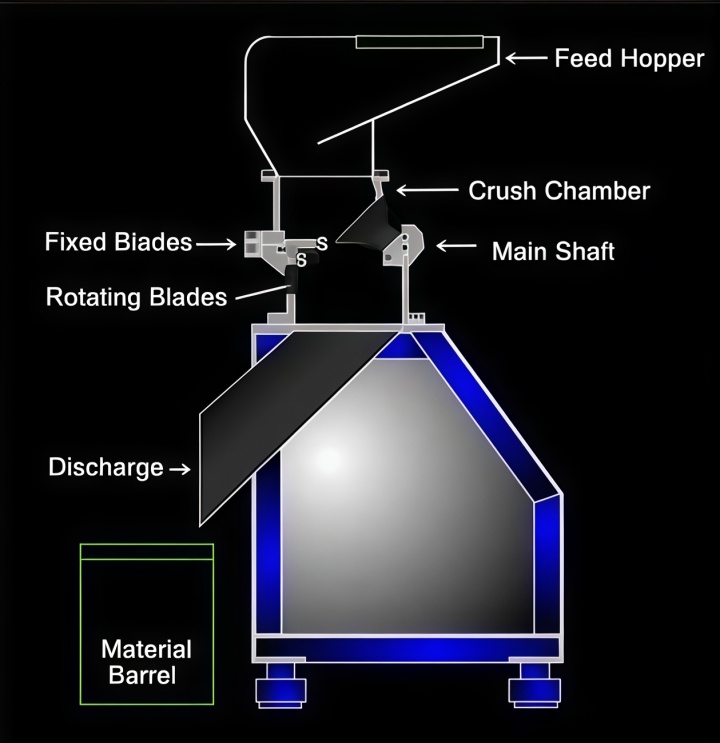
Material is fed through the hopper into the crushing chamber, where it is continuously subjected to shearing and impact forces generated by the high-speed rotation of the blade assembly against the fixed stationary blades. The gap between the rotating and stationary blades can be continuously adjusted according to material characteristics to control the particle size distribution of the output. A screen within the crushing chamber sieves out particles that meet the size requirement, while oversized material remains in the chamber for further crushing until it passes through the screen openings. Centrifugal force from the rotating chamber continuously pushes qualified particles toward the discharge outlet, enabling fully automated continuous discharge.
In workshop conditions at 25°C ambient temperature and 60% humidity, a CSJ-400 model processing 3mm PE film with an 8mm screen achieved an average throughput of 435 kg/h over a 4-hour continuous run, with an output uniformity of 92.3%. Three repeat tests under identical conditions showed a throughput fluctuation range within ±5%, confirming the equipment's operational consistency under stable working conditions.
Coarse Crusher Machine Technical Specifications
The following table lists the primary technical specifications for commonly used models of the equipment:
| Model | Capacity kg/h | Feed Size mm | Output Fineness mesh | Spindle Speed r/min | Motor Power kW | Dimensions mm | Weight kg |
| CSJ-80 | 30-200 | ≤50 | 0.5-20 | 500 | 2.2 | 600×500×950 | 180 |
| CSJ-120 | 100-500 | ≤100 | 0.5-20 | 500 | 4 | 700×800×1250 | 250 |
| CSJ-200 | 80-300 | ≤100 | 0.5-20 | 480 | 3 | 900×600×1440 | 200 |
| CSJ-300 | 100-800 | ≤100 | 0.5-20 | 480 | 4 | 900×700×1440 | 300 |
| CSJ-400 | 200-1000 | ≤100 | 0.5-20 | 480 | 5.5 | 900×800×1440 | 380 |
| CSJ-500 | 120-700 | ≤100 | 0.5-20 | 650 | 7.5 | 880×880×1500 | 582 |
| CSJ-600 | 500-1500 | ≤100 | 0.5-20 | 480 | 11 | 1000×900×1440 | 500 |
The data above is based on testing standard plastic pellets with moisture content below 8%. For every 10% increase in material density, actual throughput decreases by approximately 6% to 8%. Output fineness is controlled by changing the screen aperture—a 1.0mm screen corresponds to approximately 18 to 20 mesh, while a 4.0mm screen corresponds to approximately 4 to 6 mesh.
When selecting a model, it is important to note that the difference between rated and actual throughput is primarily determined by material characteristics. When moisture content exceeds 12%, screen blinding becomes significantly more likely, making it advisable to conduct small-batch trial runs before full-scale production.
What Are the Key Advantages of a Coarse Crusher Machine?
Coarse Crusher Machine offers comprehensive advantages across three dimensions: material corrosion resistance, operational economy, and material adaptability.
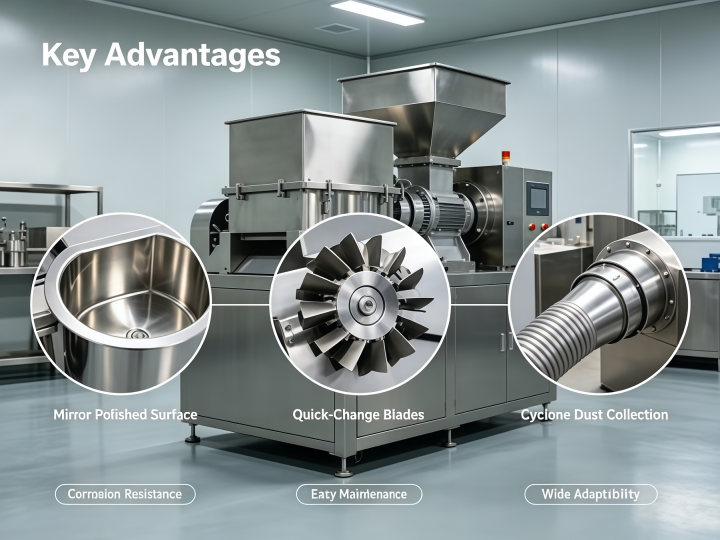
Material and Structural Advantages: All product-contact components are manufactured from stainless steel with a dead-corner-free interior design, enabling a complete cleaning cycle of no more than 15 minutes. The horizontal crushing design allows for adjustable material residence time within the chamber, helping to control the proportion of excessively fine particles generated.
Operational and Maintenance Advantages:Blades can be replaced individually without removing the entire rotor assembly, with a single blade change taking approximately 30 minutes. The machine can be equipped with a cyclone dust collection system that maintains exhaust outlet dust concentration at low levels. The modular blade mounting system requires no specialized tools for installation or removal.
Compatibility and Adaptability Advantages: Three blade material options are available—standard high-speed steel for conventional materials, tungsten carbide for high-hardness materials, and wear-coated blades for high-fiber materials—covering the majority of industrial coarse crushing applications.
What Application Scenarios Is a Coarse Crusher Machine Suitable For?
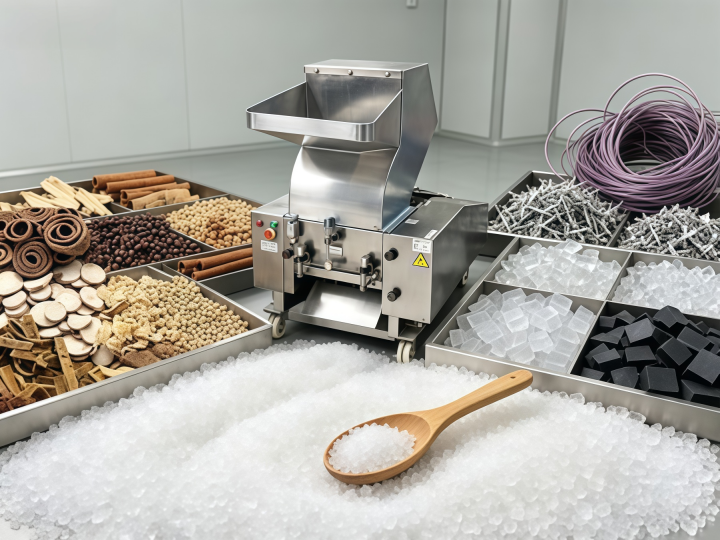
Coarse Crusher Machine demonstrates effective crushing adaptability across three material categories: plant-derived materials, synthetic polymers, and metal recyclables.
Plant-Derived Materials: In the pre-treatment coarse crushing of traditional Chinese medicinal herbs and pharmaceutical tablets, the machine breaks large plant material into uniform intermediate particles, providing a consistent feed for subsequent fine grinding. Sugar, spices, coffee beans, grains, and other food ingredients are equally suitable for coarse reduction. For fibrous materials, wear-coated blades combined with a wider blade gap of 0.8 to 1.0mm are recommended to reduce the impact of fiber wrapping on throughput.Synthetic Polymer Materials:In the coarse crushing of epoxy resins, polyethylene, polypropylene, rubber bales, and similar materials, Coarse Crusher Machine adjusts to different elastic moduli through blade gap regulation, delivering effective cutting force against highly elastic materials. When processing elastic materials, reducing the spindle speed minimizes material rebound and improves the single-pass qualification rate.
Metal Recycling Materials:In processing scrap copper wire, the equipment performs the initial separation and crushing of copper core and plastic insulation layers. When paired with downstream sorting equipment, it enables metal recovery.
Choose the Right Model of Coarse Crusher Machine
Selection should be based on three core factors: throughput requirements, material characteristics, and installation conditions.
For throughput, the CSJ-80 suits small-batch or R&D applications, while the CSJ-600 targets large-scale continuous production lines. It is advisable to add a 20% to 30% buffer above the rated capacity to accommodate variations in material properties. Material characteristics are the most critical selection variable.
High-hardness materials such as phenolic resins require tungsten carbide blades and higher spindle speeds, while highly elastic materials like natural rubber require the blade gap to be controlled within 0.5mm to reduce capacity loss from deformation. Blade gap adjustment precision affects output uniformity—a gap of 0.3 to 0.5mm is recommended for brittle materials, while 0.8 to 1.0mm is more suitable for fibrous materials.
Pre-installation checks should confirm that equipment dimensions match workshop space, floor loading capacity, and available power supply. Providing a material sample for trial testing before final selection is strongly recommended. The discharge conveying system configuration affects the equipment's throughput performance—the dust collection fan airflow should match Coarse Crusher Machine's exhaust design specifications; insufficient airflow creates inadequate negative pressure in the crushing chamber, resulting in poor discharge.
Frequently Asked Questions About Coarse Crusher Machine
What should I do if the Coarse Crusher Machine fails to start?
Check the power connection and supply lines. If power is normal, inspect whether the motor overload protection has tripped, then manually reset after cooling. Frequent overload trips typically indicate that the feed rate exceeds the equipment's processing capacity, requiring a reduction in feeding speed.
Why has the crushing performance of the Coarse Crusher Machine deteriorated?
Verify whether the blade gap remains appropriate for the current material and inspect the screen for wear or blockage. Screens should be checked regularly, and blades can be resharpened multiple times before replacement becomes necessary.
What should I do if operating noise from the Coarse Crusher Machine suddenly increases?
Stop Coarse Crusher Machineand check whether foreign metal objects have entered the crushing chamber, whether blades are loose, and whether mounting bolts remain tight. If noise follows a periodic pattern accompanied by vibration, bearing wear is a likely cause requiring timely lubricant replacement.
What causes poor material discharge from the Coarse Crusher Machine?
Clear any screen blockages and verify that the feed rate is not excessive. When processing sticky materials, incorporating a small amount of dry flow agent can be helpful, while also checking the dust collection system's fan operating status.