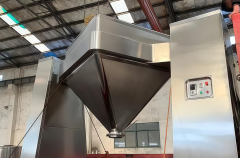
Square Cone Blender for Pharmaceutical Granules
What is Square Cone Blender for Pharmaceutical Granules?
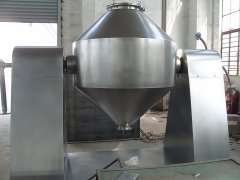
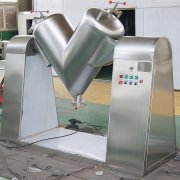
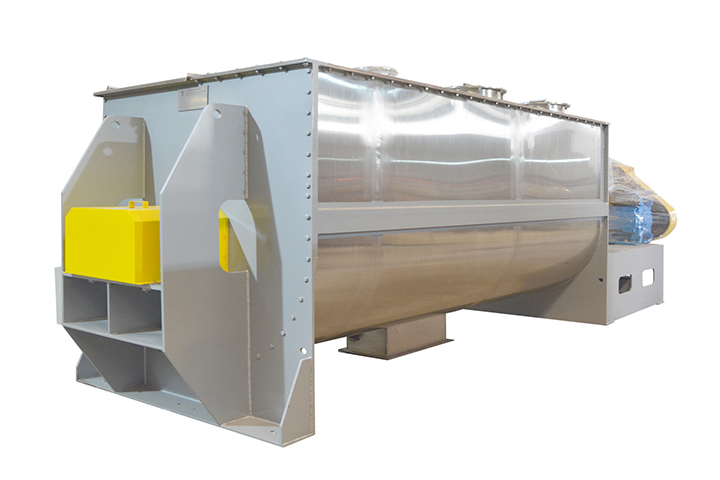
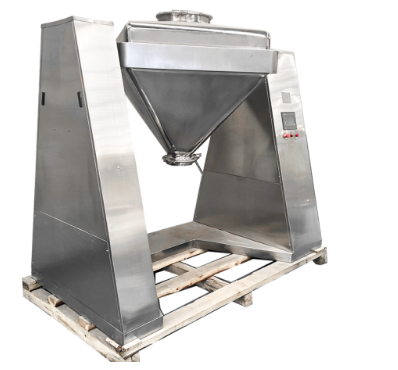
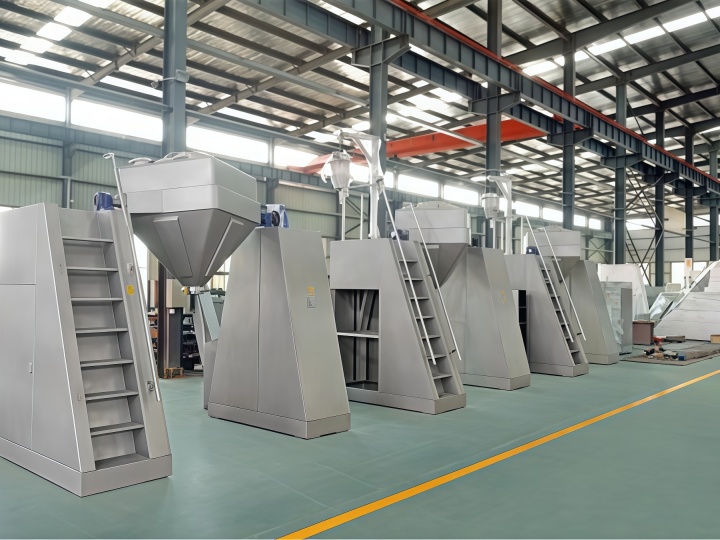
Square Cone Blender for Pharmaceutical Granules is a specialized square-cone blending device for solid dosage form production in the pharmaceutical industry. The square-cone mixing drum maintains a 30-degree angle with the rotary axis, achieving high uniformity mixing through three-dimensional compound motion. Compared to V-type and double-cone blenders, the square-cone structure prevents material accumulation in drum corners and results in low residual after discharge. This product is designed per Chapter 5 of cGMP guidelines concerning equipment design and construction, with CE certification covering electrical safety and mechanical performance per EN ISO 12100.
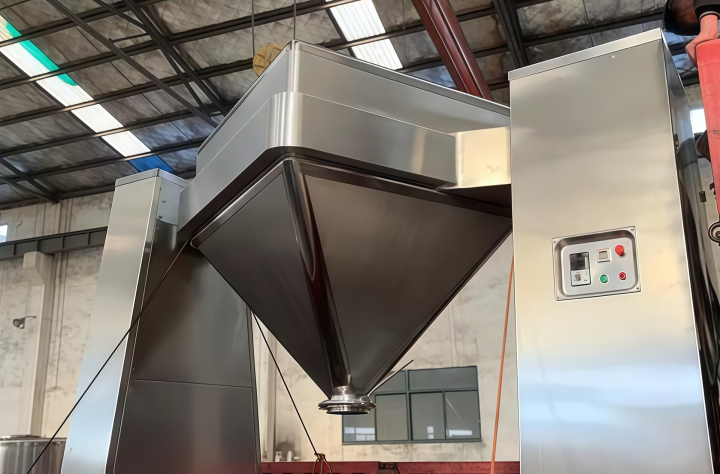
How Square Cone Blender for Pharmaceutical Granules Achieves High Uniformity Mixing?
The mixing process of Square Cone Blender for Pharmaceutical Granules is based on three-dimensional compound motion. After material is loaded into the sealed drum, the drive shaft rotates the drum. Because the drum symmetry axis maintains a 30-degree angle with the rotary axis, material simultaneously undergoes circumferential tumbling, radial diffusion, and axial convection. This product contains no internal blades and relies solely on gravity and drum geometry for dynamic blending. This gentle method generates no frictional heat and does not damage granules, while the enclosed system prevents dust leakage. A 2024 DEM simulation study in Volume 225 of the International Journal of Pharmaceutics validated the mixing mechanism of conical blenders.
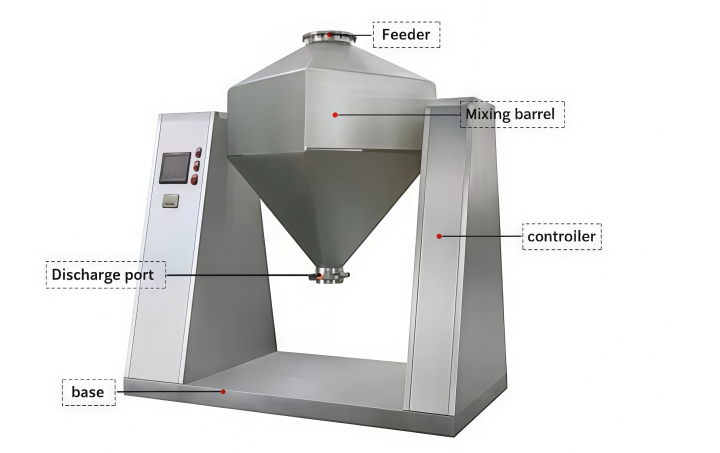
Core Advantages of Square Cone Blender for Pharmaceutical Granules in Production
This product demonstrates several practical advantages over similar equipment in pharmaceutical granule blending, including blend uniformity, cleaning validation efficiency, and preservation of material integrity.
Blend uniformity data is verifiable. This product achieves a measured blend uniformity of 99.2% in dry granules with particle size between 100 and 300 microns, with a volumetric fill coefficient of 80%, higher than the 40% to 50% level of other equipment. Internal surface roughness does not exceed 0.4 microns, meeting surface finish requirements.
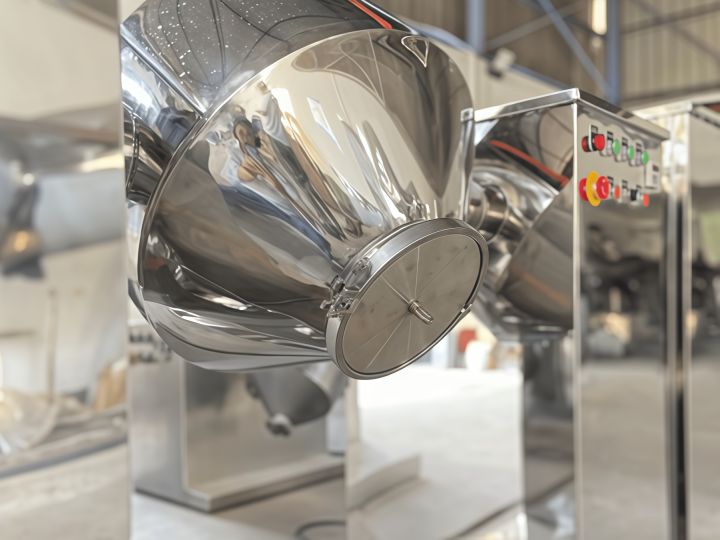
Cleaning validation efficiency is relatively high. The drum walls are mirror-polished with smooth radius transitions at all internal corners. The most difficult area to clean is the flange joint near the discharge port, requiring focused sampling during cleaning validation. Per CDE guidelines issued in 2022, mixing sampling for square-cone blenders should follow a designated diagram.
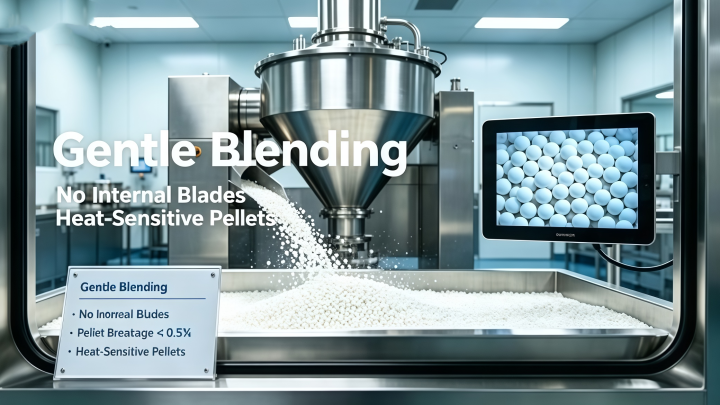
The mixing process does not alter material properties. The blade-free design provides an advantage when blending heat-sensitive sustained-release pellets. In 2025, a solid dosage plant in Zhejiang Province experienced approximately 5% pellet breakage when using a blender with blades for 5mg pellets; after switching to this product, breakage dropped to below 0.5%.
Technical Parameters and Selection Guide for Square Cone Blender for Pharmaceutical Granules
This product is available in sizes from 50L to 8000L. The table below lists technical parameters and material recommendations for the FH series.
| Model | Drum Volume L | Max Load kg | Drum Speed rpm | Motor Power kW | Typical Applications |
|---|---|---|---|---|---|
| FH-50 | 50 | 25 | 0-25 | 1.1 | Lab R&D and pilot granules |
| FH-150 | 150 | 75 | 0-20 | 1.5 | Pilot batch granule blending |
| FH-300 | 300 | 150 | 0-20 | 1.5 | Pilot and small-scale production |
| FH-500 | 500 | 250 | 0-18 | 2.2 | Tablet granules, powder mixtures |
| FH-1000 | 1000 | 500 | 0-15 | 4 | Tablet granules, powder mixtures |
| FH-1500 | 1500 | 750 | 0-12 | 5.5 | Standard solid dosage total mixing |
| FH-2000 | 2000 | 1000 | 0-12 | 7.5 | Standard solid dosage total mixing |
| FH-3000 | 3000 | 1500 | 0-9 | 11 | TCM extract granules, sustained-release pellets |
| FH-4000 | 4000 | 2000 | 0-9 | 11 | TCM extract granules, sustained-release pellets |
| FH-5000 | 5000 | 2500 | 0-8 | 11 | Large-scale solid dosage production |
| FH-6000 | 6000 | 3000 | 0-8 | 15 | Large-scale solid dosage production |
| FH-8000 | 8000 | 4000 | 0-6 | 18.5 | Ultra-large batch production |
When selecting a model, consider material bulk density. TCM extract granules typically have bulk density between 0.4 and 0.6, so actual load should be 80% to 85% of the theoretical value. Lab-scale testing is recommended before finalizing the model.
What Pharmaceutical Materials Does Square Cone Blender for Pharmaceutical Granules Suit?
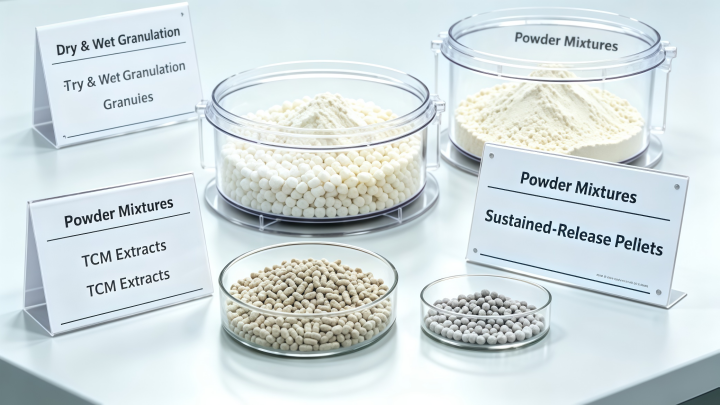
Square Cone Blender for Pharmaceutical Granules is suitable for blending various solid dosage materials in pharmaceutical manufacturing, including dry/wet granulation granules, powder mixtures, and TCM extracts and sustained-release pellets.
Blending dry and wet granulation granules. Granules from dry or wet granulation require total mixing before tableting. Moisture content should be below 3% for wet-granulated granules before blending to prevent adhesion. Dry-granulated granules have irregular shapes, and the three-dimensional compound motion prevents segregation.
Blending powder mixtures. Powder direct compression involves uniform dispersion of active ingredients and excipients. For powder mixtures with significant particle size differences, extending blending time to 15-20 minutes achieves content uniformity compliant with USP requirements.
Blending TCM extracts and sustained-release pellets. TCM extract granules have low bulk density, and actual load should be 80% to 85% of theoretical values. Sustained-release pellets are sensitive to mixing intensity, and the gentle blending characteristics prevent pellet breakage.
Choose Between Square Cone Blender for Pharmaceutical Granules and Other Blenders
This product offers advantages over V-type and double-cone blenders. With an 80% fill coefficient compared to 40%-50% for other equipment, the same batch can be processed with a smaller model. Per Chapter 5 of cGMP guidelines on equipment cleanability, the dead-zone-free interior enables more thorough cleaning, providing an advantage on lines with frequent product changeovers. For heat-sensitive materials, the blade-free design is a key selection consideration.
Regulatory Compliance and Quality Standards for Square Cone Blender for Pharmaceutical Granules
The design and manufacture follow specific requirements of Chapter 5 of cGMP guidelines concerning surface finish and cleanability. Material-contact surfaces are stainless steel with roughness Ra not exceeding 0.4 microns. Each unit undergoes no-load and load simulation testing before delivery with a test report. The 2022 CDE guideline on blend uniformity for oral solid dosage forms specifies sampling requirements for square-cone blenders, and this product complies with relevant provisions.
Operation Points and Maintenance Schedule for Square Cone Blender for Pharmaceutical Granules
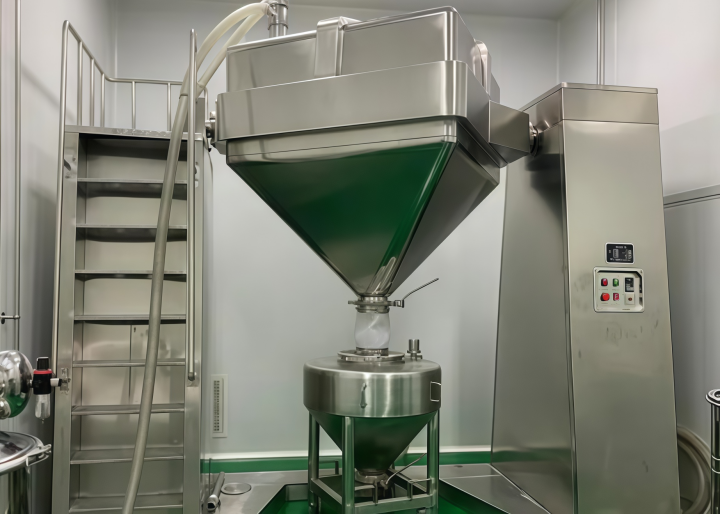
Proper operation and maintenance affect blending performance and service life. Before operation, confirm material has been screened with mesh size typically 60 to 120 mesh to remove agglomerates. Blending time and speed should be determined through process validation, with dry granule blending typically requiring 8 to 15 minutes. After each cycle, clean the drum interior promptly, paying special attention to the flange joint near the discharge port. Drive bearings and seals should be inspected every 2000 operating hours and replaced every 4000 hours.
Frequently Asked Questions About Square Cone Blender for Pharmaceutical Granules
How does Square Cone Blender for Pharmaceutical Granules prevent segregation when blending materials with significant particle size differences?
Set blending time to 15-20 minutes and control fill coefficient between 70% and 75%, while ensuring uniform moisture content to prevent segregation caused by static electricity or moisture variation.
How to select the appropriate Square Cone Blender for Pharmaceutical Granules model based on material characteristics?
First determine maximum batch size, then calculate required drum volume based on an 80% fill coefficient. For materials with bulk density below 0.6, select the next larger model, and finalize based on lab-scale test data.
How is cleaning validation sampling performed for Square Cone Blender for Pharmaceutical Granules?
Per CDE guidelines, square-cone blenders require sampling per a designated diagram. Typically, swab sampling is performed at the flange joint near the discharge port, combined with analysis of final rinse water residue content.
Is Square Cone Blender for Pharmaceutical Granules suitable for blending static-prone materials?
Yes. The blade-free design reduces triboelectric charging. For static-prone materials, adjust ambient humidity to between 45% and 60% before blending.
Summary
With 99.2% blend uniformity, an 80% fill coefficient, and cGMP-compliant dead-zone-free design, this product provides a reliable granule blending solution for pharmaceutical manufacturers. It addresses process challenges including low loading efficiency, lengthy cleaning procedures, and heat-sensitive material damage associated with conventional equipment, and is suitable for production across various scales.