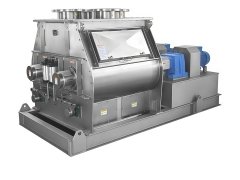
Paddle Mixer for Foundry Sand
What is a Paddle Mixer for Foundry Sand?
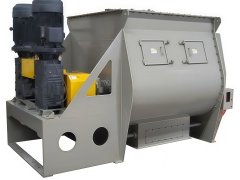
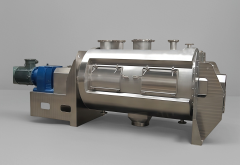
In the foundry industry, achieving consistent sand quality starts with the mixing process. A Paddle Mixer for Foundry Sand is a horizontal twin-shaft continuous mixing unit built specifically for resin sand, sodium silicate sand, and green sand applications. It produces molding sand and core sand with reliable compactability, permeability, and compressive strength. According to U.S. Patent US3964732, the shafts rotate at approximately 65 RPM with sand retained for about 1.5 minutes, while the paddle shape creates an aeration effect that releases heat from reclaimed sand before it returns to the molding line.
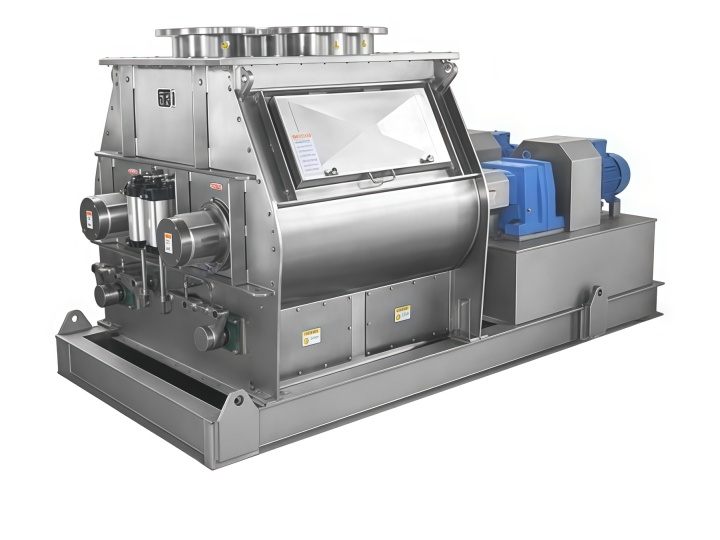
How Does a Paddle Mixer for Foundry Sand Work?
Paddle Mixer for Foundry Sand completes mixing through multiple sets of paddles on two parallel shafts rotating in opposite directions. The paddles push sand to form convective mixing along the axial direction, shear mixing along the radial direction, and diffusion mixing in the overlapping zone between the two shafts. According to patent US4126398, the residence time of sand in the mixing chamber ranges from 1 to 5 seconds. This equipment empties the mixing chamber at the end of each cycle without requiring cleaning with clean sand, which reduces sand waste in foundry operations.
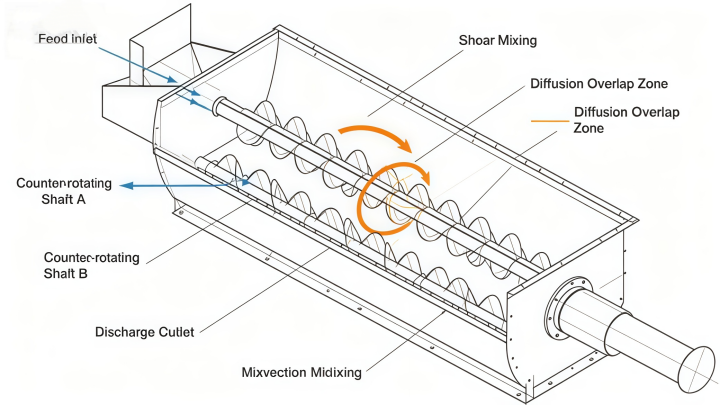
Core Advantages of a Paddle Mixer for Foundry Sand
The value of Paddle Mixer for Foundry Sand is demonstrated in three verifiable technical aspects: precise control of paddle clearance, complete emptying of the mixing chamber, and adjustable binder ratio.
The clearance between paddle tips and the chamber wall is maintained at specific measurements: 0.5 inches or less for a 6-inch diameter chamber; 1 inch or less for a 14-inch diameter chamber; and 1.5 inches or less for a 20-inch diameter chamber. This enables uniform binder distribution and helps reduce casting defects such as veining and porosity.
The chamber empties completely at the end of each cycle, eliminating the need for cleaning with clean sand and reducing material waste.
The discharge rate and binder-to-sand ratio can be adjusted to suit three binder systems: air-setting, gas-setting, and thermo-setting. Operators can use a higher binder proportion in facing sand to achieve a smoother casting surface, while using a lower proportion in backing sand to control costs.
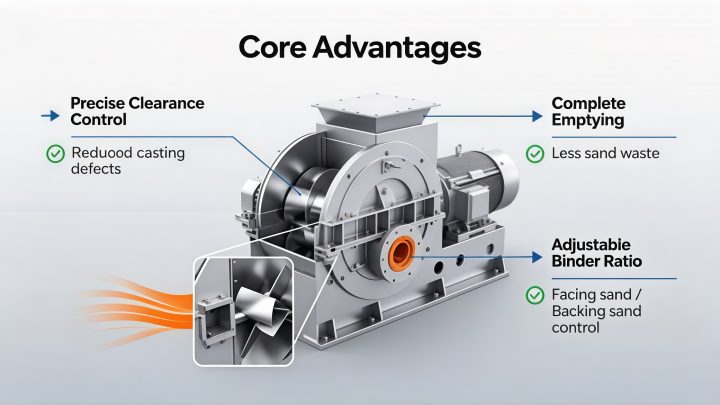
Technical Specifications of Paddle Mixer for Foundry Sand
Paddle Mixer for Foundry Sand is available in six models from PFS-500 to PFS-6000, covering production requirements from small to large foundries. The following table provides key specifications for each model.
| Model | Outlet Capacity L | Motor Power kW | Shaft Speed RPM | Weight kg | Dimensions mm |
|---|---|---|---|---|---|
| PFS-500 | 500 | 11 | 65 | 780 | 1635×1465×1125 |
| PFS-1000 | 1000 | 37 | 65 | 5200 | 2780×2080×1965 |
| PFS-1250 | 1250 | 45 | 65 | 5700 | 2900×2200×2000 |
| PFS-2000 | 2000 | 18.5×2 | 65 | 8600 | 3200×2560×2120 |
| PFS-4000 | 4000 | 30×2 | 65 | 13200 | 3800×2965×2300 |
| PFS-6000 | 6000 | 55×2 | 65 | 19500 | 4750×3130×2745 |
How to Choose the Right Model of Paddle Mixer for Foundry Sand
Model selection requires consideration of three factors: daily output, sand type, and production continuity. The following guidelines apply to different scenarios.
For daily output below 50 tons, consider PFS-500 to PFS-1250. These three models are suitable for small to medium-sized foundries or batch production.
For daily output between 50 and 150 tons, consider PFS-2000 or PFS-4000. These are suitable for continuous production lines in medium to large foundries.
For daily output exceeding 150 tons, consider PFS-6000. This model is designed for high-capacity automated molding lines in large foundries.
Application Scenarios for Paddle Mixer for Foundry Sand
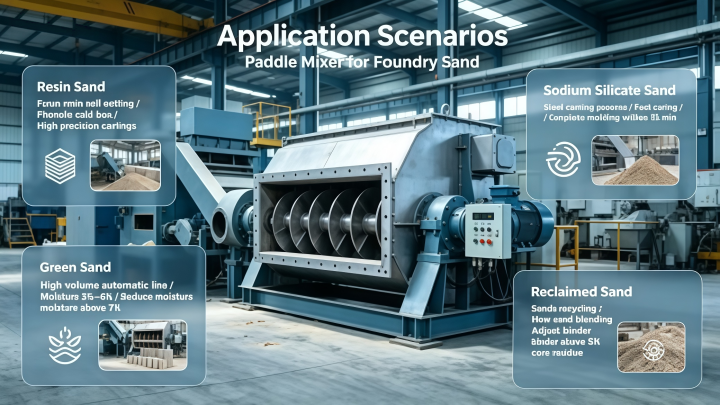
This equipment is suitable for four main sand types in the foundry industry, with different operational requirements for each material.
Resin sand is used in furan resin self-setting sand and phenolic resin cold-box sand processes, applicable to castings with complex shapes and high precision requirements such as machine tool beds and pump bodies. This scenario commonly experiences resin pump line blockages, and monthly cleaning of the lines is recommended.
Sodium silicate sand is used in steel casting sodium silicate self-setting sand processes. The curing speed of sodium silicate is relatively fast, and it is recommended to complete core making or molding within 15 minutes after discharge.
Green sand is used in high-volume automated molding lines for small to medium castings such as engine blocks, brake discs, and pipe fittings. This equipment maintains stable mixing performance when sand moisture content ranges from 3% to 6%. When moisture exceeds 7%, it is advisable to reduce sand moisture before feeding.
Reclaimed sand is used in recycling systems for mixing reclaimed sand with new sand. This equipment can process reclaimed sand with high core sand residue levels. When core sand residue exceeds 5%, increasing the resin addition rate may be considered to compensate for strength loss.
Frequently Asked Questions About Paddle Mixer for Foundry Sand
The following four questions cover key maintenance points from initial startup to paddle replacement.
What should be checked during the initial startup of a Paddle Mixer for Foundry Sand?
Check the tightening torque of all bolts, especially the paddle mounting bolts, before the first startup. Confirm that the shaft rotation direction is correct. The paddles function as fans during operation to create an aeration effect, so the ventilation openings should not be blocked.
Can a Paddle Mixer for Foundry Sand handle different binder systems for molding sand?
Yes. According to patent US4126398, this system allows adjustment of discharge rate and binder ratio, making it suitable for air-setting, gas-setting, and thermo-setting binder systems.
How should residual sand in the chamber be cleaned when a Paddle Mixer for Foundry Sand is shut down?
This equipment empties the mixing chamber at the end of each cycle and does not require cleaning with clean sand. For extended shutdowns, open the side inspection door to check and remove any residual sand, with cleaning intervals not exceeding 4 hours.
How can you determine when the paddles of a Paddle Mixer for Foundry Sand need replacement?
New paddle alloy layers are approximately 8mm thick. Replacement should be considered when the remaining thickness falls below 3mm or when large-area spalling occurs. Measurement every 100 hours with recorded data is recommended to establish a wear curve for predicting replacement timing.