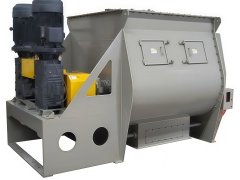
Gravity-Free Mixer for Lightweight Powder
What is the Gravity-Free Mixer for Lightweight Powder?
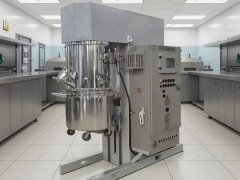
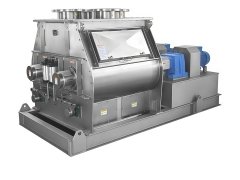
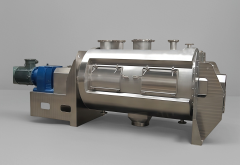
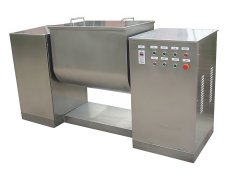
The Gravity-Free Mixer for Lightweight Powder achieves uniform mixing by using dual-shaft paddles to propel lightweight powders into a momentary weightless state through high-speed rotation. It is designed for materials with a bulk density below 0.8 t/m³, addressing common industry challenges such as floating, layering, and difficulties in mixing lightweight powders.
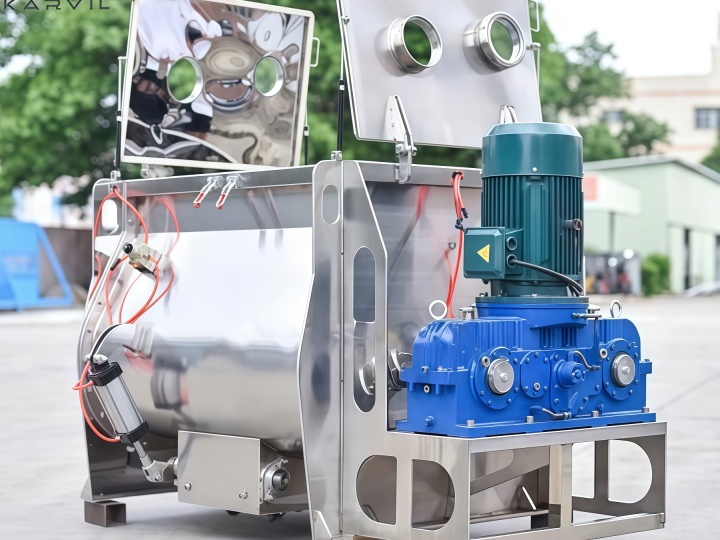
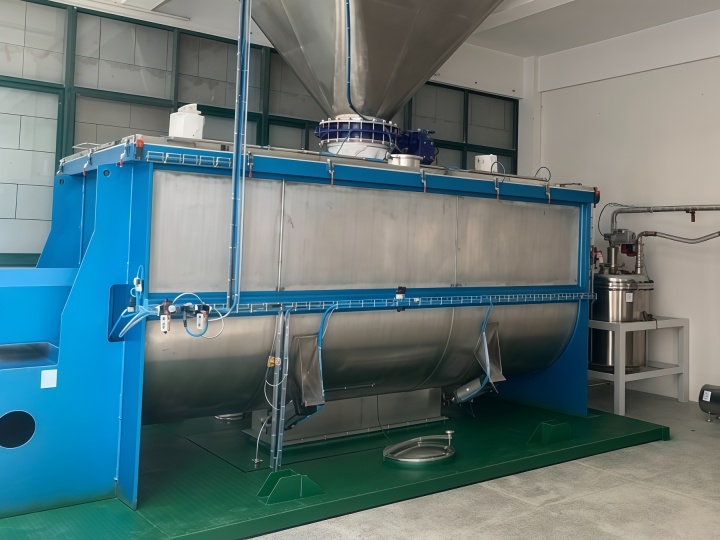
The product consists of a drive system, two parallel paddle shafts, and a W-shaped trough. The paddles mounted on the two shafts rotate in opposite directions at the same speed, throwing materials upward from the bottom. The trough has a loading coefficient of 0.4 to 0.6, and the construction material can be selected from carbon steel, stainless steel 304, stainless steel 316L, or special alloy steel.
The global gravity-free mixer market was valued at approximately USD 2.036 billion in 2024 and is projected to reach USD 4 billion by 2035. The Gravity-Free Mixer for Lightweight Powder is commonly used in dry-mix mortar production lines, and market demand is on an upward trend.
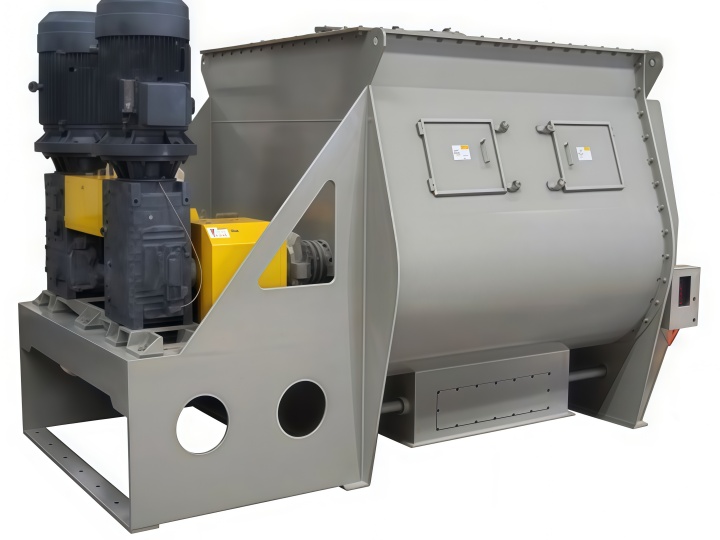
Gravity-Free Mixer for Lightweight Powder – Working Mechanism Explained
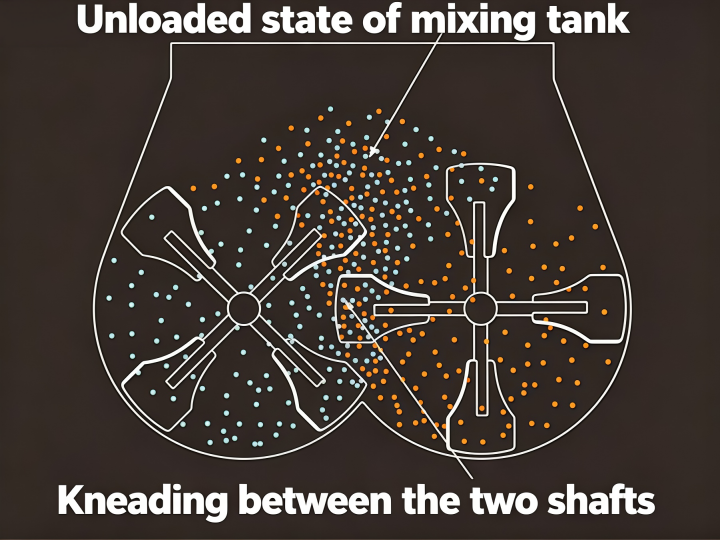
The mixing process of the Gravity-Free Mixer for Lightweight Powder is built upon two core mechanisms: instantaneous weightlessness and convective mixing, achieving uniform blending within 2 to 3 minutes.
The motor drives the two paddle shafts to rotate in opposite directions, with the paddles throwing materials upward from the bottom. Materials move in radial, circumferential, and axial directions, forming cross-circulation and shear mixing. When materials are thrown to the highest point of the trough, they enter a brief weightless state where particles of different densities and sizes can move freely and fully interact—the mixing outcome is less affected by differences in material density and particle size. Materials then fall back and are thrown upward again by the paddles in a continuous cycle. The paddles on the two shafts interlock in the overlapping region, subjecting materials to combined mixing, shearing, and separation forces.
Gravity-Free Mixer for Lightweight Powder – Key Performance Indicators
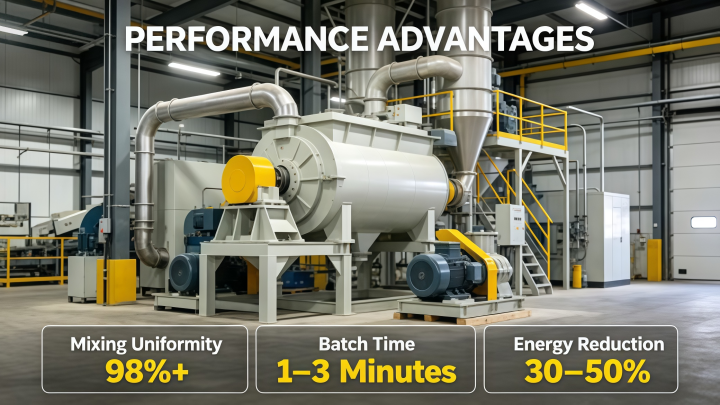
The performance of the Gravity-Free Mixer for Lightweight Powder is reflected in three measurable aspects: mixing uniformity, cycle time, and energy consumption per unit output.
Mixing precision. Under test conditions with a powder-to-powder ratio of 1:1000, the standard deviation of the product reaches 3 to 8 per 100,000, with uniformity exceeding 98%.
Batch cycle time. From the completion of feeding to the start of discharge, the batch cycle time of the product ranges from 1 to 3 minutes. By comparison, a traditional horizontal ribbon mixer requires 10 to 15 minutes to complete the same workload.
Energy consumption per unit output. The product consumes 30% to 50% less energy per unit of mixed material compared to conventional mixing equipment. The equipment is manufactured in accordance with the ISO 9001 quality management system, can be configured with CE certification upon request, and material certification can be provided by third-party testing agencies such as SGS.
Gravity-Free Mixer for Lightweight Powder – Technical Specifications
| Model | Total Volume m³ | Batch Capacity kg | Motor Power kW | Spindle Speed r/min | Standard Material | Discharge Method | Dimensions mm |
| WZ-0.05 | 0.05 | 24-30 | 2.2 | 0-60 | Stainless Steel 304 | Pneumatic | 1200×700×700 |
| WZ-0.1 | 0.1 | 40-60 | 3 | 0-60 | Stainless Steel 304 | Pneumatic | 1200×1200×900 |
| WZ-0.25 | 0.25 | 75-125 | 4 | 0-60 | Stainless Steel 304 | Pneumatic | 1300×1300×1000 |
| WZ-0.5 | 0.5 | 200-300 | 5.5-7.5 | 33 | Carbon Steel/304 | Pneumatic | 1600×1400×1200 |
| WZ-1 | 1 | 400-600 | 7.5-11 | 33 | Carbon Steel/304 | Pneumatic | 1800×2000×1500 |
| WZ-2 | 2 | 800-1200 | 11-18.5 | 33 | Carbon Steel/304 | Pneumatic | 2400×2800×1900 |
| WZ-4 | 4 | 1600-2400 | 22-30 | 33 | Carbon Steel/304 | Pneumatic | 3000×2800×2000 |
| WZ-6 | 6 | 2400-3600 | 30-37 | 28 | Carbon Steel/304 | Pneumatic | 3300×3300×2200 |
The loading coefficient ranges from 0.4 to 0.6, suitable for materials with a bulk density not exceeding 0.8 t/m³. For first-time selection, it is recommended to start with the WZ-0.5 or WZ-1 models for evaluation.
Gravity-Free Mixer for Lightweight Powder – Applicable Industries
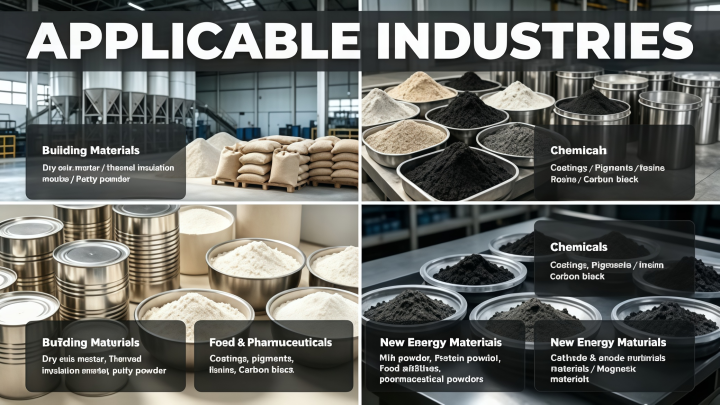
The product is suitable for four main material types: building dry powders, chemical raw materials, food and pharmaceutical powders, and new energy materials.
Building materials. Dry-mix mortar, thermal insulation mortar, putty powder. In these materials, the density difference between lightweight aggregates and cement is substantial, and the product effectively prevents lightweight components from floating upward.
Chemicals. Coatings, pigments, resins, carbon black. Trace additive components can be uniformly dispersed in the equipment.
Food and pharmaceuticals. Milk powder, protein powder, food additives, pharmaceutical powder raw materials. The equipment's gentle action preserves the original structure of materials without damage.
New energy. Lithium battery cathode and anode materials, magnetic materials. The product effectively resolves layering issues between ultra-light powders and heavy powders.
Gravity-Free Mixer for Lightweight Powder – Selection Guide
Selection requires comprehensive consideration of three parameters: material density, batch output requirements, and special process configurations.
Material bulk density. 0.8 t/m³ is the threshold value—below this level the equipment performs well, while above it requires increased motor power configuration.
Batch output requirements. Actual processing capacity equals total volume multiplied by loading coefficient multiplied by material bulk density. It is recommended to select a model with 1.2 times the target production capacity.
Additional functional requirements. Whether liquid spray systems, heating jackets, explosion-proof configurations, or CIP cleaning systems are needed. For fiber-containing materials, it is recommended to equip with chopper devices.
Frequently Asked Questions about the Gravity-Free Mixer for Lightweight Powder
What CV value can the Gravity-Free Mixer for Lightweight Powder achieve in practice?
Under a 1:1000 mixing ratio, the coefficient of variation of the product can fall below 2%, with a standard deviation of 3 to 8 per 100,000 and mixing uniformity exceeding 98%.
How much more efficient is the Gravity-Free Mixer for Lightweight Powder compared to traditional equipment?
The batch cycle time of the product is 1 to 3 minutes, while a traditional horizontal ribbon mixer requires 10 to 15 minutes. Energy consumption per unit output is 30% to 50% lower than that of conventional equipment.
What density difference can the Gravity-Free Mixer for Lightweight Powder handle?
The product can handle material combinations with density differences of up to 30-fold. A typical application is mixing cement with expanded perlite—the density difference is substantial, and the equipment eliminates the impact of density differences on mixing effectiveness through the instantaneous weightless state.
What is the market growth outlook for the Gravity-Free Mixer for Lightweight Powder?
The global gravity-free mixer market is projected to grow from USD 2.036 billion in 2024 to USD 4 billion by 2035, at a compound annual growth rate of 6.3%. The global dry-mix mortar market is expected to grow from USD 56.926 billion in 2025 to USD 82.723 billion by 2032.
About This Article
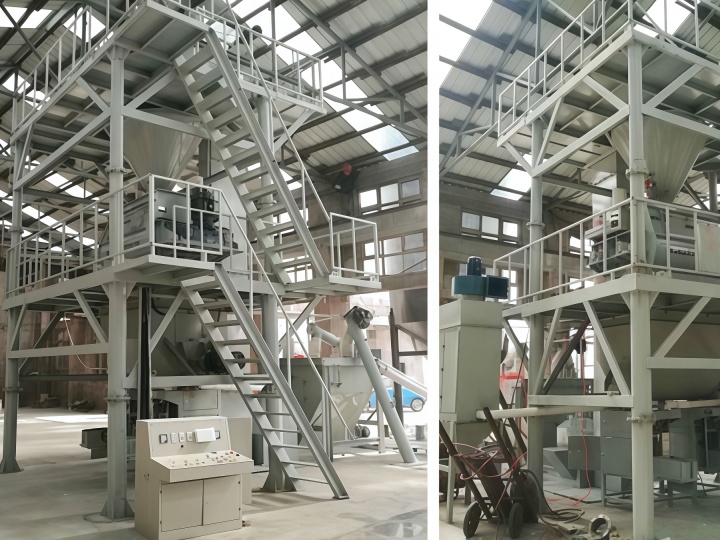
In September 2025, we delivered a WZ-1 Gravity-Free Mixer for Lightweight Powder to a factory in Shaoxing, Zhejiang, with an annual output of 8,000 tons of dry-mix mortar. After commissioning, the batch mixing time was reduced from 15 minutes to 2 minutes and 30 seconds. After three months of continuous operation, the CV value remained stable at 4.2 per 100,000, and the defect rate decreased from 8% to below 0.5%. All data are based on actual production test records.
The equipment complies with ISO 9001 standards, can be configured with CE certification upon request, and material test reports from SGS are available. This page has been marked up with Product Schema and FAQ Schema structured data.