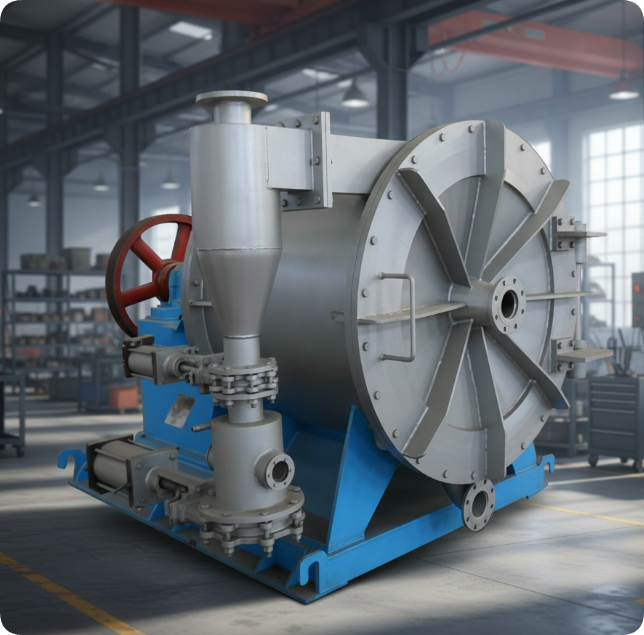
ZDFD Single-Effect Fiber Separator
What is a ZDFD Single-Effect Fiber Separator?
The ZDFD series single-effect fiber separator is mainly used to separate light and heavy impurities from waste paper and to perform secondary pulping on pulp from a hydrapulper. The screen apertures of the hydrapulper can be enlarged, increasing its production capacity.
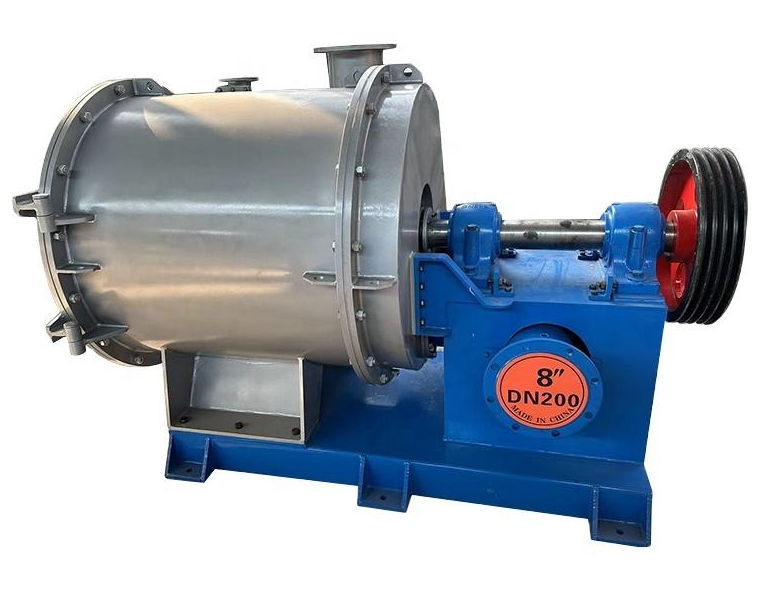
What are the uses of the ZDFD Single-Effect Fiber Separator?
Its core tasks can be summarized in three actions: further dispersing fibers, separating light and heavy impurities, and screening out qualified pulp.
The entire process takes place in a sealed tank. The working principle mainly utilizes the synergistic effect of centrifugal force, specific gravity difference, and mechanical force:
Eddy current separation (using specific gravity difference): The pulp enters the circular tank tangentially under a certain pressure. Driven by a high-speed rotating impeller inside, a strong eddy current is generated. At this time, substances with different specific gravities will follow different "paths":
Light impurities (such as plastic sheets, foam): With a lower specific gravity, they are concentrated in the central area by the eddy current and then periodically discharged through the central light impurity discharge pipe.
Heavy impurities (such as sand, staples, and metal blocks): These have a high specific gravity and are thrown against the tank wall by strong centrifugal force, eventually sliding down into the heavy slag pipe and being discharged from the machine.
Secondary debonding (using mechanical force): During vortex separation, the high-speed rotating impeller generates strong mechanical tearing and fluid shearing forces on the pulp, further breaking down the fiber bundles that were not fully dispersed in the hydrapulper, resulting in qualified pulp fibers.
Final screening: After debonding and separation, the pulp passes through a screen plate behind the impeller. Qualified fine fibers pass smoothly through the screen holes and flow out from the good pulp pipe to the next process; while coarse impurities and fiber bundles cannot pass through the screen plate and are ultimately discharged from the tail pulp pipe.
Therefore, it cleverly combines the debonding function of a hydrapulper, the impurity separation function of a deslag remover, and the screening function of a coarse screen into one device.
What are the advantages of the ZDFD single-effect fiber separator?
Compared to using multiple individual units, the ZDFD single-effect fiber separator offers significant advantages in terms of process flow and economy:
Multi-functional, simplified process: Integrating debonding, impurity removal, and screening into one unit, it simplifies the waste paper processing flow, making the entire pulping line more compact.
Improved downstream efficiency: Fiber debonding is completed before impurities are separated, preventing further breakage into small, difficult-to-remove particles within the equipment, greatly reducing the burden on subsequent screening and purification equipment.
Allows the use of lower-quality waste paper: Due to its efficient impurity separation capabilities, paper mills can use lower-quality, cheaper waste paper as raw material while maintaining the quality of the final pulp, effectively reducing raw material costs.
Energy saving and consumption reduction: Due to its efficient design, it consumes less energy than traditional multi-unit combinations when processing the same amount of pulp. Data shows that compared to conventional equipment, its power consumption can be reduced by 30-50%, and unit energy consumption can be saved by 10-20%.
High production efficiency: Its large throughput capacity effectively increases the output of the entire pulping system. Some improved models can increase output by 20-40% compared to conventional fiber separators.
| Model | Production capacity (t/d) | Feed concentration (%) | Feed pressure (Mpa) | Pressure difference (Mpa) | Motor power (Kw) |
| ZDFD2 | 50-70 | 2-4 | 0.15-0.20 | 0.03-0.05 | 45 |
| ZDFD3 | 80-120 | 2-4 | 0.15-0.20 | 0.03-0.05 | 55 |
| ZDFD4 | 180-250 | 2-4 | 0.15-0.20 | 0.03-0.05 | 75-90 |
| ZDFD5 | 280-360 | 2-4 | 0.15-0.20 | 0.03-0.05 | 160 |
| ZDFD6 | 300-400 | 2-4 | 0.15-0.20 | 0.03-0.05 | 200 |
| ZDFD7 | 400-500 | 2-4 | 0.15-0.20 | 0.03-0.05 | 280 |