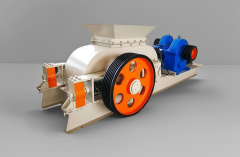
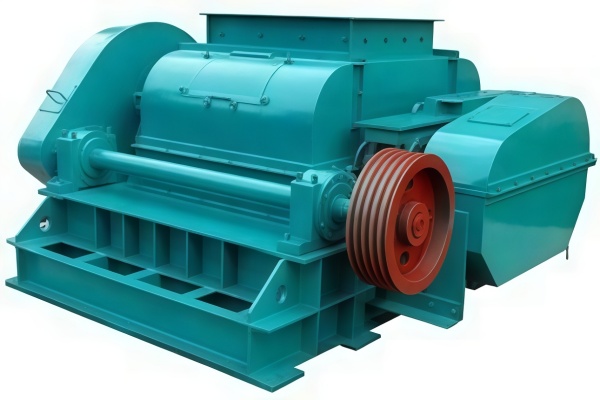
Roller Crusher Capacity Calculator: How to Choose the Right Model
Wednesday August-26 2026 10:55:12
Selecting the right Roller Crusher for a production line starts with accurate capacity calculation. Our factory's technical team experienced this firsthand when assisting a nickel mining project in Sulawesi, Indonesia. The client presented a recommended solution from an equipment manufacturer, proposing a Roller Crusher with a 1000 mm roll diameter. We tested the material on‑site and found its moisture content at 11% with a maximum feed size of 280 mm.
Using the standard formula, the theoretical capacity did reach 80 tons per hour. However, we insisted on performing nip angle verification and effective width correction for the toothed roll, and discovered that the actual capacity could only reach 45 tons per hour. If we had placed the order directly based on the manufacturer's recommendation, the entire production line commissioning would have been delayed by at least three months.
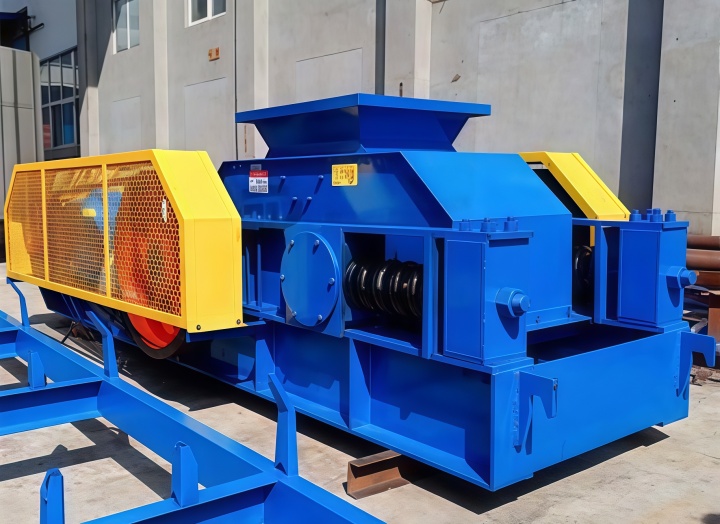
Capacity is the primary indicator that determines Roller Crusher selection. Oversized selection means unnecessary procurement costs and floor space occupation,
while undersized selection directly reduces the entire production line's throughput capacity. This article walks through the practical application of the capacity calculation formula, the three most commonly misunderstood critical parameters, and the four steps that must be personally verified during selection, explaining step by step how to use the Roller Crusher Capacity Calculator to make the right selection decision.
Quick Answer: First use the formula C=V×L×D×ρ×60 to calculate theoretical capacity, then determine the efficiency factor based on the material's fines percentage and moisture content. For toothed rolls, multiply the roll width by 0.5 to 0.6 as a correction factor, and finally add a 15% to 20% margin. If the nip angle exceeds 25 degrees, a larger roll diameter is required.
A Real Project Case Showing How to Use the Roller Crusher Capacity Calculator Correctly
Returning to the nickel project in Sulawesi, Indonesia. The material was lateritic nickel ore with a bulk density of 1.5 tons per cubic meter, the discharge opening was set at 30 mm, and the manufacturer recommended a roll surface linear speed of 65 meters per minute with an effective roll width of 1.2 meters. Substituting these values into the formula: 65×1.2×0.03×1.5×60=210.6 tons per hour theoretical capacity.
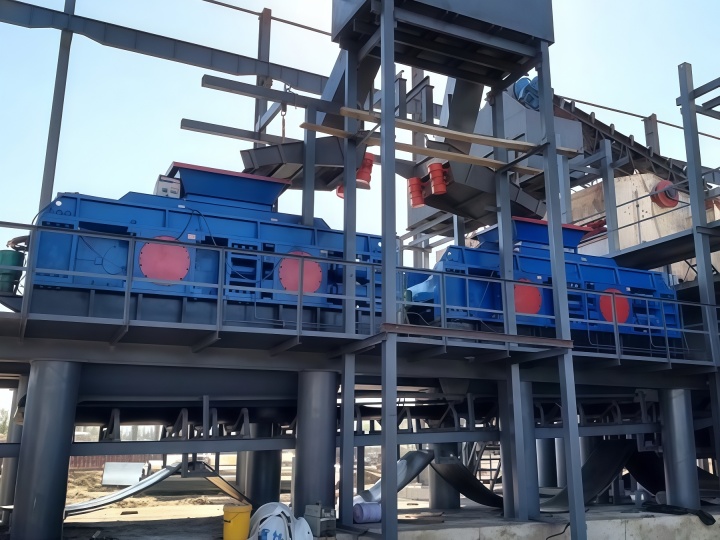
The real question was what efficiency factor to use. After screening the material sample, we found that fines smaller than the discharge opening size accounted for as much as 38% of the total feed. These qualified particles did not participate in the crushing process but occupied valuable space within the roll gap. Taking both the fines content and material stickiness into consideration, we ultimately set the efficiency factor at 0.28. This gave us 210.6×0.28=59 tons per hour.
After adding a 15% margin, the target capacity was set at 68 tons, and we finally selected a model with a 1200 mm roll diameter. After commissioning and six months of continuous operation, the actual measured capacity remained stable between 72 and 78 tons per hour, with roll surface wear within the expected range.
The three core parameters that determine the actual capacity efficiency factor of this equipment are roll surface linear speed, feed fines percentage, and effective roll width value. Each parameter has specific field‑tested methods for determination.
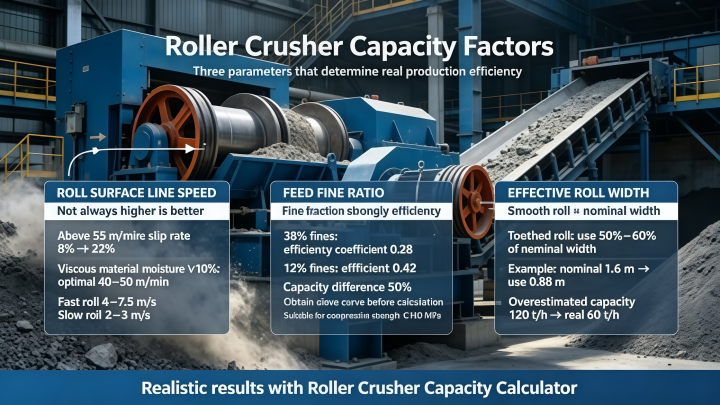
Roll surface linear speed is not always better when higher. When the linear speed exceeded 55 meters per minute, the slippage rate jumped from 8% to 22%, and the actual throughput decreased instead. For sticky materials with moisture content above 10%, the comprehensive efficiency peaks when linear speed is controlled between 40 and 50 meters per minute. According to industry literature, the circumferential speed of high‑speed rolls can reach 4 to 7.5 meters per second, while low‑speed rolls operate at 2 to 3 meters per second.
The percentage of fines in the feed has a tremendous impact. When fines accounted for 38%, the efficiency factor was pressed down to 0.28. In another project where the feed had been pre‑screened and fines were only 12%, the efficiency factor for the same specification of equipment could be taken as 0.42, resulting in a 50% difference in capacity. Before using the formula, you must obtain the screening curve. In terms of material hardness, roller crushers are suitable for materials with compressive strength ≤160 MPa.
The effective roll width value is completely different for toothed rolls versus smooth rolls. Smooth rolls directly use the nominal roll width in the formula. Toothed rolls are much more complex, as the roll teeth occupy a significant portion of the width space. According to industry standards, the effective width of non‑smooth rolls should be taken as 50% to 60% of the nominal roll width.
A client once selected a toothed‑roll crusher based on a nominal width of 1.6 meters and calculated a capacity of 120 tons per hour, but after commissioning, the actual capacity was only 60 tons. This happened because they failed to apply the effective width correction. We helped them recalculate using 1.6×0.55=0.88 meters, which solved the problem. By combining the field‑tested judgments of these three parameters, the final result from the Roller Crusher Capacity Calculator can truly reflect real operating conditions.
Four Steps for Personally Verifying Your Selection
Verifying your selection requires completing four steps in sequence: material data collection, nip angle verification, efficiency factor determination, and capacity margin reservation. Each step directly affects the accuracy of the final selection.
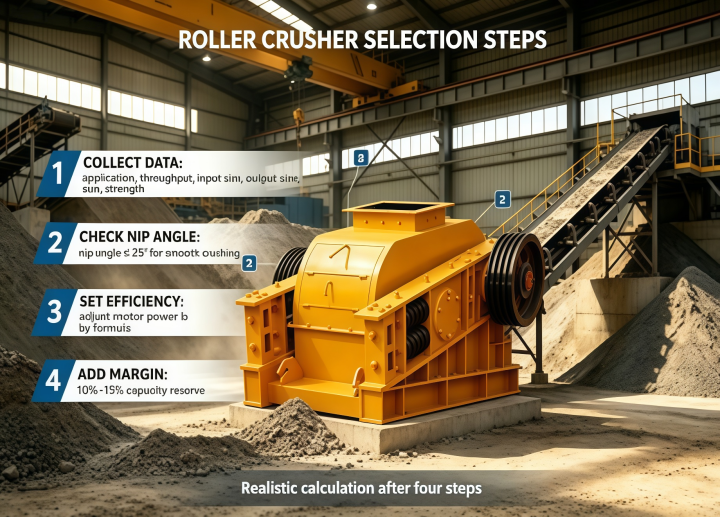
Step 1: Obtain the complete set of basic material data. This includes bulk density, moisture content, screening curve, and compressive strength. Do not start calculating if any of these items are missing. Bulk density is used to calculate mass‑based capacity, moisture content and fines percentage determine the efficiency factor, and compressive strength tells you whether the material falls within the applicable range of the equipment. For materials with compressive strength exceeding 160 MPa (approximately 23,200 psi), the roll surface service life will be significantly shortened, and you should evaluate whether a roller crusher is suitable at all.
Step 2: The nip angle must be verified. The nip angle formula is cos α = (D+S)/(D+k), where D is the roll diameter, S is the roll gap, and k is the maximum feed particle size. When the nip angle exceeds 25 degrees, the material cannot be effectively drawn into the crushing chamber. When the roll diameter is insufficient, material will sit on top of the rolls without entering the crushing zone. This not only directly loses capacity, but the material will also repeatedly rub against the roll surface like an abrasive, accelerating roll shell wear. In the Indonesia project, when we substituted the recommended 1000 mm roll diameter into the nip angle formula, the angle came out to 29 degrees, meaning the material could not be drawn in properly. This is why we insisted on switching to 1200 mm.
Step 3: After correcting the effective width, recalculate the theoretical capacity and determine the efficiency factor. For toothed rolls, take the effective width as 50% to 60% of the nominal roll width. The efficiency factor is determined comprehensively based on fines percentage and moisture content. According to industry experience, the looseness factor Ks generally ranges from 0.1 to 0.3, with metal ores taking 0.1 and soft materials taking 0.3. Combined with our factory's measured data: when fines are below 15% and moisture is below 8%, take 0.40 to 0.50; when fines are 15% to 30% or moisture is 8% to 12%, take 0.30 to 0.40; when fines exceed 30% or moisture exceeds 12%, take 0.25 to 0.30.
Step 4: Add a 15% to 20% margin to the capacity to account for three real‑world issues: daily fluctuations in material properties, gradual capacity decline due to roll surface wear, and short‑term production increase requirements. After completing these four steps, substitute all corrected parameters into the Roller Crusher Capacity Calculator to obtain a selection basis with real practical reference value.
Field‑Tested Capacity Comparison Between Toothed and Smooth Rolls
| Roll Type | Nominal Roll Width | Effective Width Value | Actual Capacity Difference | Application Scenario |
|---|---|---|---|---|
| Smooth Roll | 1200mm | Directly 1200mm | Baseline | Dry materials, uniform product size required |
| Toothed Roll | 1200mm | 600‑660mm | 40%‑50% lower than smooth | Wet/sticky materials, high reduction ratio |
| Grooved/Segmented Roll | 1200mm | 840‑960mm | 15%‑25% lower than smooth | Medium‑hard materials, balanced efficiency and wear life |
While toothed rolls have lower capacity, their throughput stability when handling wet and sticky materials is far superior to smooth rolls. When moisture content exceeds 10%, smooth rolls experience capacity fluctuations of ±30% due to material slippage and roll surface adhesion, whereas toothed rolls maintain fluctuations within ±10%. During selection, beyond calculating the capacity numbers, you also need to evaluate which roll surface type can operate stably under your specific material characteristics. This is often the part of Roller Crusher selection that requires more experience‑based judgment than theoretical calculation alone.
Closing Remarks
Roller Crusher capacity selection is a data‑driven decision, not a matter of simply buying whatever a salesperson recommends. From the screening curve and moisture content to nip angle verification, effective width correction, efficiency factor determination, and margin reservation, each step must be personally verified. The Indonesia project would likely still be struggling with insufficient capacity today if these verifications had not been performed.
We hope the Roller Crusher Capacity Calculator usage methods and supporting empirical data provided in this article serve as a useful reference in your actual selection process. If you have specific material data and are uncertain about what efficiency factor to use, we recommend consulting with factory technical personnel who have experience handling similar materials, as the data they provide is usually much more practical than what you will find on equipment specification sheets.
FAQ
Q1: What efficiency factor should I use in the Roller Crusher Capacity Calculator when fines percentage is 25%?
When fines are 25% and moisture is between 8% and 12%, take 0.30 to 0.35, with 0.32 recommended as the baseline for initial calculations.
Q2: How can I compensate for insufficient capacity when site space is limited and I can only choose a smaller roll diameter Roller Crusher?
A smaller roll diameter means a larger nip angle. You can reduce the roll surface linear speed to improve bite conditions, and moderately increase the discharge opening size to trade some product fineness for additional capacity.
Q3: How often should the discharge opening be adjusted to maintain capacity as the Roller Crusher roll surface wears?
Based on our factory's tracked data, smooth rolls should have their roll surface wear measured every 200 to 300 operating hours. When wear causes the discharge opening to increase by approximately 8%, the gap should be readjusted.
Q4: Will tramp metal mixed into the feed damage a Roller Crusher?
Yes. Tramp metal stuck between the rolls not only causes instantaneous capacity loss but can also damage the roll surface or trigger overload shutdowns. A magnetic separator must be installed at the feed end for protection.