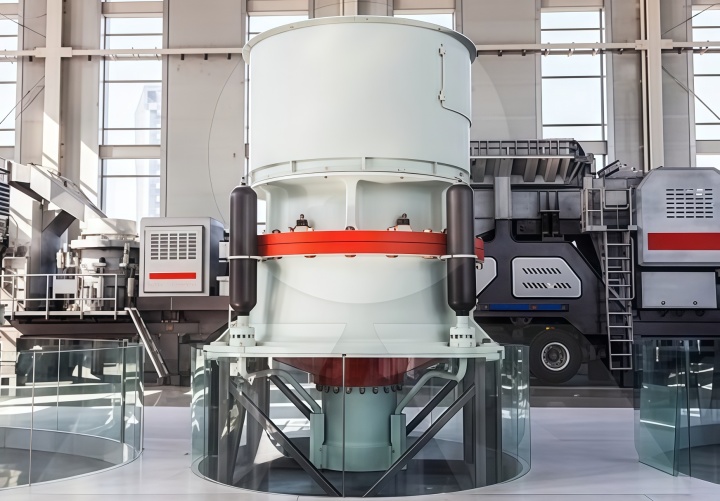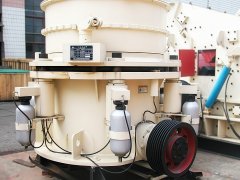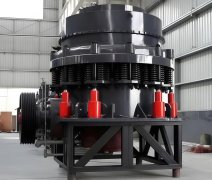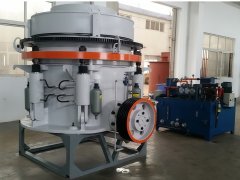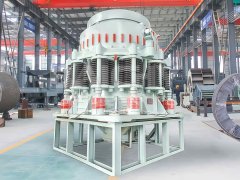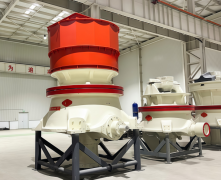
Single Cylinder Cone Crusher
What Is a Single Cylinder Cone Crusher?
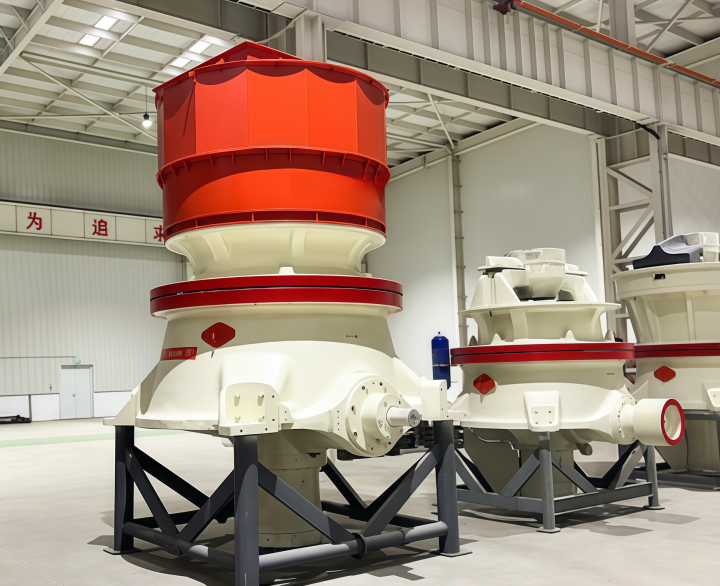
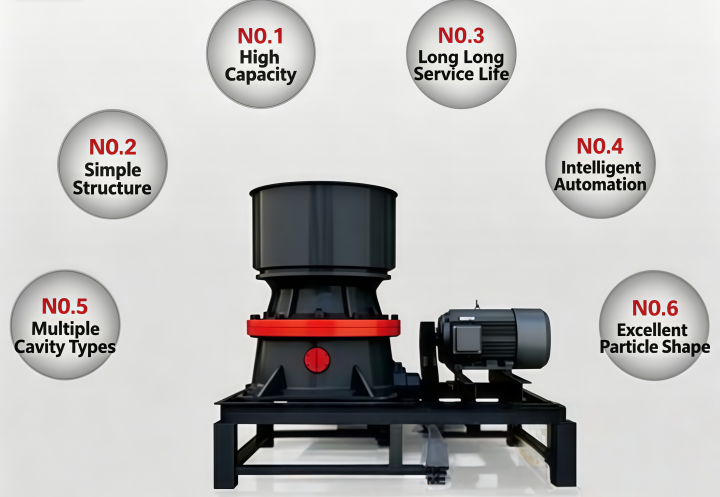
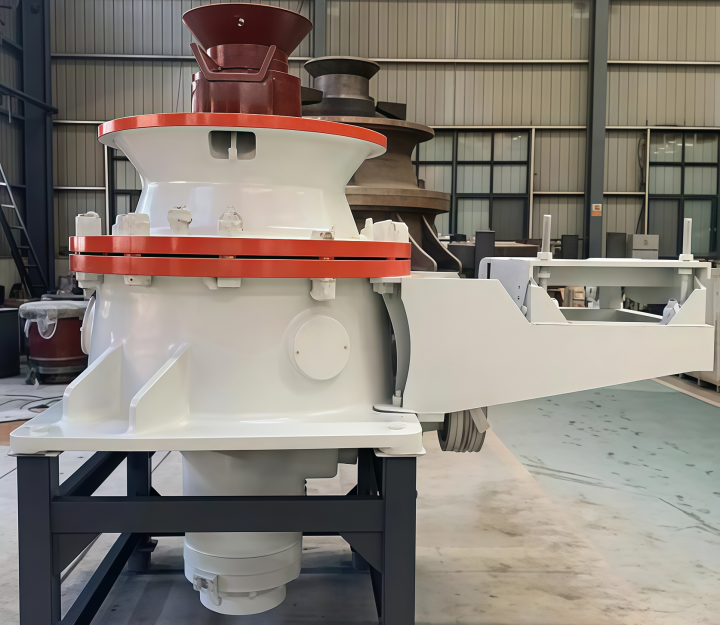
For medium and fine crushing operations, the Single Cylinder Cone Crusher uses a single bottom hydraulic cylinder to handle discharge adjustment, tramp iron protection, and chamber clearing. It accepts feed up to five hundred sixty millimeters and processes over two thousand tons per hour. Typically used as secondary or tertiary crusher paired with a jaw crusher.
Compared to a spring cone crusher of the same size, this equipment is fifteen percent lower in height and twelve percent lighter, reducing foundation requirements.
Working Principle of the Single Cylinder Cone Crusher
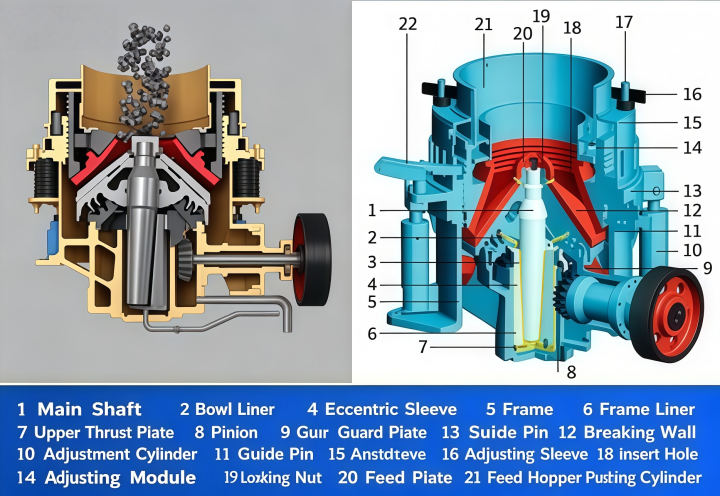
The motor drives the horizontal shaft, which rotates the eccentric sleeve through bevel gears. The eccentric sleeve makes the mantle gyrate around the chamber center. When the mantle approaches the bowl liner, it compresses material; when it moves away, crushed material discharges. The hydraulic cylinder controls mantle height to adjust discharge opening.
When an uncrushable object enters, system pressure rises, the cylinder retracts to enlarge the opening and release the object, then automatically resets. The chamber uses laminating crushing, where material is compressed by the weight column above and inter-particle forces. Cubic particles exceed eighty-five percent, and flat particles stay below five percent. Liner wear is reduced by about twenty percent versus traditional methods.
Technical Parameters of the Single Cylinder Cone Crusher
Reference data for three common models: medium-hard granite, bulk density 1.6 t/m³, moisture below four percent.
| Model | Base Diameter (mm) | Max Feed (mm) | Discharge Range (mm) | Capacity (t/h) | Power (kW) |
|---|---|---|---|---|---|
| Coarse | 1060 | 190 | 19-45 | 70-250 | 160 |
| Medium | 1060 | 110 | 10-32 | 50-200 | 160 |
| Fine | 1060 | 50 | 6-19 | 45-130 | 160 |
Additional cavity types are available. Replacing liners on a Single Cylinder Cone Crusher takes four workers about six hours, from shutdown cooling to no-load test run completion.
Where Are the Advantages of the Single Cylinder Cone Crusher?
Efficiency is higher than traditional equipment.
In September 2025, our factory tested granite from Jiujiang, Jiangxi, over three days. Material compressive strength was 200 MPa, feed below 150 mm. Both crusher types ran alternately at the same 25 mm discharge opening. The Single Cylinder Cone Crusher delivered about forty percent higher throughput and cut power consumption by roughly 0.8 kWh per ton. It ran seventy-two hours continuously without hydraulic alarms.
Laminating crushing gives better product shape.
The Single Cylinder Cone Crusher uses multi-directional compression rather than simple squeezing. In the same test, flat particles were 3.2 percent, versus 8.7 percent from the spring cone crusher. Keeping flat particles below five percent meets railway bridge concrete aggregate standards.
Maintenance costs are low among comparable products.
Liner replacement only requires loosening upper frame bolts and lifting it with hydraulic aid; the main shaft stays in place. The hydraulic and lubrication systems are integrated, using about three hundred liters of oil—one-third of a spring cone crusher's requirement. Oil change interval is two thousand hours, using about one hundred twenty liters each time.
The control system monitors five key parameters.
It tracks motor current, discharge opening, oil temperature, oil pressure, and tank level. The system alerts when liners wear to minimum thickness. Two automatic modes are available: constant discharge opening for strict size control, and constant power for unstable feed conditions.
What Specific Applications Use the Single Cylinder Cone Crusher?
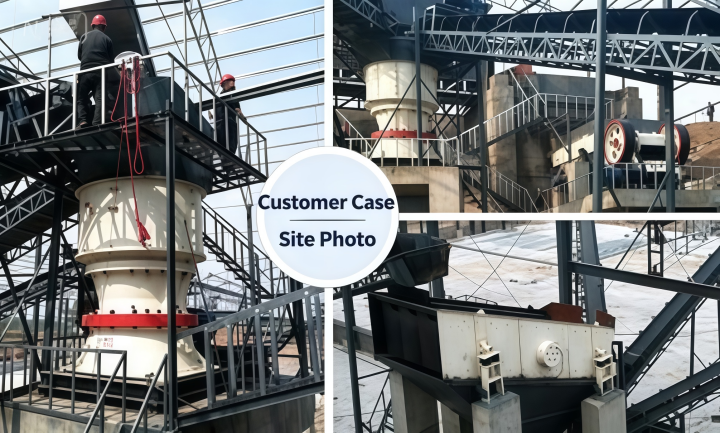
The Single Cylinder Cone Crusher serves three main applications.
In metal mines, it crushes iron and copper ore at medium and fine stages, with discharge openings of ten to twenty millimeters, feeding ball mills.
In aggregates, it processes granite, basalt, and diabase for highways, railways, and hydroelectric projects.
In cement lines, it crushes limestone at twenty to thirty millimeters for vertical or ball mills.
Non-metallic mineral processors also use it for quartz and feldspar, changing liners for different abrasiveness.
How to Choose the Right Single Cylinder Cone Crusher?
Determine the crushing stage.For secondary (medium) crushing, choose a coarse cavity with larger discharge to maximize throughput. For tertiary (fine) crushing, choose a fine cavity with smaller discharge to control product size. Wrong cavity selection leads to capacity or size issues.
Match material hardness and feed size.The Single Cylinder Cone Crusher handles materials below 350 MPa compressive strength. Feed size should not exceed eighty percent of the maximum allowable size, which depends on cavity type: coarse accepts 190 mm, fine accepts only 50 mm. If clay exceeds ten percent or moisture exceeds five percent, add pre-screening to avoid chamber blockage.
Calculate capacity and power.Select the model based on target throughput and verify on-site power supply for motor starting current. Motor power ranges from 160 kW to 400 kW, with starting current three times the rated value. Confirm transformer and cable specs with an electrical engineer beforehand.
Daily Maintenance of the Single Cylinder Cone Crusher
According to our after-sales records for 2025, over sixty percent of unscheduled shutdowns among forty-seven units came from poor maintenance, mainly lubrication issues.
Check oil level and temperature daily. If oil level drops below the sight glass midline, add the same grade oil. Winter startup without preheating caused nine failures in 2025, accounting for eighteen percent of hydraulic repairs. Do not start below fifteen degrees Celsius; preheat for twenty to forty minutes until oil reaches twenty degrees.
Check accumulator nitrogen pressure weekly. Maintain pressure within plus or minus five percent of the set value. Thirty-two percent of tramp iron jams came from low accumulator pressure. Low pressure slows release and may jam the unit; high pressure reduces release stroke.
Clean radiator fins every two weeks.Dust buildup raises oil temperature above sixty degrees in summer. Use compressed air from inside outward, and check the cooling fan. Radiator blockage caused twenty-six percent of summer high-temperature alarms.
Check actual discharge opening monthly. Liner wear gradually enlarges the opening. Measure with a lead ball or gauge. If deviation exceeds two millimeters, adjust the cylinder or plan liner replacement. When liner thickness falls below thirty percent of original, discharge control risk increases.
Change oil and clean filters every two thousand hours. Old oil has lower viscosity and more contaminants. Always replace or clean both suction and return filters. Data shows that changing oil without filters returns contaminant levels to pre-change condition within one hundred to one hundred fifty hours.
Common Fault Codes for the Single Cylinder Cone Crusher
The control system displays these five fault codes.
E01: oil temperature above sixty-five degrees—check radiator, fan, and oil level.
E02: accumulator pressure below eighty percent of set value—recharge nitrogen and check the bladder.
E03: discharge adjustment timeout—check cylinder seals and oil lines.
E04: motor overload—stop immediately, check feed size and chamber for uncrushable objects. Continuous overload degrades motor insulation; test winding resistance every six months.
E05: insufficient lubrication flow—check oil pump and filters.
Practical Q&A on the Single Cylinder Cone Crusher
What checks are needed before starting the Single Cylinder Cone Crusher?
Check oil level above sight glass midline, oil clarity, and no leaks at joints. Clean the oil filter surface. Rotate manually to confirm no material or tools remain in the chamber.
What if the Single Cylinder Cone Crusher vibrates heavily during operation?
Check if the ammeter fluctuates and if feed is steady. If feed is normal and vibration continues, shut down, lift the upper frame, and inspect liners for looseness or cracks, and check eccentric bearings.
How to handle oil temperature above sixty degrees on the Single Cylinder Cone Crusher?
Inspect the radiator for dust or sludge, and check fan direction. If clear, check oil level. If oil stays hot, consider internal hydraulic leakage and call maintenance.
Why does the discharge opening of the Single Cylinder Cone Crusher keep changing?
Aged seals in the hydraulic cylinder cause pressure oil leakage, shown by gradual opening increase and frequent repressurization. Replace the seal assembly. Another cause is a ruptured accumulator bladder mixing nitrogen into oil; replace the bladder and recharge nitrogen.