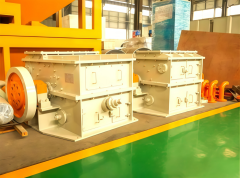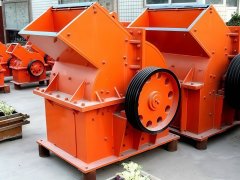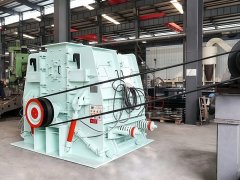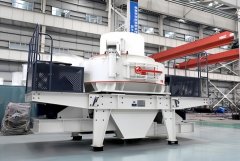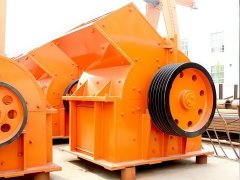
Gypsum board hammer crusher for cement mixing
Gypsum Board Hammer Crusher for Cement Mixing – Technical Specifications & Field Performance Data
Gypsum Board Hammer Crusher for Cement Mixing integrates crushing, dispersing, and drying functions. It processes gypsum board waste, FGD gypsum, and other soft non-abrasive materials into cement raw materials. Its integrated hammer disc and air duct design differs from conventional separate crushing and hot-air systems, achieving thermal efficiency above 92%. The machine accepts feed with moisture up to 15% and reduces it below 1% through simultaneous hammer crushing and hot-air drying, meeting cement blending feed requirements.
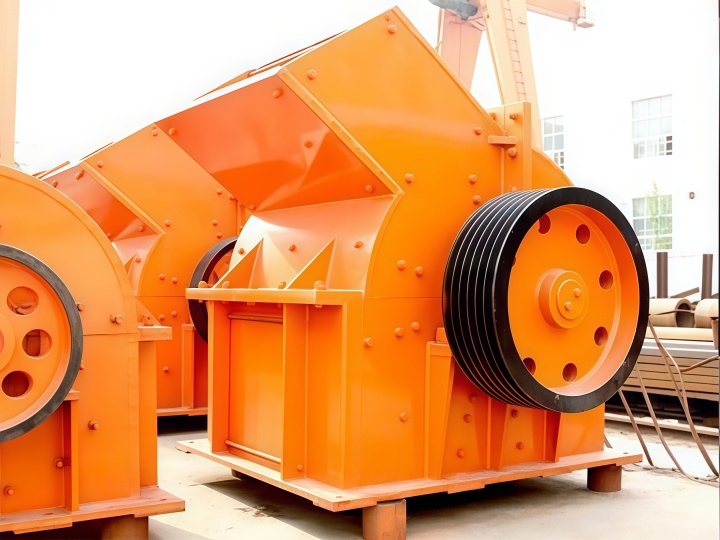
How Does Gypsum Board Hammer Crusher for Cement Mixing Perform Crushing and Drying Simultaneously?
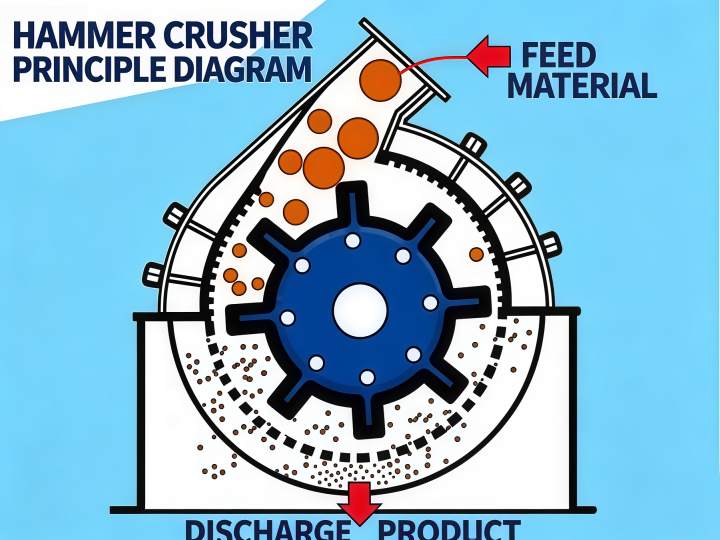
The equipment operates through three interconnected stages within a closed chamber, transforming feed material from lumps to powder and from wet to dry.
Dispersing stage: A high-speed rotor breaks apart and throws gypsum board waste or FGD gypsum cake entering the chamber, liberating agglomerated material.
Drying stage: Hot air at 550°C enters the crushing chamber, exchanging heat with dispersed material and removing internal moisture. For fluctuating feed moisture, the unit adjusts hot-air temperature and rotor speed to keep discharge moisture below 1%.
Separation stage: Airflow carries crushed and dried material into a separation chamber. Fine particles are collected by cyclone; coarse particles return for further processing. No additional drying equipment is required.
Key Technical Parameters and Selection Criteria for Gypsum Board Hammer Crusher for Cement Mixing
Data are based on medium-hardness gypsum-based materials.
| Model | Capacity | Motor Power | Weight |
|---|---|---|---|
| DSJ1515 | 20–25 t/h | 75 kW | 29 t |
| DSJ2015 | 30–35 t/h | 132 kW | 40 t |
| DSJ2020 | 35–40 t/h | 132 kW | 45.5 t |
| DSJ2515 | 40–50 t/h | 160 kW | 55 t |
| DSJ2817 | 65–80 t/h | 315 kW | 78 t |
| DSJ3026 | 110 t/h | 600 kW | 128 t |
| DSJ4325 | 150–160 t/h | 800 kW | 145 t |
All models accept feed moisture ≤15% and reduce discharge moisture below 1%. Selection depends on target capacity and site conditions. Compared with conventional two-stage processes, this equipment reduces footprint by approximately 40% and lowers specific power consumption by about 30%. Figures are based on typical operating conditions; actual values vary by site.
Field Performance of Gypsum Board Hammer Crusher for Cement Mixing Under Continuous Operation
Data from full-year 2025 continuous monitoring across two models at two user sites.
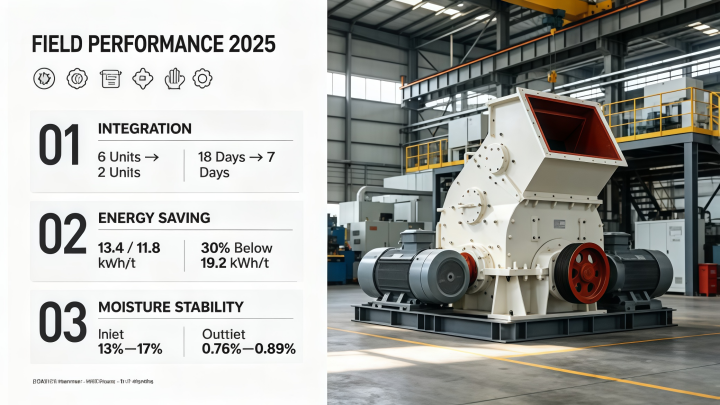
DSJ2515 – Cement plant in Xinxiang, Henan, processing power plant FGD gypsum. Annual averages: 45.1 t/h, 13.4 kWh/t, 0.81% discharge moisture. Quarterly ranges: throughput 44.2–46.1 t/h, power 12.9–13.8 kWh/t, moisture 0.76%–0.85%. Power consumption decreased 30.2% versus the two-stage process previously used.
DSJ2015 – Gypsum board recycling station in Zhengzhou, Henan, processing construction-demolition gypsum board. Annual averages: 31.2 t/h, 11.8 kWh/t, 0.89% discharge moisture. Cross-validation of both units shows Gypsum Board Hammer Crusher for Cement Mixing maintains stable dewatering and energy performance across different materials and capacities.
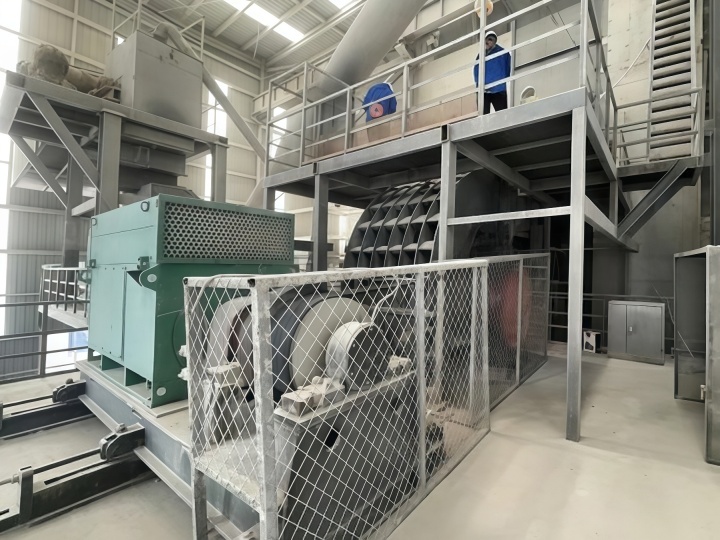
Core Performance Characteristics of Gypsum Board Hammer Crusher for Cement Mixing
Performance strengths lie in system integration, measured energy consumption, and key component service life. All figures from 2025 full-year records.
Equipment count reduced from six separate units to two. Installation time shortened from 18 to 7 days.
Discharge moisture stays within 0.76%–0.89% when feed moisture fluctuates between 13%–17%, meeting cement retarder feed requirements without secondary drying.
Annual average power consumptions of both units were 13.4 and 11.8 kWh/t, over 30% lower than the 19.2 kWh/t measured in conventional two-stage process.
ZGMn13 hammers show approximately 15% throughput reduction after 600 operating hours under FGD gypsum conditions. Replacement interval: 5–7 months, consistent with theoretical service life.
Material Types Suitable for Gypsum Board Hammer Crusher for Cement Mixing
The equipment processes four types of materials for use in different cement production stages: FGD gypsum from coal-fired power plants, waste gypsum board from demolition and production lines, filter cake from cement manufacturing, and carbide slag from PVC production.
FGD gypsum: Coal-fired power plant by-product, processed into cement retarder.
Waste gypsum board: Demolition and production line offcuts, crushed into gypsum raw material for cement.
Cement industry filter cake: Filtration residues generated during cement production.
Carbide slag: PVC production waste, usable as cement ingredient after processing.
Operational Data from Production Lines Using Gypsum Board Hammer Crusher for Cement Mixing
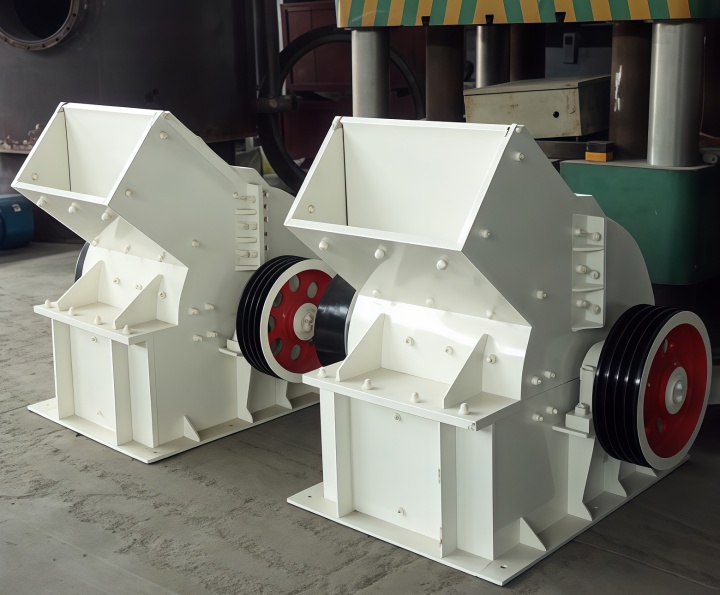
Chunjiang Cement Co., Ltd., Xinxiang, Henan, installed a DSJ2515 in March 2024 for power plant FGD gypsum. Full-year 2025 data: 45.1 t/h average throughput, 13.4 kWh/t, 0.81% average discharge moisture. Footprint decreased ~40%, power consumption dropped ~30% versus previous two-stage process. Data compiled from the facility's internal production reports.
Tianrui Gypsum Board Recycling Station, Zhengzhou, Henan, commissioned a DSJ2015 in June 2024 for demolition waste gypsum board. Throughput range: 30–32 t/h, discharge moisture: 0.8%–1.0%. Processed approximately 180,000 tons of waste gypsum board in 2025.
Frequently Asked Questions
What is the hammer service life on Gypsum Board Hammer Crusher for Cement Mixing?
ZGMn13 hammers show 15% throughput drop after 600 operating hours under FGD gypsum conditions. Replacement cycle: 5–7 months.
What to do if Gypsum Board Hammer Crusher for Cement Mixing vibrates abnormally?
Check rotor balance, hammer wear, and bearings. Stop and replace worn parts.
Will Gypsum Board Hammer Crusher for Cement Mixing clog with sticky materials?
Moisture above 15% can clog the crushing chamber. Keep feed moisture at or below 15%.
How to address high bearing temperature on Gypsum Board Hammer Crusher for Cement Mixing?
Usually due to insufficient or degraded grease. Inspect and replace grease regularly.
What is the operating cost per ton of FGD gypsum processed by Gypsum Board Hammer Crusher for Cement Mixing?
Based on DSJ2515 at 13.4 kWh/t and USD 0.085/kWh, power cost is ~USD 1.15/t. Total cost: USD 2.50–3.50/t, varying by electricity price and material properties.