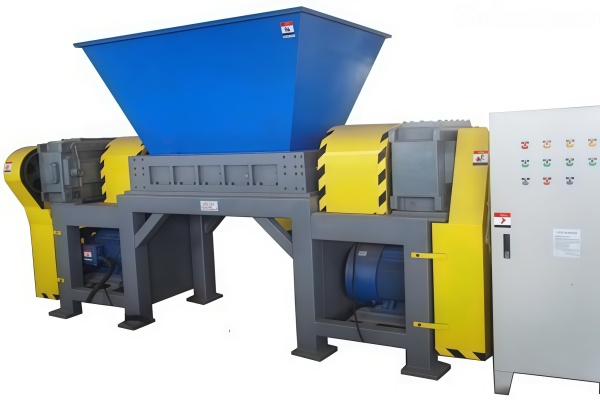
Double Shaft Shredder Maintenance Guide 2026: How to Extend Blade Life by 50% & Cut Downtime
Saturday August-22 2026 11:43:55
Facilities operating a Double Shaft Shredder Crusher know that blade replacement is an unavoidable expense. A set of blades can cost thousands, yet the real cost is not the blades themselves—it is the downtime.
Greenworld, a recycling company in Kings Lynn, UK, learned this the hard way. Their twin‑shaft shredder has 167 sickle blades that required replacement after roughly every 500 hours, with each changeover causing two full days of downtime. Two days of lost production can easily cover the purchase of several new blade sets.
Blade maintenance is, at its core, an investment. Drawing on our workshop's hands‑on experience and globally verifiable cases, this article offers a practical programme to help operators manage the lifecycle of Double Shaft Shredder Crusher blades.
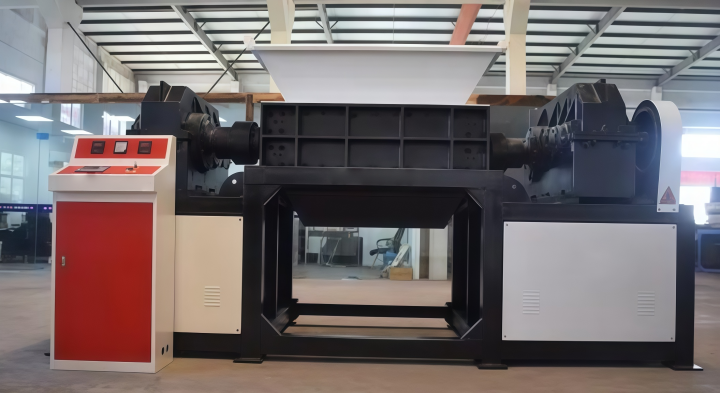
Safety First: Isolate Power Before Any Work
Before touching any blade, lock out and tag out. Disconnect the main power, lock the isolator, and confirm the rotor has stopped completely. Use dedicated tools for cleaning; never place your hands near the cutting edges. A considerable proportion of maintenance‑related injuries occur when this lockout step is skipped.
Four Warning Signs: Act Before It's Too Late
Operators can identify the need for blade maintenance through four observable indicators. These signals reflect different failure modes of the Double Shaft Shredder Crusher blades, and the appearance of any one means the blades have passed their optimal maintenance window.
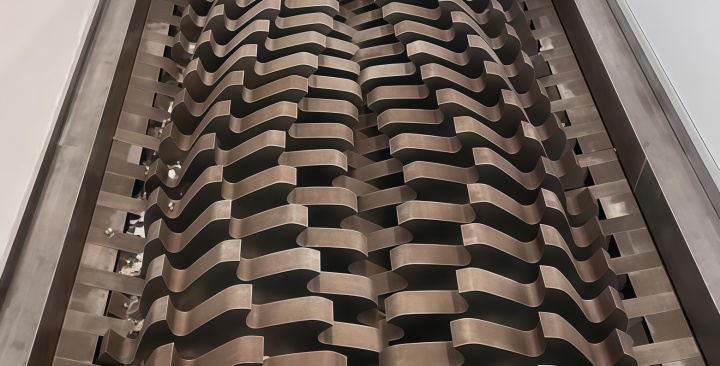
Sustained high current. When processing the same material, current rises from 70% of rated value to above 90%, indicating dull blades. UNTHA data shows an optimised ZR2400 can save €90,000 per year in electricity costs—conversely, dull blades cause considerable extra expense.
Noticeable drop in throughput. Processing volume falls from 20 to 15 tonnes over an 8‑hour shift. A continuous decline in Double Shaft Shredder Crusher throughput signals that the cutting edges have lost effectiveness.
Output becomes powdery. Sharp blades shear; dull blades crush, generating fine dust. This change in output particle shape is a direct visual clue of wear.
Abnormal operating noise. Under normal conditions, the machine produces a crisp shearing sound; when dull, this changes to a dull grinding noise accompanied by irregular vibration.
Tiered Maintenance: Daily, Weekly, and Monthly
Tiered maintenance means performing tasks at different intervals based on the wear patterns of the Double Shaft Shredder Crusher. Daily, weekly, and monthly routines complement each other.
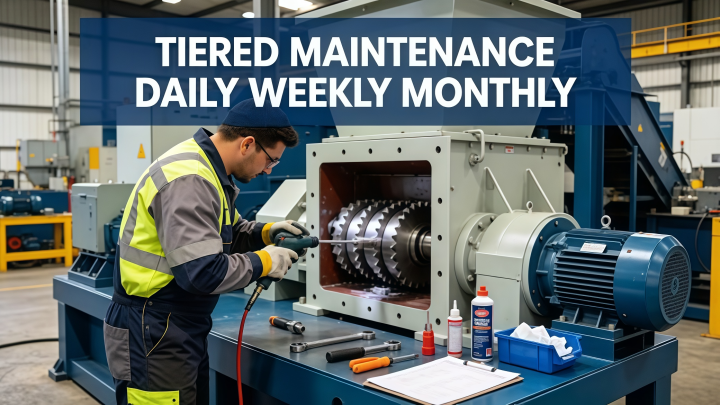
Four daily tasks. Check the chamber for residual material; hardened lumps can damage blades during startup impact. Inspect bolt tightness—use a probe and compressed air to clean debris from hex socket heads; if the socket slips and rounds the bolt head, repair time stretches dramatically. Apply thread‑locking compound to prevent loosening. For a newly fitted blade set on the Double Shaft Shredder Crusher, re‑torque every 2 hours for the first 8 hours of operation. Run the machine empty and listen for abnormal sounds before feeding.
Clean the blade seats. Once a blade is removed, clean any residue from the seat. Even a small piece of debris left under a new blade can create uneven stress during tightening, potentially causing cracks. This step directly affects the service life of the new blade set.
Weekly hands‑on work. Clean the cutting edges and check dulling depth. If dulling exceeds 1.5 mm, schedule regrinding. Measure the gap between moving and fixed blades—standard clearance is 0.5 to 2 mm. If the gap is too large, cutting force diminishes and material passes through by compression, accelerating wear.
Monthly full inspection. Calibrate all clearances and replace components that have reached end of life. Check the entire lubrication system. A Double Shaft Shredder Crusher that undergoes strict tiered maintenance can achieve blade life more than 40% longer than randomly maintained equipment.
Regrinding: Done Right Extends Life; Done Wrong Ruins the Blade
Using an ordinary bench grinder on Double Shaft Shredder Crusher blades will ruin them. The correct method is to use a specialised grinding machine, grinding along the inner side of the cutting edge while maintaining the factory angle, with each pass removing no more than 0.1 mm.
After regrinding, deburr the blade and check dynamic balance—unbalance should be kept within 0.5 g·cm. If balance is not verified, the rotor will vibrate at high speed, accelerating bearing wear and potentially damaging the rotor shaft.
Regarding cooling, some manufacturers recommend air cooling to avoid quench‑cracking; others use water cooling. Each has its own applicable conditions. For inspection intervals: under normal conditions, check the Double Shaft Shredder Crusher blades every 150 to 200 hours; for demanding applications, shorten to 100 hours. Once the wear limit is reached, further regrinding serves no purpose.
Blade Material: D2 or DC53?
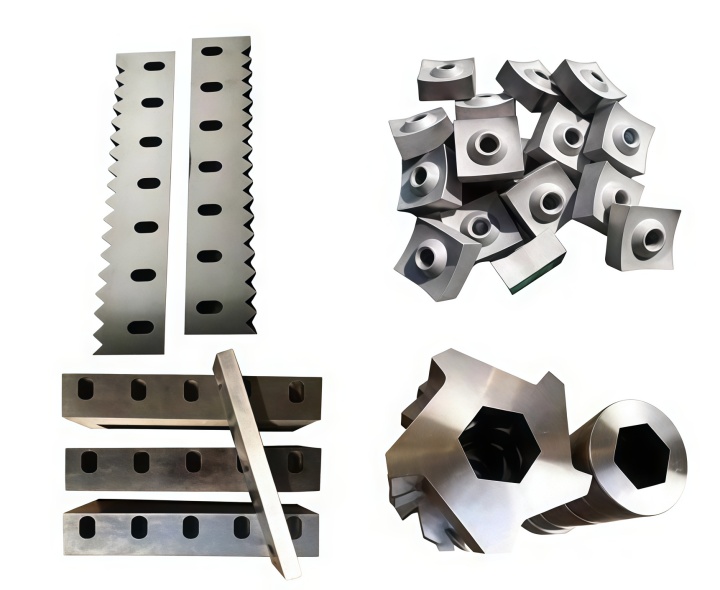
The most common materials for Double Shaft Shredder Crusher applications are D2 and DC53. D2 offers good cost‑effectiveness for conventional materials; DC53 provides better toughness for high‑impact applications.
D2 tool steel complies with ASTM A681, which specifies a hardness range of 58 to 62 HRC. D2 performs well on plastics, wood, and other ordinary materials. DC53 is a modified cold‑work tool steel that achieves 62 to 64 HRC, with toughness roughly twice that of D2—in punch‑press tests, D2 fails after about 5,000 impacts, whereas DC53 withstands approximately 25,000 impacts.
However, hardness and toughness are inversely related. When processing material containing metallic impurities, DC53 shows a higher chipping rate than D2. Fixed blade hardness is usually 2 to 3 HRC points lower than moving blades, so in a hard impact, the fixed blade fails first, protecting the more expensive moving blades and the rotor shaft. When choosing a blade material for a Double Shaft Shredder Crusher, the decision should be based on the actual material being processed.
Lubrication and Clearance
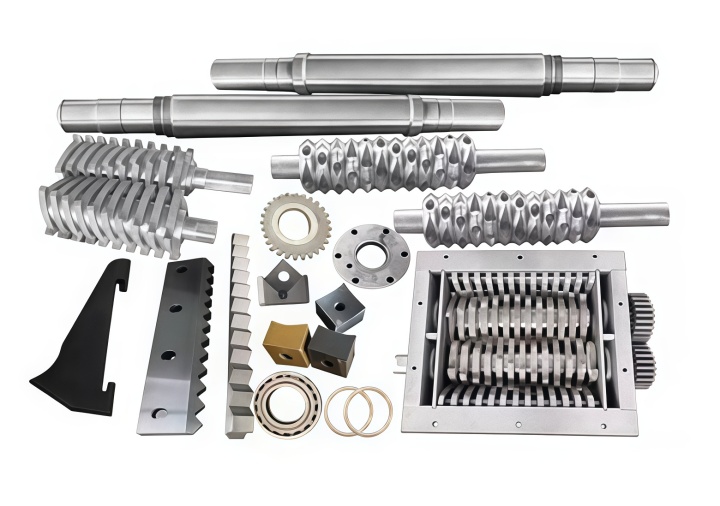
Bearing lubrication and blade clearance are two key factors affecting stable operation. Use NLGI Grade 2 lithium grease, with a regreasing interval of 100 to 500 hours and a fill volume of 70% to 80%. Gear oil should be ISO VG 320, changed every 2,000 hours, with oil temperature between 45 and 80 °C.
Measure clearance weekly and keep it between 0.5 and 2 mm—if the gap is too large, shearing force is insufficient, material passes through by compression, and Double Shaft Shredder Crusher blade wear accelerates.
Feed Pre‑treatment and Operating Parameters
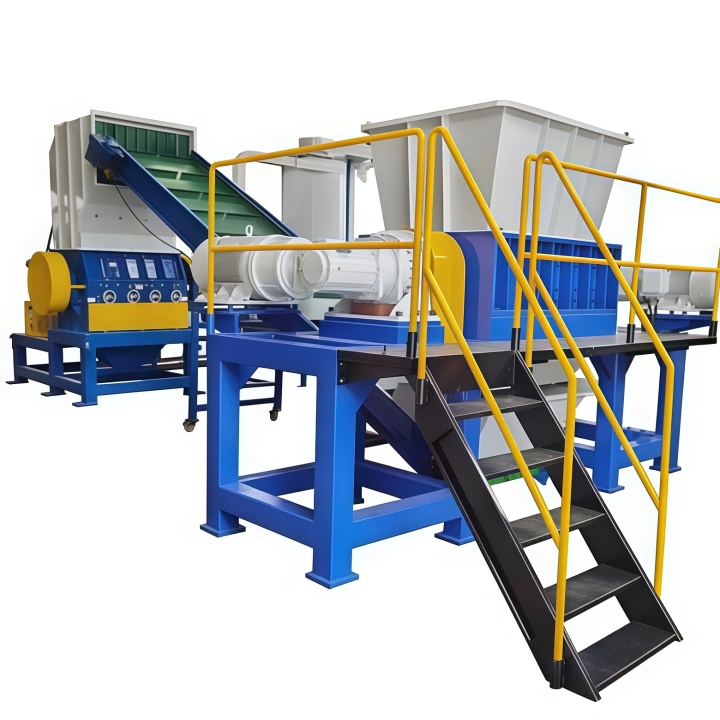
The machine has limited tolerance for metal and grit contaminants. When such impurities enter the chamber, blade wear can increase by a factor of 3 to 5. Removing hard contaminants upstream is more economical than frequent blade changes.
Rotor tip speed should be kept between 20 and 35 m/s; exceeding this range generates frictional heat that can cause blade tempering. When motor current exceeds 85% of rated value, reduce the feed rate. The investment in pre‑treatment directly reflects on the service life of the Double Shaft Shredder Crusher blades.
Hardfacing: The Greenworld Case
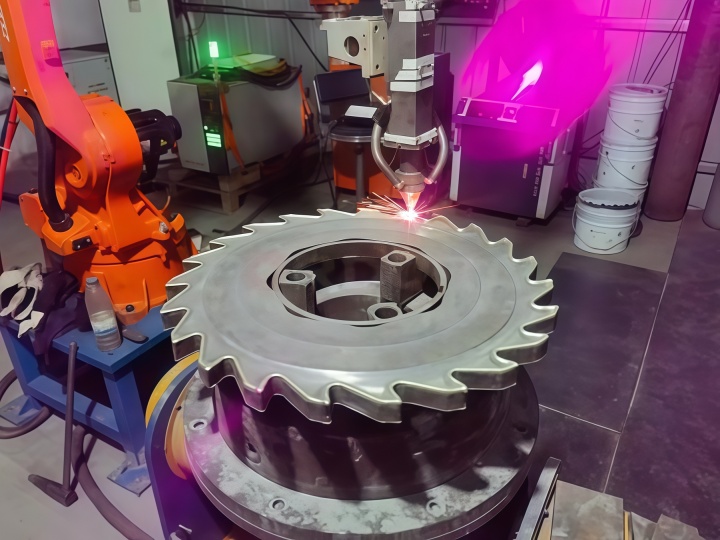
The Greenworld case illustrates the value of hardfacing. Their twin‑shaft shredder has 167 sickle blades that required replacement roughly every 500 hours, with each replacement causing two days of downtime. They commissioned Welding Alloys to apply WA Integra special‑alloy hardfacing.
After 242 hours, the hardfaced blades showed significantly less wear than new blades, maintained their tip shape, and delivered more consistent performance. David Kilham, Head of New Business Development at Greenworld, stated that service life was notably extended, with reductions in both downtime and maintenance costs.
Our workshop has observed similar outcomes—hardfaced blades typically achieve more than 80% of the service life of new blades, at a total cost of approximately 40% to 50% of new blades. The ASM International Handbook notes that tungsten‑carbide hardfacing layers offer high hardness and wear resistance.
Important: after hardfacing, blade hardness can reach 70+ HRC, and they cannot be reground by conventional methods. They are best used in a "run‑to‑failure‑then‑replace" mode, or returned to a specialist for re‑hardfacing.
Three Materials, Three Approaches
Tyres, films, and e‑scrap each impose distinct damage mechanisms on Double Shaft Shredder Crusher blades, so maintenance priorities must be adjusted to match the specific failure mode of each material type.
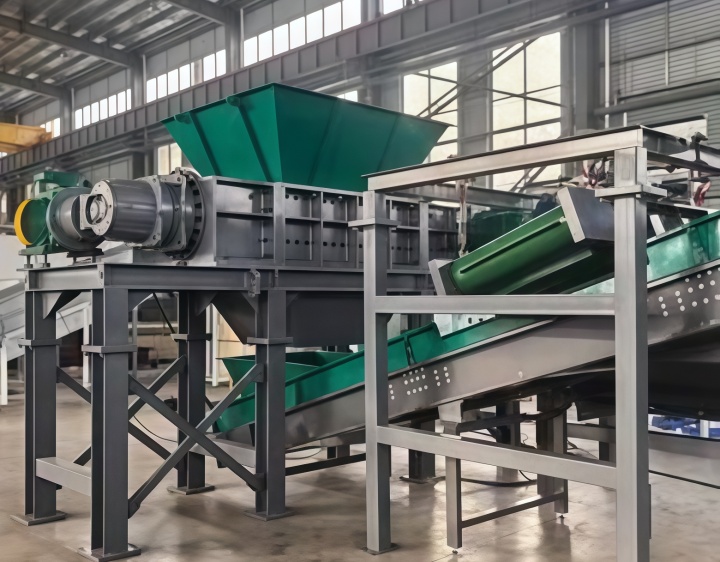
Tyres. Contain steel wire cord, produce high impact loads, and the primary failure mode is chipping. Shorten inspection to 150 hours, choose DC53, and control hardness at 60 to 62 HRC. This feed exerts the most severe impact on Double Shaft Shredder Crusher blades.
Film and textiles. Soft materials that cause little wear but are prone to wrapping around the rotor. Remove wrap‑around after each shift; otherwise, the wrapping tightens and causes uneven blade loading.
E‑scrap and metal shavings. Contain hard particles, with abrasive wear as the primary failure mode. Select material above 62 HRC and keep the load within 80% of rated capacity.
Single‑Shaft vs. Twin‑Shaft Maintenance
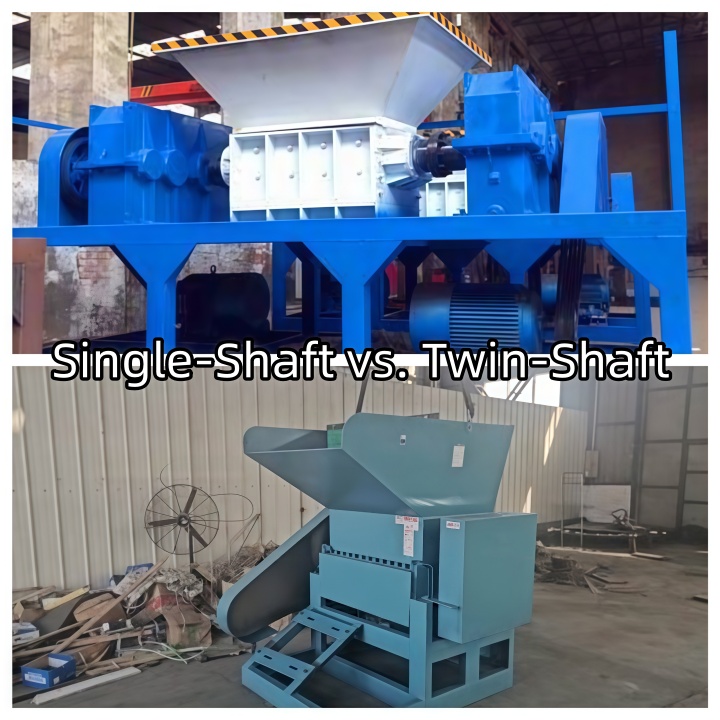
Single‑shaft shredder blades are square or crown‑shaped and can be turned four times. When one edge dulls, rotate the blade to expose a fresh edge—one set gives four service lives.
Double Shaft Shredder Crusher blades are hook‑shaped, interleaved on two shafts, and cannot be rotated. When worn, they must be hardfaced or replaced as a complete set. This is a structural feature of twin‑shaft machines and a key reason why daily maintenance must be taken seriously.
The core principle for maintaining Double Shaft Shredder Crusher blades is to intervene before problems escalate. Rising current, falling throughput, powdery output, or a change in sound—any of these signals should trigger an inspection. Select the right material, use correct regrinding practice, verify dynamic balance, follow proper lubrication, and apply hardfacing where appropriate—doing so can extend blade life by roughly 50% and reduce unplanned downtime. Through years of serving clients, our workshop has confirmed that the return on proactive maintenance is better than reactive replacement.
FAQ
Q1: Can new and used blades be mixed on a Double Shaft Shredder Crusher?
Not recommended. New and used blades have different heights; the higher blades bear the load alone and are prone to chipping. Replace the full set, or at least replace blades in matching pairs with similar wear levels.
Q2: What causes a sudden noise increase from a Double Shaft Shredder Crusher?
Common causes are tramp metal entering the chamber or bearing failure. Stop immediately, inspect and clean the chamber, and check the bearings and clearance.
Q3: How to address frequent bearing overheating on a Double Shaft Shredder Crusher?
Possible causes include insufficient lubrication, incorrect grease grade, or misaligned bearing housings. Use NLGI Grade 2 lithium grease at the prescribed interval and check alignment.
Q4: What is the emergency procedure if a Double Shaft Shredder Crusher jams?
Disconnect power, lock out, open the inspection hatch, and clear the material. Never attempt to feed material while the machine is running or reach in by hand.